🚨Sunil Chhetri Reveals Why India Is Still Missing the Fifa World Cup2026🚨
Reporter 🗣️: Why is India unable to qualify for the FIFA World Cup every time?
Sunil Chhetri 🗣️ India doesn't fail to qualify for the World Cup because of a lack of talent. The real problem is that we are not yet a true sporting nation. We do not identify and nurture talent at the right age and through the right system.
With a population of 1.5 billion, countless talented children never get discovered or developed. Countries like the United States, France , Germany, Argentina , and Brazil succeed because they have strong systems that scout talent early and provide the best coaching, facilities, and support.
The day India builds a nationwide structure where every talented child can be identified, nurtured, and given the right opportunities, we will not only improve in football but in every sport. Talent is not the issue—the system is.
If your parents are 65 and above, please listen.
They are not going to tell you they are running out of time. That is not how they were built. They will wave you off, say they are fine, tell you not to worry, because they spent a lifetime protecting you from hard truths and they are still doing it now.
But time is not asking their permission.
Look closely the next time you see them, really look. The hands that once seemed so capable, the voice that used to fill a room, the eyes that still light up the moment you walk in, because you walking in is still, after all these years, one of the best parts of their day.
You are so busy becoming while they are quietly diminishing, and both things are happening at the same time and nobody talks about it.
The repeated stories are not a malfunction. They are what mattered most to them, they are trying to pass something to you before they go, so receive it.
One day you will be mid-sentence and suddenly remember the exact way they laughed, and it will stop you cold, and you would trade almost anything to hear it one more time in real time, not just in memory.
That day is coming, you do not know when.
So call, not when you have time, because you do not have time, nobody does, but call anyway, visit anyway, sit in the quiet with them and let it mean something.
Give them your presence while they can still feel it, not later.
Now.
Religion.
Has killed more humans than all infections combined. Infections have vaccines though. A vaccine for religion is rationalism and humanism, which seems to be rare these days and awaiting rediscovery.
If we don't educate children in history, culture, languages, religion, traditions, ethics and critical thinking preferring instead to limit them to STEM subjects, then we are raising a generation of easy to manipulate morons. This is becoming ever more obvious today.
We are sending our kids to school to memorize facts that AI can retrieve in 0.3 seconds.
We're grading them on essays that AI writes better than their teachers.
We're preparing them for jobs that won't exist by the time they graduate.
The entire education system is training humans to compete with machines at what machines do best.
That's not education. That's sabotage.
The schools that survive will teach thinking, not memorizing. Creating, not repeating. Discerning, not obeying.
Every other school is a museum that doesn't know it yet.
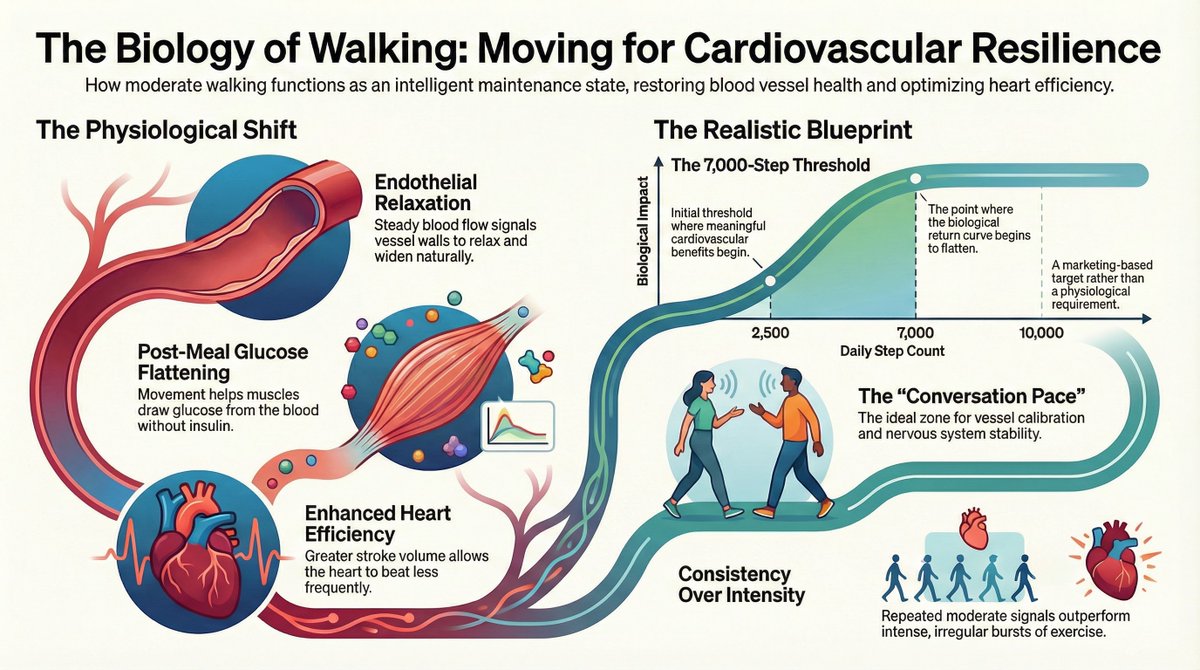
WHAT WALKING ACTUALLY DOES
Your heart isn't the problem. The pipes are.
Most cardiovascular disease starts with stiff, resistant blood vessels forcing the heart to push harder against mounting pressure. The pump itself works fine until the system wears it down.
Walking fixes this at the source through steady flow stimulating vessel walls to relax and cooperate.
Blood vessels have an inner lining called endothelium. When blood flows consistently past it, the endothelium releases signals that make vessels widen.
No force required. Just regular use preventing stagnation. As vascular resistance drops, each heartbeat becomes less strained. The heart stops fighting its own infrastructure.
This happens fast. Within minutes of walking, blood flow patterns shift. Vessels detect the change and begin adjusting. Not dramatically. Quietly.
The nervous system stays calm because the body doesn't interpret moderate movement as threat. You're not triggering alarm responses. You're entering an intelligent maintenance state where efficiency improves without drama.
THE STEP COUNT FALLACY
Biology doesn't care about 10,000 steps. That number is marketing, not physiology.
Large observational studies show meaningful cardiovascular benefits starting around 2,500 to 2,700 daily steps. For sedentary people, that tiny increase produces disproportionately large gains.
First steps carry the highest biological return. The curve flattens past 7,000 steps, where the cardiovascular system gets most signals it needs for flexibility and resilience.
This matters because fixation on arbitrary targets creates unnecessary pressure. People cycle between intense bursts and burnout instead of building sustainable rhythms.
The body doesn't track your calendar. It integrates signals over time. Even hitting higher step counts one or two days weekly offers protection compared to nothing.
Walking stops being a task and becomes collaboration with your own biology. That's where durable benefits emerge.
PACE TEACHES PRECISION
How you walk matters nearly as much as how much. A moderately brisk pace creates gentle challenge space where heart and vessels must coordinate more precisely while staying fully controlled. Not suffering. Calibration.
Faster cadence produces stronger, smoother blood flow. Vessel walls expand more dynamically. The heart fine-tunes rhythm and contraction strength to maintain stability.
With repetition, the cardiovascular system learns to handle above-normal conditions gracefully, preparing infrastructure for peak loads while everyday operation remains quiet.
A pace allowing short conversation signals the ideal adaptive zone. In this range, the cardiovascular system receives clear learning signals while the nervous system stays stable enough to support recovery.
Advanced, highly efficient walking is interval walking, where a faster pace alternates with an easier pace.
THE POST-MEAL WINDOW
After eating, blood glucose rises and the body redirects flow toward digestion. For people with metabolic dysfunction or sedentary habits, this becomes quiet vascular stress. Sharp glucose spikes directly affect endothelium, creating less favorable environments for vessel function.
Light walking after meals intervenes remarkably gently. No intensity needed. Movement allows muscles to draw glucose from blood through insulin-independent pathways, flattening post-meal peaks and reducing metabolic stress on vessels. Blood flow redistributes evenly. The endothelium receives its familiar signal: steady, moderate flow without shock.
This protects vessels at their most vulnerable moment. Even healthy people experience cumulative stress from repeated daily glucose spikes. Walking after meals doesn't erase modern eating patterns but softens metabolic edges enough to reduce unnecessary cardiovascular strain over years.
It uses a window that already exists. A few minutes of movement after eating sends a powerful biological message. The system is supported, not overwhelmed.
WHAT CHANGES OVER TIME
Consistent walking produces measurable traces. Blood pressure drops modestly, but over years this reduces cumulative vessel strain and translates into tangible cardiovascular risk reduction.
Resting heart rate lowers not pathologically but because each beat becomes more efficient. With greater stroke volume, the heart beats less often to meet resting demands.
Large population studies show walking habits correlate with lower rates of cardiovascular events and all-cause mortality at moderate activity levels. Not extremes. Biological consistency.
The deeper change is harder to chart. Everyday movements trigger less alarm. Heart rate rises less dramatically for the same effort. Breathing steadies faster after exertion. Stress recovery improves as the cardiovascular system becomes flexible and confident rather than locked in prolonged alert mode.
These aren't flashy shifts. They quietly reshape how heart, vessels, and nervous system coordinate daily. From that stable foundation, the most durable cardiovascular health builds through intelligent repetition, not intensity.
THE EVOLUTIONARY FRAME
Humans evolved moving frequently at moderate intensity throughout the day. Not to train. To survive. Our cardiovascular systems optimized for that environment: steady movement, manageable demand, minimal prolonged alarm.
Walking is the closest modern behavior to that evolutionary template. It doesn't trigger excessive survival responses or force the heart into battle. Instead it sends a familiar signal: environment safe, demand reasonable, efficiency preferred.
Modern science confirms what intuition suggested. From sustained blood pressure reductions and lower resting heart rate to improved vascular flexibility and faster stress recovery, walking doesn't just improve numbers. It re-educates how the cardiovascular system responds to life itself.
A body not constantly over-activated recovers better, tolerates stress more effectively, ages more slowly. Walking doesn't grant immortality but allows systems to operate as designed. That alignment is the foundation of long-term health.
Perfection isn't required. Not 10,000 steps. Not pain. Not force. Just small, correctly timed, repeatedly delivered signals. Biology rewards consistency, not extremes.
Walking is a daily message to heart and vessels that the world is manageable. In an era defined by chronic pressure, that message might be one of the most powerful forms of medicine we still underestimate.
I watched a guy on the bus today. 6:45 AM in the morning while jogging, His eyes looked heavy, like he was carrying the weight of an entire lineage on his shoulders. But immediately he sat down, he brought out his phone and started scrolling TikTok.
As a Biomedical Engineer, I wanted to snatch that phone from his hand.
See, let me tell you the bitter truth nobody wants to hear.
Most of you are not lazy or "unlucky." You are chemically sabotaging your own destiny before you even brush your teeth.
The first 60 minutes of your day is a war zone. Your brain is begging for direction. It runs on dopamine, that’s the fuel for your motivation. But what do you do?
You wake up. Your eyes haven't even adjusted to the darkness of your room, and gbam, you pick up your phone.
You check WhatsApp to see who ignored you. You check X to see who is fighting. You check Instagram to see your mates buying cars you can't afford yet.
You think you are just "waking up," but scientifically? You are flooding your brain with cheap, unearned dopamine. You are frying your reward system. By 8 AM, your brain is already tired. It has consumed "content" but produced nothing.
And let me speak to the men for a second.
I write about men a lot because I see what you go through. The pressure is much. You wake up and the first thought is Rent, School fees, the woman you want to impress.
It is terrifying.
So, you grab your phone to escape. The phone is your pacifier. It numbs the panic of the morning. But that comfort is a lie.
When you start your day with cheap dopamine, actual work feels like torture. You have programmed your neurochemistry to be a consumer, not a king.
You are training your brain to be weak in a world that eats weak men for breakfast.
Here is the hard truth (and you can drag me if you like):
Your morning mood doesn’t determine how your day goes. It determines your capacity to suffer for your success.
If you can’t survive the first hour of the day without a screen, how do you want to survive the economy?
Protect your first hour.
Don't touch that phone.
Stare at the ceiling. Pray. Do pushups. Go for a morning jug or walk.
Let your brain starve for a bit so it learns to hunt for the hard things.
Stop feeding your destiny to the algorithm.
@EurekaForbes I have booked service as part of the ongoing AMC for my dr Aquaguard classic+ service request number WO-151124-56500143 for 13/5/25. It's been 4 days now no technical service person is assigned.