Hey Jack, military historian here. India raised the largest all volunteer army in human history for the Second World, over 2.5m by 1945, defeating the Japanese in two of their greatest defeats. 78% of Allied armies in the Far East were Indian. Don’t believe me? Try reading a book. https://t.co/OGTQPom2i8
In light of suggestions that Susie Wiles and James Blair may pursue legal action over my Joe Rogan interview, I am publicly requesting that she, Ballard Partners, Continental Straregy, and other relevant parties immediately preserve all potentially relevant records and communications, including:
✅All communications between Susie Wiles, Ballard Partners, and their representatives concerning lobbying access, meetings, policy decisions, and corporate clients.
✅All communications involving Bayer, Monsanto, Ballard Partners, and White House officials concerning glyphosate, the national security executive order, and the administration’s position in Supreme Court litigation involving Bayer.
✅All communications concerning sugar-industry political contributions, fundraising commitments, and discussions about how those interests related to federal nutrition policy.
✅All communications involving Tony Fabrizio, food-industry representatives, and White House officials concerning MAHA initiatives, school nutrition standards, and the proposed federal definition of ultra-processed foods.
✅All drafts, internal correspondence, meeting notes, and communications involving Walker Barrett, Heidi Overton, and other relevant officials concerning the glyphosate executive order and Bayer litigation, including discussions about Secretary Kennedy’s involvement.
✅All relevant lobbying agreements, invoices, payment records, meeting calendars, visitor logs, and communications concerning corporate efforts to influence the policy decisions discussed in my interview - including from Continental Strategy.
✅All nonprivileged communications concerning my allegations, their factual accuracy, and any contemplated legal action arising from my interview.
This preservation request includes emails, text messages, Signal, WhatsApp, encrypted or disappearing messages, attachments, drafts, and relevant electronically stored records.
I welcome a full and transparent examination of the facts.
In 1950, a newly independent India was running low on food. India requested the US for help.
It wasn't provided immediately. After much debate in the US congress on why they should help India, Truman signed the India food relief act to provide India with $190 million of assistance to help it buy US wheat.
But that US wheat came with a weed. The weed known as Parthenium or also called "Congress grass." This weed destroyed any plant around it. Till today, India has not been able to get rid of this weed.
Some 35 million hectares of arable Indian farmland has been laid waste by this weed. Including, and as far as, Andaman & Nicobar Islands.
This weed is one of the biggest causes of losses for Indian agriculture and productivity. American experts still say it came into India "accidentally."
Has this tweet been deleted?
Who will brief them on Gadi Eisenkot’s Iran and Gaza policy?
This is what happens when you want to be an expert on all issues but don’t know even F of Foreign Policy.
This is a formal request for Susie Wiles and James Blair to stop harassing me with texts and calls.
If there is a factual inaccuracy in what I said, send it to me in writing and I will vigorously correct and apologize for any misstatements. I will note that everything I said is substantiated by other senior officials.
If you want to file a lawsuit and get into discovery of whether it’s provably true that Ballard and Continental had an undue influence on the White House policy process, do it.
I believe we are in an existential moment for the country, and Americans were owed an honest accounting of the past two years so we identify the problems we need to move on from.
Remember remdesivir? Was the frontline antiviral during covid. People still died. Why? Because remdesivir attacks the virus and viruses mutate. You can’t kill what you can’t consistently recognize.
So Anand and Shailaja created something that blocks the protein that the virus feeds on. Now the virus starves, whatever its form. What a brilliant idea!
Congratulations to the team on this massive breakthrough. And the best part, there’s a paper that’s “peer reviewed,” not a preprint. That’s how you do science.
Thank you Anand, can’t wait to see this go to trial and come out a raging success!
Ramayana is in the news so Audrey is “loosely translating” with her lurid takes again…
Valmiki never wrote "harem pet" or "furniture cover." Just as he never said Sita calls Rama a “misogynist pig.”
Here's what the text says.
On the living deer, Aranya Kanda 3.43.16:
अन्तःपुरविभूषार्थो मृग एष भविष्यति antaḥpura-vibhūṣārtho mṛga eṣa bhaviṣyati
"This deer will be an ornament of the inner palace." Not “harem.” Sita is talking about after the exile, when they're back in Ayodhya. The word is vibhūṣā, ornament. It's a marvel to bring home to Bharata and the queen mothers. It isn't a "pet," and it isn't a harem plaything. We also know that Rama never took another wife, let alone kept a harem.
On the slain deer, 3.43.19:
शष्पबृस्यां विनीतायामिच्छाम्यहमुपासितुम् śaṣpa-bṛsyāṃ vinītāyām icchāmy aham upāsitum
"I wish to sit on its golden skin, spread over a seat of tender grass." A bṛsī is an ascetic's grass seat. She's a forest-dweller in exile, picturing herself sitting beside Rama. That isn't upholstery or a "furniture cover." Rama even pictures the same scene himself a few verses later (3.43.34).
So "harem pet" and "furniture cover" aren't translations. Each one picks the most lurid or trivial reading available so that Sita comes off as decadent and vain. The text doesn't support either.
We've seen this before. In 2018 Truschke "loosely translated" Sita at the agnipariksha as calling Rama a "misogynist pig." Robert Goldman, the translator she cited, disowned it.
She starts from a Sanskrit word, takes the most loaded English you can find, and presents it as scholarship. That's academic malpractice.
And it’s a pattern.
This @ROKhanna is a Janus-face duplicitous politician whose grandfather Amarnath Vidyalankar was a soiled foot mat of Nehru and later Indira Gandhi and voted in support of Emergency in 1975. Vidyalankar also supported the idea of 'Single Party System' to ensure Congress and his masters did not face any opposition.
It ill behoves this person to talk about democracy and pluralism.
One thing I have noticed, and I am not exaggerating: In many ways, America follows India in democracy.
- be it women as top leaders (Kamala decades after Indira, still no woman as president),
- be it universal voting rights (india had it on day 1, 15 years before the US did),
- or be it minorities in top positions (the US still has not seen top native-American leaders).
But some low self-esteem Indians who suck up to the west will always get excited based on some new thing in the US.
Like when Americans get excited about their "first woman VP", "first Muslim mayor", "first black president".
These Indians will get excited as well and start lecturing India in a patronizing way about how to follow that.
They forget India already achieved those things decades ago.
And even if you point this to them, they will still feel somehow the US has done it first and it did it better.
They are suckers for western narratives. You really can't reason with them. It's part of the epigentic brown sepoy syndrome.
During the Dantewada massacre in 2010, in which 76 CRPF jawans were killed by Naxals, there were celebrations at JNU, one of the top universities in India. Leftists were rejoicing over the massacre of our soldiers.
So, this time, in 2026, let's celebrate the fact that, for the first time in 47 years, the CRPF has completed a year without suffering a single operational fatality, despite our soldiers having been engaged in several high-risk operations.
Let's rejoice and celebrate for our soldiers.
Everyone knows the Rigveda is the oldest book of India. Almost nobody knows what a computer scientist from Srinagar found hiding inside its table of contents.
This is that story....
@subhash_kak Ji is a prof. of computer science at Oklahoma State. 1 of the 2 known methods of quantum cryptography comes from him. But his most unusual work is a discovery he calls the astronomical code of the Rigveda.
Start with the fire altar, described in the Shatapatha Brahmana down to the last stone. It is enclosed by 360 stones: 21 for the earth, 78 for the atmosphere, 261 for the sky.
It holds 10,800 ordinary bricks, which is exactly the number of muhurtas in a year of 360 days. And the same text says the Rigveda has 432,000 syllables. 432,000 is 40 x 10,800. The book is being described as an altar built out of verses.
Now look at 261, the sky number. The sun appears about half a degree wide in our sky. Count its own diameters from horizon to horizon and you get ~339. Subhash Ji calls these sun-steps. Take the mean of 339 and 183, the half-year, and you land exactly on 261. The altar's sky number.
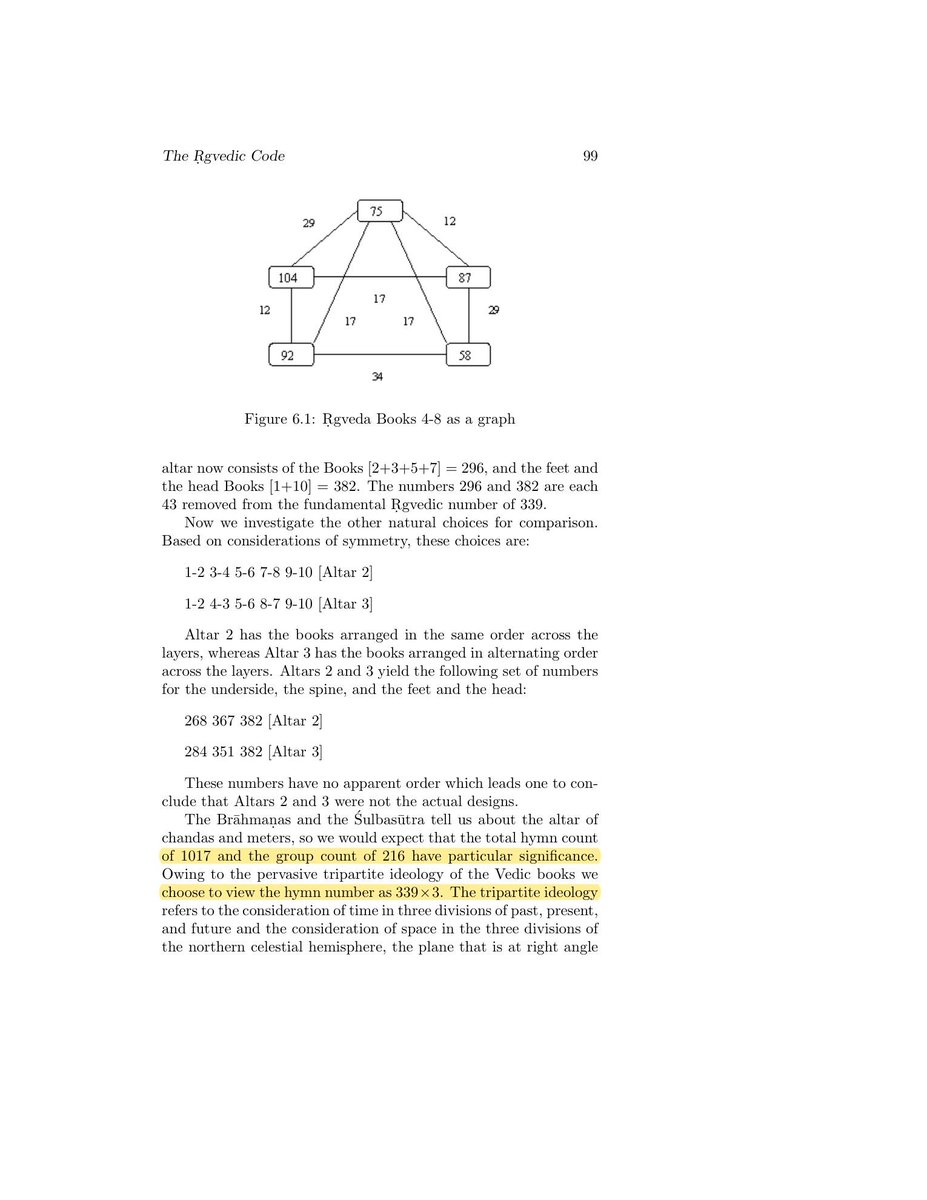
Then Subhash Ji did something nobody had tried. He arranged the 10 books of the Rigveda in layers, like an altar. The Rigveda has 1,028 hymns / 1,017 without the 11 Valakhilya hymns that the tradition itself treats as a later supplement. Arrange the books as an altar and this is what falls out:
- Books 4, 6, 8 and 9, the spine, hold exactly 339 hymns. The sun-step number.
- Books 1 and 10 hold 382, which is 339 + 43.
- Books 2, 3, 5 and 7 hold 296, which is 339 - 43.
- And 43 is the hymn count of Book 2 itself.
- Books 5 and 7 add to 191, which is the count of both Book 1 and Book 10.
- The full count is 1,017, which is 339 x 3.
- He counts 216 hymn groups. 216 is 2 x 10⁸.
The Jaiminiya Grhyasutra says plainly: Mercury is Vishnu. Vishnu's most famous feat in the Rigveda is measuring the universe in 3 strides. Subhash Ji's reading: divide the sky's 261 days by the 3 strides and you get 87 days.
Mercury's actual year is 88 days. And 3 of Mercury's cycles through the sky, 118 days each in the code, give 354 days, the lunar year. The hymn says 2 of Vishnu's steps are visible to men, but the 3rd is beyond the flight of birds.
Mercury is the hardest planet to spot precisely because it never strays far from the sun's glare.
The code does not stop there. The Vedanga Jyotisha, the astronomy manual of the same world, counts the moon rising 1,768x in a yuga of 1,830 days. Divide and you get the moon rising every 24 hours and 50.5 minutes.
I do not know if all of this was design. But when the spine of the altar of books adds up to the number of steps the sun takes across the sky, I find it hard to call it an accident. Anyone with a calculator can check every number here in one evening. That, to me, is the most stunning part.
Source: Subhash Kak, The Astronomical Code of the Rgveda (3rd edition); S. Kak, Quarterly Journal of the Royal Astronomical Society, 1995 and 1996.
Photo 1: The 10,800 brick count = a year's muhurtas (p.75).
Photo 2: Shatapatha Brahmana 10.4.2.23-24, the Rigveda as 432,000 syllables (p.89).
Photo 3: The 1,017 hymn total and Subhash Ji's 339x3 reading - note he frames it as "we choose to view", i.e. his interpretation, not a count stated in the text (p.99). Also has his own Books 4-8 graph figure.
Photo 4: The Mercury-Vishnu identification - 3 revolutions in 261 sky days, so 87 days (p.110).
Today, I was reading about something called the Mandela Effect.
It is actually a very interesting psychological phenomenon. In this, a large group of people share the exact same false or distorted memory of a historical event. A mass delusion of some sort.
The name of this effect came from the mass false memory, that Nelson Mandela died in prison. When in reality, he didn't
There are many examples of Mandela effect in the world, and one of which is very popular in India. And it pertains to Islamic invasions.
Most of us believe that Indian kings of the time were pushovers and they usually folded and ran at the first sight of Islamic invading armies.
This memory has been reinforced with history books telling us how Ghazni invaded us 17 times or how Ghori defeated us and installed an Islamic Sultanate that ruled India forever after that, etc etc
This makes us think, we always lost.
The reality however, is slightly different.
Because we are never taught about the following battles. Battles which can bust the Mandela effect prevalent on this subject.
Battles in which Indian kingdoms, sometimes alone, sometimes together, smashed, annihilated and routed the invaders, over both land and the sea.
These are those battles, that we are never told about.
637 CE - An Arab force under the Umar Caliphate invades what is today's Thana, get their ass kicked by the Chalukya Empire, They tried to repeat it in both Bharuch and Dabhol, with similar ending.
738 CE - A confederation of Chalukyas, Pratiharas, Bappa Rawal and other Mewar Chiefs, destroy the Ummayad armies in the Battle of Rajasthan. The rout was total. So much for the narrative that we kept fighting amongst ourselves.
739 CE - A naval invasion of Sindhi Arabs, was defeated by the unknown Saindhava Dynasty on the Saurashtra Coast
758 CE - The Arabs launched a second naval invasion, but the result was the same. They were totally annihilated by the Saindhava King Krishnaraja off Saurashtra coast
776 CE - A third and final naval invasion was launched by Arab Sindhis. Records say more than a thousand ships were launched.
We don't know the exact number, but what we do know that they were so badly routed by the Saindhava King Agukka, that the Arabs gave up on their intentions to invade India for the next 250 years.
1021 CE - Mahmud Of Ghazni laid Siege to the Lohkot Fortress defended by the Lohara Dynasty of Kashmir. He tried to capture it for more than a month, but the Loharas repelled all the attacks. Finally Mahmud of Ghazni was forced to Withdraw and he never subjugated the Loharas till the end.
1034 CE - Raja Suheldev of Shravasti, destroys the Armies of Salar Masud, the nephew of Mahmud of Ghazni, in what is called the Battle of Bahraich.
And by destroyed, I meant the entire Ghaznavid army was annihilated. There is even a nice book written on it by @authoramish Do read it
1034 CE - Now this one is a subject for a very good movie.
Ahmad Niyaltigin, the Ghaznavid governor of Punjab, raided the prosperous city of Benaras, which was held at that time by the Kalachuri King Gangayadeva. The usual pillage and destruction followed.
What happened after that, was a little different. Because Gangayadeva didn't keep quiet. He followed the Ghaznavid army, caught up with them at Kangra, which was then under Ghaznavi control and routed them.
1043 CE - A confederacy of Raja Bhoja of Paramaras, Karna of the Kalachuris, the Chahamanas and the Tomaras, recover a good chunk of the territories lost to the Ghaznavids in the previous decade of invasions.
Our history books teach us we lost. Not the fact that we actually recovered our territories quickly afterwards.
1109 CE - Ghaznavids again raid Kannauj and take prisoner the Gahadavala king Madanachandra. His son defeats the Ghaznavids, secures his father and sends them scurrying back where they came from.
1178 CE - 13 years before the battle with Prithviraja, Muhammad of Ghor tries to invade India thru Rajasthan. He meets a determined army, led by the by Regent Queen Naikidevi of the Solankis (Chaulukyas).
The Solankis totally annihilate the Ghurid army, in what we call the Battle of Kasahrada, and send them scurrying into the desert, with no water and provisions. Most of the army dies in the retreat and Muhammad of Ghor himself was lucky to make it back home in one piece.
1204 CE - When Qutub Ud Din Aibak expanded the Ghurid Rule in the Gangetic belt and captured the fortress of Kalinjar, located in present day Banda in UP, from the Chandelas. King Trilokyavarman, mounted a counter attack, recaptured the fort, killed every single member of the Ghurid Army.
So Qutub ud Din Aibak marched against them with a new army, which was routed in the Battle of Kakadadaha, fought in present day Lalitpur district of UP.
Aibak didn't return after that and Chandelas continued to rule for another 115 years.
All of us talk about repeated Invasions and Plunder and what not.
I will never understand why nobody actually talks about the resistance and defeats that we repeatedly inflicted on these armies, over land and sea, for more than 300 years.
P:S: I may have missed out on some more battles. Please do point them out in the comments section. I will be very happy.
P:P:S: All these battles are marked on https://t.co/qxLVr1muHi. You can see the territorial changes post some battles on the site.
I post 7-8x a day on an average. My best post usually gets 10-15k impressions. Sometimes someone writes 1 casual line and gets 100k. Initially it puzzled me, but it does not bother me anymore.
I have considered Substack and other platforms. But I have a demanding day job that pays my bills. I am not a professional content creator, and managing multiple platforms takes time I do not have.
So I am staying on X and sharing what interests me (because at least 40K audience is still here and I do not have to start from scratch again). Whoever reads it is a win.
I have found my nirvana and mental peace here, even if the algo and I remain strangers :))
She is Lakshmi.
When a man named Hemanth entered a school in Raptadu, Andhra Pradesh, carrying a chainsaw, nobody could have imagined the horror that was about to unfold.
Hemanth entered a classroom and brutally attacked a girl student named Gopika.
But in that terrifying moment, one girl refused to stand by and watch. She is Lakshmi, Gopika's friend. She bravely stepped forward and tried to save her friend from the attacker.
In that struggle, Lakshmi was also seriously injured. She could have chosen to save herself, but she chose to stand up for her friend and did everything she could to protect her.
Today, both girls are fighting their own battles in hospital. Gopika has undergone major surgeries, and Lakshmi is also receiving treatment for her injuries.
We pray for the speedy recovery of both Gopika and Lakshmi.
Not all heroes wear capes. Some wear school uniforms.
Yes, Professor Kevin.
In 'PPP per capita' terms India is growing faster than China was at one stage. That's something amazing. So the transformation is going to be faster.
But India will be much better than Mexico, Brazil, Thailand in a decade, and on par with China in many aspects (by PPP).
Because, in 2030s:
- India's manufacturing will become a big contributor to its economic prosperity.
- India's exports will be many times of what it is now.
- India's massive investments in national infra and logistics now will start paying huge dividends.
- And most importantly, the Indian rupee will start appreciating sometime in 2030s due to all the above. It can't be kept weak even if India wishes.
- The AI enabled tech acceleration in 2030s will contribute to faster transformation of India.
- India's next infra push starting soon is going to be in developing its cities to world class, modern standards and providing quality housing for all.
So that's why I keep saying the world will experience "the great Indian short squeeze" in 2030s.
Due to adversarial attacks and infowar, to hurt India in many ways, India is being shorted by the world as being some laggard incapable of improvement.
Indians themselves have been made to believe this by constant propaganda using everyday issues (which were much worse before.)
And suddenly, in 2030s, the world will realize they have been misled about India. They will land in India to experience much better infra and facilities than home. They will see most Indians living affordable and wealthy lives with low crime and high trust.
It will be a Megasthanes, Marco Polo, and Mark Twain moment for the west, discovering India, all over.
Four thousand years ago, Indian merchants were living in Mesopotamia in large enough numbers to have a village of their own and a professional interpreter to deal with them.
Texts from Lagash written towards the end of the third millennium BC, record a village of Meluhha inside Sumerian territory. Meluhha is the Sumerian name for Indus-Sarasvati lands. The Louvre holds the cylinder seal of a man called Shu-ilishu, whose inscription describes him as an interpreter of the Meluhhan language. Around 2300 BC, Sargon of Akkad boasted that ships from Meluhha, Magan and Dilmun were moored at the quay of his capital, Agade.
Indus seals have been found at Ur, Kish and Nippur, while hardly any Mesopotamian seals or objects have been found in the subcontinent, suggesting the pro-active merchants were Indian. The monsoon blows one way across the Arabian Sea for half the year and back for the other half, so a merchant who sailed west could spend months in a foreign port waiting for the wind to turn. This goes a long way to explaining both the village and the interpreter.
The Sumerians knew perfectly well whose ships were tied up at their quays, and they wrote the name down.
Episode 3 of my graphic novel, Maritime World: The True Cradle, is called The River That Fed the World and follows one of those merchants from Lothal to a Sumerian market and home again. Link in the reply.