todays rebound in korean equities was probably driven by us market being closed
etfs tracking korean stocks were not trading, so foreign investors likely were not selling as aggressively as they had been over past few days
kioxia also released positive news, which helped lift memory sector
at same time, sector tested 50 ema, flushed out some leverage and bounced
for semiconductors, i see two major catalysts ahead
first one is sk hynix adr listing, which could trigger either rally or short squeeze
second one is upcoming q3 earnings from mag 7 companies
market needs confirmation that mag 7 capex is still intact
i also think recent strength in mag 7 and software is mostly coming from pair trade unwind
at same time, treasuries, credit markets and gold are all pointing toward risk-on setup
my plan for july is to rotate part of my semiconductor exposure into spy, gold and mag 7
i also plan to accumulate sk hynix on dips ahead of sk hynix adr listing
yesterday i sold all my 2x semiconductor etfs and only kept some common shares
nand pricing also came in below expectations yesterday, which is bearish for sandisk
michael burry is short mu, and i think large institutions may keep shorting semiconductor names while pushing negative headlines over next few days
thats why i sold both mu and sndk, then rotated into sk hynix and few other names
ill most likely buy them back after mag 7 earnings
overall, i think semiconductor sector will keep deleveraging through july
for july, ill be holding spy, gold, copper, mag 7, sk hynix and intel
after sk hynix adr listing, ill sell my sk hynix position, then buy back semiconductor positions on day of mag 7 earnings
for now, ill only day trade semiconductor names because sector is still too crowded and needs more deleveraging
next major leg higher will most likely come after mag 7 earnings
the point of making money online should be freedom
but staring at a laptop 12 hours a day is actually worst than a 9-5 job.
> work from somewhere outside of your comfort zone
> be present online and irl with balance
> be effective rather than always available
> don't neglect your own time
multi-agent systems do not become expensive because models are thinking too deeply
they become expensive because every agent keeps rereading the same context
real cost problem is not intelligence, its repetition
when each agent loads full history, checks same documents, and reprocesses same information, token usage compounds fast
one agent is manageable, ten agents reading same context ten different times becomes completely different cost structure
that is token economics of agent fleets
SAKANA FUGU ULTRA vs. CLAUDE OPUS 4.8 RESULTS
Prompt: "build a really high quality single html file crossy road game with three.js"
Sakana Fugu Ultra:
- Tokens Used: ~89k ($7.32)
- Time Elapsed: 22 minutes
- Issues: inverted directional turn, wonky camera, no sfx, not identical to Crossy Road game
Claude Opus 4.8 Ultracode:
- Tokens Used: ~940k (~$37.85)
- Time elapsed: 79 minutes
- Issues: got stuck twice in a retry loop (had to prompt to self-correct), wrong character position after restart, difficult from the start (whereas Fugu's version got significantly more difficult as you progress, which is the correct behaviour)
I think in terms of application functionality, quality, and design, Opus won. In terms of model speed and performance, Fugu on Opencode won.
What are your thoughts? Comment down below who you think won! ⬇️
11 free GitHub repos for Polymarket trading…
Here is everything you need to automate and make your trading easier:
1. This is the largest Polymarket dataset with over 107GB of real trading data, based on more than 1.1 billion trades, analyzed by 5 professors from Shanghai University.
GitHub: https://t.co/7hj5ZXRz0K
2. A working backtesting simulator that lets you test your own ideas and strategies on real historical markets to see your potential Pnl and possible risks.
GitHub: https://t.co/fmzzTgXAUl
3. This tool analyzes the real trading behavior of any Polymarket trader, finds repeated patterns in his trades, shows which strategies he uses and how you can adapt them to your own trading.
GitHub: https://t.co/SzdjHtASLt
4. This bot automatically manages your limit orders on Polymarket to maximize liquidity rewards.
GitHub: https://t.co/nvb96dTIwx
5. A weather bot from a Chinese dev that can analyze multiple sources in real time, like forecasts, airport data and aviation observations (METAR + SPECI) to generate a detailed weather report for any specific city and day.
GitHub: https://t.co/No3sBcqMg1
6. This bot comes with 118+ ready to use automated strategies and tools for trading on prediction markets, including arbitrage between Polymarket and Kalshi, Polymarket - Binance price latency, Mean Reversion and more.
GitHub: https://t.co/2MCzD8iZG7
7. This is a useful tool for building your own AI agents and connecting them to your trading workflow.
GitHub: https://t.co/eItPbDlVhs
8. A trading dashboard where multiple AI agents analyze a selected market from different angles (checking news, price behavior, technical indicators and possible risks) to help you make better decision.
GitHub: https://t.co/02iWujLbxe
9. This tool lets you search for information about any historical market, price or trader across different prediction market platforms inside one dashboard.
GitHub: https://t.co/Z8I3z9sh74
10. This is a trading bot-toolkit that includes copy trading, arbitrage, market making, spread farming, whale alerts and more.
GitHub: https://t.co/p3obYeQTzO
11. The largest public list with 100+ free useful tools and services for Polymarket, from analytics tools and trading bots to AI agents and education resources.
GitHub: https://t.co/jqvVR9106v
All of these repositories are free and come with a detailed step by step installation and usage guides in English.
pacex $spcx is expected to go public on june 12
if that happens, it could become the biggest ipo ever and immediately force a major revaluation across the broader space sector
these are the main space segments worth watching
launch providers
$rklb rocket lab
$fly firefly aerospace
space imaging
$pl planet labs
$satl satellogic
$gsat globalstar
$bksy blacksky technology
$spir spire global
$hawk hawkeye 360
satellite communications
$asts ast spacemobile
$gsat globalstar
$sidu sidus space
$sats echostar
$irdm iridium communications
$etl eutelsat
$tsat telesat
$gilt gilat satellite networks
$vsat viasat
space infrastructure
$rdw redwire space
$lunr intuitive machines
$mda mda space
$voyg voyager space
$yss york space systems
specialty materials
$crs carpenter technology
$mtrn materion
$hxl hexcel
$ati ati
$glw corning
$pke park aerospace
aerospace and defense
$rtx rtx corporation
$lmt lockheed martin
$ktos kratos defense and security
$voyg voyager space
$lhx l3harris technologies
$noc northrop grumman
$ba boeing
$air airbus
$ho thales
space components
$tdy teledyne technologies
$aph amphenol
$krmn kaman space
$rbc rbc bearings
$ph parker hannifin
$ame ametek
$velo velo3d
$ghm graham
$hei heico
$dco ducommun
$atro astronics
This guy showed how his brother makes $18,400 a month using just a Mac Studio and a $20 Claude subscription. He doesn't have a powerhouse dev team. No VC funding. No computer science degree.
He built a "micro-SaaS factory" powered by multiple collaborating AI agents → a system his 10-year-old blogger brother calls “lobster farming.”
The system works like this:
1 business hypothesis → Cursor Next.js initialization → Claude writes a B2B copywriting engine → Vercel deploys a live link → Guerrilla DMs automatically convert Shopify sellers while he sleeps.
3 recurring revenue streams from a weekend project:
> $29/month Starter plan
> $79/month Pro plan
> $149/month Unlimited package
> Paid directly via Stripe
> Total build time: 48 hours
He just feeds the AI a hypothesis. Everything else → from the first line of code to the final integration into the Shopify App Store → is handled by tokens. As one 10-year-old school kid put it perfectly: Tokens are the hard currency of the AI era.
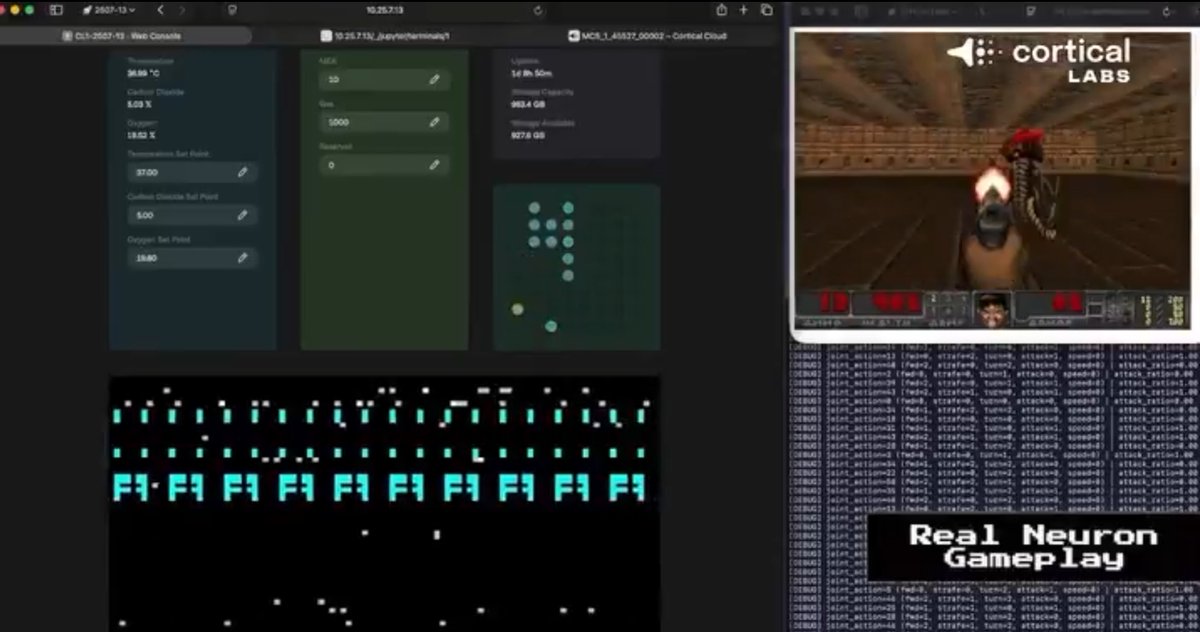
we are pouring more than 200b year into data centers for ai, while one company raised just 11m, grew human brain cells on chip, and got them to learn 3d shooter in week
cortical labs placed 200000 human neurons on silicon chip and trained them to play doom. cells can move through environment, lock onto enemies, and fire in real time. their earlier pong setup needed 18 months on older hardware. doom took only week. and whole integration was built by an independent developer with no biotech background using python api. neurons handled rest
that shift from 18 months down to one week says lot about where this could be heading
what can it run doom crowd is missing is economics. each cl1 unit costs 35000, and full rack of 30 units uses only around 850 to 1000 watts in total. human brain runs on about 20 watts. meanwhile gpu cluster training an llm can burn through megawatts. biological compute is massively more efficient than silicon on energy, and that advantage only gets bigger at scale
investor lineup also says alot. horizons ventures, blackbird, and in q tel, cia backed venture arm. in q tel does not back random science experiments. they back infrastructure that matters. 115 units already started shipping in 2025
cortical labs is now offering wetware as service through cortical cloud. developers can deploy code to living neurons remotely without ever touching lab. access is priced more like software, but hardware is running on real human brain cells derived from adult skin and blood samples
doom demo is just attention hook. real bet is that biological neurons could eventually beat silicon at exact things ai still struggles with most real time adaptation under uncertainty, learning from very small amounts of data, and handling ambiguity without brute force compute
real question was never whether it can run doom
real question is what happens when it can run everything else