THE ERA OF CRYPTO IS ENDING SOON…
…and that’s a good thing!
I’ve spent every day of the last 8 years with this technology, and I absolutely cannot stand the word "Crypto"anymore. I associate it with Crypto Bros in Lamborghinis, NFTs, speculation, and scams. I couldn't care less whether Bitcoin is having a strong or a weak phase.
But what I do own is a vision for the technology behind it. We are currently witnessing something paradoxical that makes me incredibly happy and proud after all these years: We are experiencing Blockchain’s TCP/IP moment. The technology is FINALLY fading into the background, and we are talking about infrastructure, applications, and above all, utility!
Public interest in crypto is declining, but adoption by the world's largest companies is exploding. Here are just a few examples from recent weeks that show what the “invisible revolution” looks like:
Case Study Cloudflare: The Currency for the Agentic Web
@Cloudflare realized that the ad-supported internet model works as long as users consume content, watch ads, and pay with credit cards. However, with the transition to an Agentic Web - where autonomous AI agents act, interact, and use services independently - this model hits a structural wall. AI agents don’t consume ads, they don’t have bank accounts, and they operate at extremely high frequencies. Yet, they access APIs, use data, computing power, or models, often in interactions that might cost fractions of a cent.
Just as TCP/IP once enabled the global exchange of information without users ever having to think about the protocol, the Agentic Web needs an invisible, native payment infrastructure for machines. From this insight, the NET Dollar was born. This is explicitly not about speculation or a new asset for end-users, but a pure settlement instrument for automated micro-transactions.
The problem with classic payment systems becomes glaringly obvious here: If an AI agent needs to pay 0.001 cents for a single API query, credit card fees are not just inefficient, they are economically absurd. They are too expensive, too slow, and not programmable. The NET Dollar enables fully automated pay-per-use payments between machines. Global, 24/7, and with minimal costs. The blockchain here is not an end in itself, but a necessary technical tool to make this kind of settlement scalable and trustless in the first place. Just as no one "uses" TCP/IP on the internet, the underlying technology here disappears completely behind the application.
This paradigm shift is particularly evident in the introduction of x402, a new standard linked directly to HTTP status code 402 – Payment Required. The idea is radically simple: Payment becomes a native part of the request. An agent makes a request, pays automatically, and receives the answer with no login, no checkout, no human interaction. Value transfer becomes as natural as data transmission.
In this context, @coinbase plays a central role as an infrastructural enabler. Coinbase positions itself less as a classic exchange and more as a payment and settlement layer for the Internet of Agents, including wallet infrastructure, stable settlement, and developer tools that make machine-to-machine payments practical.
This example illustrates perfectly what the TCP/IP moment of crypto looks like. Not as a consumer product, not as a speculative asset, but as invisible infrastructure that enables entirely new forms of applications. Mass adoption in this context doesn't mean billions of people learning to use blockchains. It means blockchains disappearing into the background.
Case Study YouTube: The Infrastructure of the Creator Economy
The Creator Economy is at a similar turning point to the early internet. Platforms like @YouTube are no longer just media platforms; they are global employers for millions of creators. This is exactly where the obsolescence of classic payment infrastructure shows: International payouts take days, depend on banks, cut-off times, and local clearing systems, even though the underlying digital content is distributed globally in seconds.
That’s why YouTube has taken the first step of enabling payouts via @PayPal stablecoin $PYUSD for US creators. The crucial point here is not the stablecoin itself, but how it is used. YouTube holds no crypto assets, operates no wallets, and exposes itself to no volatility. Instead, the platform simply uses PayPal's more efficient payment rails in the background. For YouTube, it remains a pure infrastructure decision, comparable to switching from a slow network protocol to a faster one.
For creators, however, the experience changes fundamentally. Earnings can be paid out globally in near real-time, without classic bank waiting times, without intermediaries, and without the fragmentation of national payment systems. It is still measured in dollars and behaves identically to them, with one major difference: Money is no longer "wired," it is transmitted. Fast, direct, and programmable.
This is where the TCP/IP narrative becomes tangible. No one on YouTube thinks about which protocols transport videos. Likewise, creators shouldn't have to think about which payment systems run in the background. The blockchain here is neither product nor feature, but an invisible settlement layer that simply has better properties than the existing system. Just as email didn't replace traditional mail because users understood protocols, but because it was faster and more global, this new payment infrastructure replaces slow banking processes. And the best part? On the frontend, almost everything stays the same for the user, but the experience and utility get better: It feels like dollars, but moves like email.
Case Study Klarna: The Tokenization of Payments
Global payments are still based on infrastructure built for a different era. The SWIFT network connects banks worldwide but is slow, expensive, and highly fragmented. Fees in the triple-digit billions flow through this system annually, while transfers still take days, depend on cut-off times, and are barely programmable. End-users feel this inefficiency indirectly through costs, delays, and limited availability.
@Klarna is taking a radically different approach. Instead of incrementally optimizing the existing system, Klarna is building its own payment network with KlarnaUSD on the payment-optimized Tempo Blockchain. The key here is not the introduction of a new end-user product, but the tokenization of settlement itself. Money is no longer moved through a construct of correspondent banks and message formats, but transferred directly as digital value.
Tempo is being developed in collaboration with infrastructure partners like @stripe and @paradigm and is specifically optimized for payments: high throughput, low latency, and negligible transaction costs. The blockchain functions as a settlement layer, not a user interface. Here again, the TCP/IP principle applies: Technical complexity remains completely in the background.
To ensure this new infrastructure remains truly invisible to users, Klarna integrates wallet infrastructure from @privy_io. The user experience hardly changes. They see a balance, make payments, and receive statements without wallet setups, seed phrases, or other "crypto moments." In the background, however, runs a tokenized payment architecture that drives costs toward zero and enables settlement in near real-time.
This case illustrates how payments can evolve in the Post-SWIFT era. Not by introducing new apps or re-educating users, but by replacing outdated rails without a visible break in the frontend.
Klarna shows that the next phase of financial infrastructure is not loud, not speculative, and requires no explanation. It is invisible, programmable, and cost-minimal. This is exactly what the moment looks like when crypto stops being a "topic" and blockchain becomes the self-evident foundation for global value transfer.
In summary, a clear picture emerges from these case studies:
a) Decoupling of Brand and Technology: Terms like "Crypto," "Web3," or "DeFi" are disappearing from the corporate communications of major tech companies. Instead, they speak of "Stablecoins," "Payouts," or "Digital Wallets."
b) Focus on the US Dollar: It is no longer about the competition of thousands of new currencies (Bitcoin, Ether, Dogecoin) as a means of payment. It is about the tokenization of the US Dollar (PYUSD, KlarnaUSD, NET Dollar, USDT, USDC) or the Euro (EURC). The speculation of recent years is making way for non-speculative applications.
c) B2B instead of P2P: Future volumes will not come from users sending money to each other, but from companies (@Visa, @Mastercard, @Klarna) optimizing their internal settlement or machines (Cloudflare) paying machines.
Conclusion: Crypto dies as a brand, but Blockchain wins as a technology. The time will inevitably come when we no longer say "I'm paying with crypto." We will simply pay. Faster, cheaper, and more globally than ever before. And we won't even notice that a blockchain lies underneath. The phase of infrastructure and applications based on this revolutionary technology begins now. The time of crypto is ending soon, and that is a good thing for the maturity and adoption of the technology.
Yap early, yap only, yap often.
@_kaitoai is connecting AI, attention and capital with Yaps.
Just claimed my social card and I'm accumulating Yap points in real-time.
Claim yours 👉 https://t.co/T6KigXdYtQ
2/2 @base
Summary of the Comparison of Settlement Layers
Each Settlement Layer offers distinct strengths for AI applications:
Best Performance: Solana
Exceptional scalability and low latency, ideal for real-time AI inferences and handling high-volume transactions.
Best Developer Friendliness: Sui and Aptos
Sui: Object-oriented architecture, fast confirmations, and Move programming for flexible AI smart contracts.
Aptos: Focus on security, resource-oriented programming, and atomic updates for AI models.
Best Interoperability: Near Protocol
Sharding-based architecture with cross-chain capabilities via Rainbow Bridge, supporting diverse AI use cases.
Largest Developer Base: Base
Seamless Ethereum compatibility, strong tooling support, and wide adoption, making it an accessible choice for AI developers.
Stay Tuned for Part 2: AI Compute Networks
If you found this comparison helpful, make sure to like, comment, and share to support more content like this! Let me know your thoughts or questions below, and stay tuned for Part 2, where I’ll dive into AI Compute Networks and how they complement Settlement Layers for AI applications. 🚀
Simply put:
@SuiNetwork is the Solana among MoveVM chains, focusing on shipping, speed, and users.
@Aptos is the Ethereum among MoveVM chains, focusing on institutions, stability, and security.
Do you agree?
#sui#aptos#movevm#solana#ethereum
Top 3 Solana Kryptowährungen, die du kennen solltest: @jito_sol, @RaydiumProtocol und @JupiterExchange profitieren aktuell von jeglicher zunehmender Aktivität auf Solana und das könnte besonders im Bullrun von Vorteil sein. Unser Video, inklusive Zahlen: https://t.co/GYX8peIH53
In 2020, I invested in Solana based on my thesis focused on scalable L1 technologies. While projects like Aptos and Sui have since emerged as promising scalable solutions, my current focus for identifying the "next SOL" centers on several key points:
1. Value Accrual and AppChains: Major DeFi projects like MakerDAO, Aave, dYdX, and Synthetix are moving towards launching their own chains. While Ethereum, Solana, and other Layer 1s have solidified their roles as settlement layers, the next generation of projects will seek to capture a larger share of value accrual. On Solana, dApps often outperform the Solana L1 itself in terms of fee revenues, whereas in the Ethereum ecosystem, more projects are positioning themselves as intermediaries to capture fees. I believe the superchain thesis--with Ethereum, Polygon, Arbitrum Orbits, Avalanche Subnets, Polkadot Parachains, zk Elastic Chains, and similar concepts--will not succeed in the long term. The security benefits of a L1/L2 will diminish as projects grow large and dominant enough to thrive as independent chains.
2. I believe Chain abstraction will become crucial for seamless user experience and wallets will be our Web3 Browsers and evolve to offer chain abstraction as a service. Wallets will also manage interactions with various AppChains and L1s. Transparently for advanced users and conveniently for most of the users.
3. Pure DA providers need to offer additional unique services to remain competitive. Calling that DA+, since DA itself won't be valuable enough. These could be customizable data retention and archiving solutions, AI-powered data optimization and prediction services, integrated analytics and insights and more.
The implications are:
We will see more dApps choose integrated L1s as their origin chain. It gives them scalability and the opportunity to generate revenues without having many intermediaries.
We will see DeFi leaders as sovereign AppChains, who will attract DeFi service providers on their chain to enrich their product.
We will see that the restaking and shared security model will fail ultimately.
We will have more influential and powerful wallet providers for the crypto ecosystem.
We will see the modular and the integrated thesis coexist but this will benefit mainly the integrated L1s and modular infrastructure projects but not the modular settlement layers.
I read a lot about the intregrated vs modular thesis from people such as @KyleSamani@masonnystrom@mert and my observation so far is clear that modularity will be a double edged sword for a lot of these "superchain" projects.
Unpopular Opinion: @Polkadot, @avax and @0xPolygon and similar chains are dead ends.
In Crypto there are 3 major drivers. Let's break it down:
1. If you need top-tier security from the underlying layer or aggregation layer, Ethereum is the clear winner. Just look at BlackRock's move into tokenizing digital assets.
2. If you're after maximum flexibility and want to capture value with your own app, you're better off launching an AppChain.
3. For those seeking the benefits of an integrated blockchain in terms of performance and composability, Solana, Aptos, and Sui are leading the pack.
This is why Polkadot, Polygon, and Avalanche are struggling to gain traction. There's simply no scenario where I'd recommend a company to develop their dApp on Avalanche, unless their goal is to attract short-term funding.
Polygon's business development has been praised, but it was essentially attracting projects via funding - a PR move to attract retail investors. Now, these projects are either migrating away from Polygon or sunsetting altogether. It's been unsustainable.
In contrast, Solana's hackathons have been far more effective. They're building a culture and attracting developers who are creating projects that either didn't exist before or couldn't exist on Ethereum due to performance restrictions and high fees.
The Solana Foundation has also initiated many ideas that were later spun off and developed outside the foundation.
In this landscape, chains like Avalanche are caught in the middle - not secure enough to compete with Ethereum, not flexible enough for AppChains, and not integrated enough to match Solana's ecosystem. They're solving a problem that no one really has.
Thoughts?
💥 ANNOUNCING VOYAGER II ON TABI TESTNET! 💥
🏴☠️ Ahoy, sailors! Voyager II is now live on #TabiTestnet!
Discover the @Tabichain world and embark on new adventures. 🌍
Join now for special rewards!
https://t.co/lQcT9NV3kf
💥 ANNOUNCING VOYAGER II ON TABI TESTNET! 💥
🏴☠️ Ahoy, sailors! Voyager II is now live on #TabiTestnet!
Discover the @Tabichain world and embark on new adventures. 🌍
Join now for special rewards!
https://t.co/lQcT9NV3kf
Thank you @Tabichain for gifting me the mysterious treasure!
Join me in the Voyager II event to explore Pirate Island, rack up points, and return with lavish loot. Let's set sail to fortune and beyond! 🏴☠️💎
Head to https://t.co/scclynz0jr to claim yours!
We're happy to announce our latest campaign on @Galxe. Taiko x Blazpay: Mint, Stake, and Play! ⚡️
Check out @BlazpayOfficial's innovative NFT entrypass system and explore new dashboard features. 🎮
🔗 Start your adventure: https://t.co/ViCpFTkze0
Check out what's in store 👇
What makes @ionet_official different from other GPU aggregators on the market?
@ionet_official's ability to form decentralized clusters by aggregating GPUs across multiple locations.
Without clustering, it would be virtually impossible to train today's machine learning models, which are highly complex.
This creates the opportunity for a 'structural arbitrage', allowing @ionet_official to offer unmatched cost efficiency and low latency GPU compute up to 90% cheaper than the competition.
What makes @ionet_official different from other GPU aggregators on the market?
@ionet_official's ability to form decentralized clusters by aggregating GPUs across multiple locations.
Without clustering, it would be virtually impossible to train today's machine learning models, which are highly complex.
This creates the opportunity for a 'structural arbitrage', allowing @ionet_official to offer unmatched cost efficiency and low latency GPU compute up to 90% cheaper than the competition.
Over $400K in Worker earnings (just $100K in the last 21 days) in just four short months since launch.
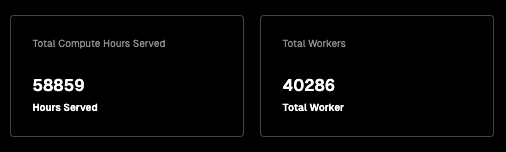
40,000+ Workers in the network and over 3,800 GPU clusters deployed.
AI/ML companies can create clusters of up to tens of thousands of GPUs for both model training AND inferencing.
Over $400K in Worker earnings (just $100K in the last 21 days) in just four short months since launch.
40,000+ Workers in the network and over 3,800 GPU clusters deployed.
AI/ML companies can create clusters of up to tens of thousands of GPUs for both model training AND inferencing.