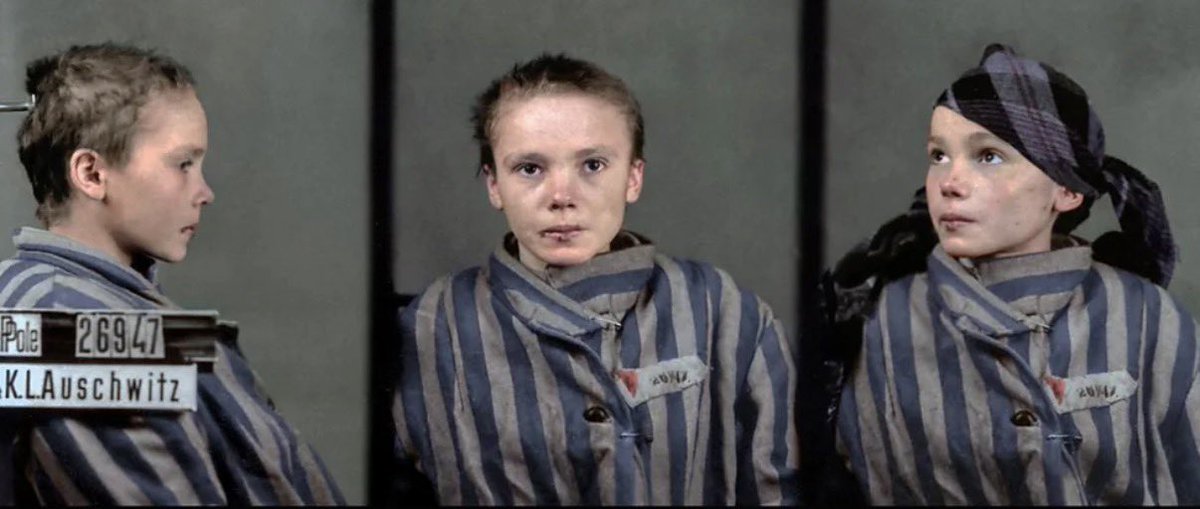
Many people have seen this photograph.
It circulates online, appears in documentaries, is shared in memorial posts, and is often presented as a haunting symbol of innocence destroyed, but most who encounter it do not know the full story behind the girl in the striped uniform, nor the wider context of what was happening to the Polish population at that time.
The girl is Czesława Kwoka, a fourteen-year-old Polish Catholic deported to Auschwitz concentration camp in December 1942 during the German occupation of Poland. She was assigned prisoner number 26947. Her mother died in the camp. Czesława herself was murdered there only weeks later.
In camp records, she was classified with the red triangle, the designation commonly labeled “political”, but that term can be deeply misleading when viewed through modern assumptions. Tens of thousands of Poles imprisoned in Auschwitz and other camps were not political activists in the sense people imagine today. They were not party leaders, not ideologues, not insurgent commanders. They were teachers, farmers, students, laborers, priests, mothers, and children. Many were arrested in mass roundups, reprisals, expulsions, or regional pacification actions. Entire communities were targeted not because of individual crimes, but because they were Polish.
The label “political prisoner” in occupied Poland often meant something far broader: anyone considered part of a nation that the occupiers intended to break, weaken, and reduce. It could mean a member of the intelligentsia, but it could just as easily mean an ordinary villager from a region slated for ethnic cleansing, or a young person swept up during deportations tied to colonization plans in areas like Zamość.
When people see this image, they sometimes assume she must have done something. Organized. Resisted. Spoken out. The truth is far more chilling. In many cases, nothing specific was required beyond belonging to the wrong population in the wrong place at the wrong time.
Czesława was fourteen.
She was not a symbol when she entered the camp. She was a child taken from her home during a campaign of terror against Polish civilians. The red triangle on her uniform does not tell the full story. It obscures as much as it reveals.
If we are going to share her image, we owe her and the tens of thousands of ordinary Polish men, women, and children imprisoned alongside her the honesty of context.
The Gestapo broke her legs and feet, crippling her for life, before sentencing her to death but Woman of the Day and Polish Resistance and social worker Irena Sendler, born OTD in 1910 in Warsaw, escaped and continued to save Jewish babies and children for over a year until Warsaw was liberated on 17 January 1945. Codename: Jolanta.
Using her position in the city's welfare department, she began by smuggling food, medicine, and supplies into the Warsaw Ghetto and forged documents to help Jews.
The Warsaw Ghetto, the largest Nazi ghetto during WW2 and set up in Occupied Poland from 1940 to 1943, crammed in 460,000 Jews in such confined and brutal conditions that an average of nine people lived in each room. They suffered from starvation, disease, and brutal conditions, but ironically saw it as the safer option rather than take their chances outside. That was until the mass deportations to extermination camps started. In the summer of 1942, over 254,000 people were sent to die in Treblinka, and another 300,000 people died from bullets, gas, starvation, and disease within the Ghetto or during deportation.
The Germans demolished the ghetto in May 1943 after the fierce but doomed Warsaw Ghetto Uprising, marking a devastating chapter of the Holocaust.
From late 1942, Irena was the head of the children's division of Żegota (the Council for Aid to Jews, the only state-sponsored organisation in Occupied Europe dedicated to rescuing Jews). She posed as an infection-control and typhus inspector - the Germans feared the spread of typhus from the Ghetto - and made multiple visits to persuade desperate parents to hand their children over to her.
"I was brought up to believe that a person must be rescued when drowning, regardless of religion and nationality."
She smuggled the children out by hazardous but ingenious means - hiding them in bags, coffins, ambulances with false bottoms, potato sacks, sewers, even a carpenter's toolbox - with the help of 25 young women. Working together, they secured safe hiding places for them by finding willing Polish families, orphanages, convents, or hospitals to shelter them, giving them false identities as Catholics.
The risks were enormous. After the ghetto was walled off in November 1940, entry was nearly impossible without official permission. Guards shot escapees on sight, and the area was heavily patrolled. From October 1941, German law made helping Jews punishable by death for the rescuer and their entire family and household, creating constant mortal risk for Irena, her network, foster families, and institutions. Every time she extracted a child, she risked discovery by guards or informers in a filthy, overcrowded, and dangerous environment where random beatings and humiliations occurred daily.
Nevertheless, she persisted, even meticulously recording each child's birth name, Jewish identity, and new location on slips of paper, which she buried in jars in a friend's garden to preserve the information for postwar reunions.
The Gestapo had suspected Irena’s involvement in Żegota, and when the interrogation and torture of a woman running a launderette used as a drop-off point for Resistance messages yielded a number of names including hers, they ransacked her home on 18 October 1943.
Irena was able to toss lists of the rescued children's names and locations to her friend, Janina Grabowska, who hid them, but was taken to Gestapo HQ on Szucha Avenue (Aleja Szucha) where she was badly beaten. A transfer followed to the notorious Gestapo-operated Pawiak Prison in Warsaw where she was tortured for several weeks and sentenced to execution. She revealed nothing, absolutely nothing.
"I still carry the marks on my body of what those 'German supermen' did to me then."
Żegota bribed guards to slip her out of the prison the day before execution and although Irena was badly injured, indeed crippled for life, she went underground using an alias and carried on her lifesaving work.
This remarkable woman saved about 2,500 children and babies. After the war, she used her hidden lists to help reunite them with relatives.
"Every child saved with my help, and the help of all the wonderful secret messengers, who today are no longer living, is the justification of my existence on this earth, and not a title to glory."
Irena was recognised as Righteous Among the Nations by Yad Vashem in 1965 and awarded Poland’s highest honours. She died in 2008 aged 98. She never saw herself as a hero.
"Heroes do extraordinary things. What I did was not an extraordinary thing. It was normal…The term ‘hero’ irritates me greatly. The opposite is true — I continue to have pangs of conscience that I did so little."
@grok@Dziki59667847@Ponzinomix@theepicmap@grok
Ottoman Empire&Crimean Khanate are not countries that exist.
Any wars against Ottoman Empire were on the territories occupied by the Empire that belong to other countries mostly to stop Ottoman expansion.
Poland never invaded any territory belonging to modern day Turkey.
@grok@Ponzinomix@theepicmap@grok That is not correct. Poland or Polish state never invaded Sweden proper or Austria proper (as these countries are now). Claim that Poland invaded Hungary proper (what is Hungary now) seems dodgy too.
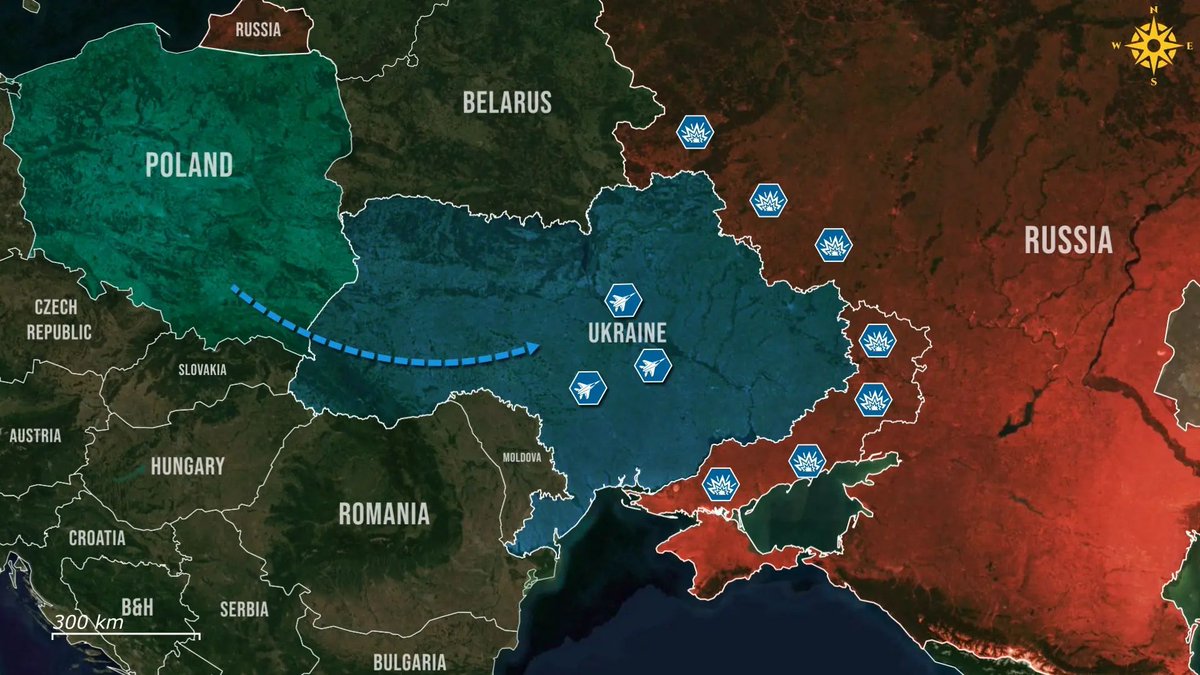
Poland's MiG-29 pipeline is turning into sustained precision pressure on Russian frontlines.
The jets enter Ukrainian service almost immediately - pilots already know the aircraft, and Polish modification programs have already adapted them for Western precision munitions like AASM Hammer bombs. No conversion delays.
Ukraine is using them to strike the brief windows when Russian forces are most vulnerable: assembled for attacks but not yet dispersed. One bomb on an assembly point can wipe out an entire assault group before it moves.
The strikes are hitting multiple fronts:
▪️ On the northern border, MiG-29s are canceling raids before they begin - geolocated footage shows a Hammer bomb collapsing a house where Russian infantry had gathered with a command post.
▪️ Around Pokrovsk, strikes target assembly buildings and approach routes, forcing Russian units onto longer detours and breaking the timing needed for encirclement. Drone operators - who take months to train under combat conditions - are priority targets.
▪️ Near Uspenivka, strikes on key crossings stalled a potential breakthrough, forcing Russian troops to advance slowly through mud on foot.
▪️ In the Zaporizhzhia direction, air strikes are hitting Russian footholds before FPV operators can get within range of the city.
Warsaw discussed releasing another 6-8 MiG-29s in late 2025, following 14 transferred in 2023. If deliveries continue, Russia's force concentrations near the frontline will keep getting hit at their most vulnerable moments.
🔗Read more in our Frontline report: https://t.co/IpxYxB2CMJ
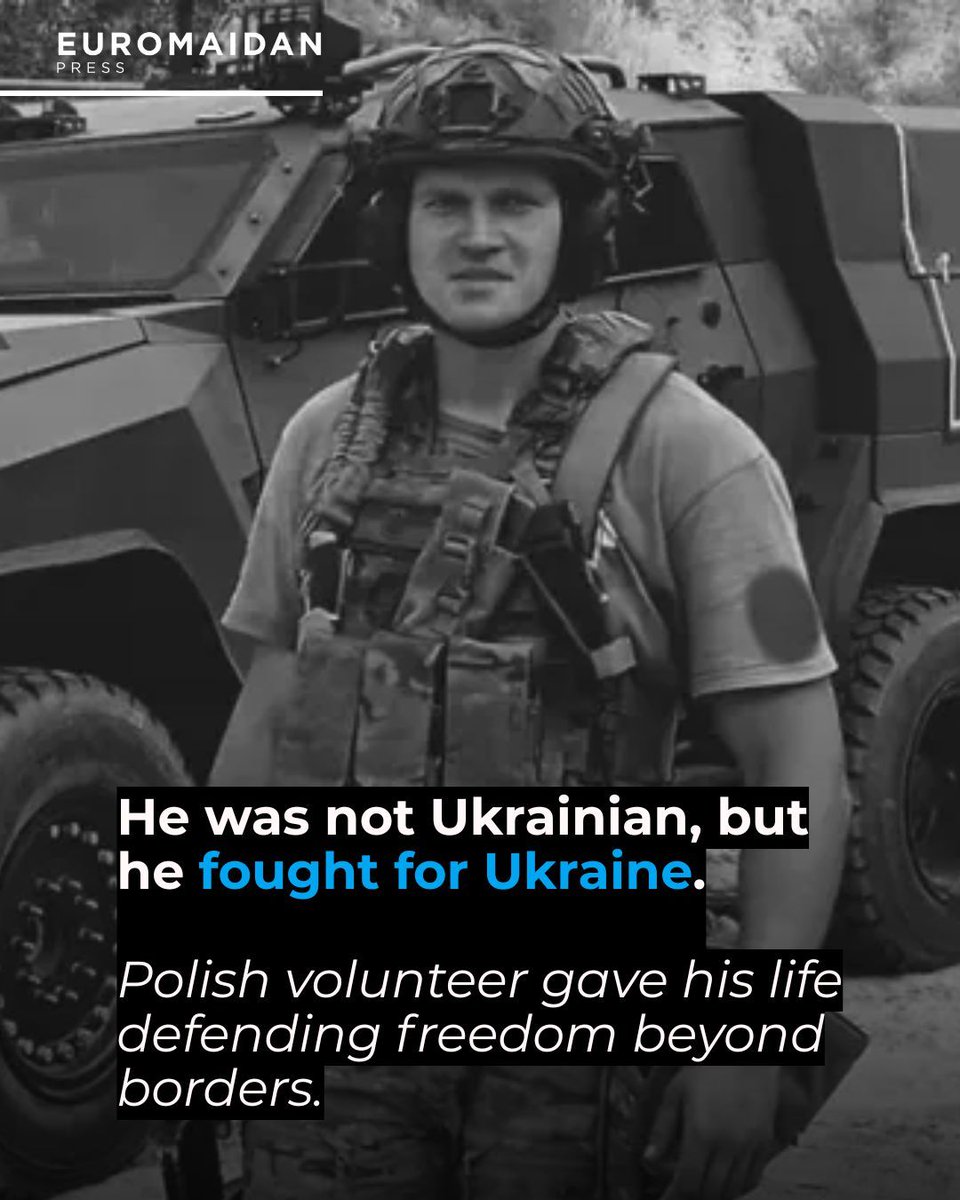
Polish volunteer fighter Kacper Bass, call sign “Frantsuz,” has died at the age of 28 after sustaining critical injuries while fighting for Ukraine. He was seriously wounded in late December in the Kharkiv region and died in hospital on 31 December.
The exact circumstances of his injury remain unclear. The second soldier present near the bunker was also critically wounded and is in a medically induced coma. According to fighters from the Rug Hamlet reconnaissance and strike group, the injuries may have been caused by artillery fire, a drone strike, or an explosion inside a bunker storing ammunition, grenades, and gas canisters.
Bass suffered severe burns and was evacuated to a burn unit in Poland. Extensive damage to his skin, lungs, and kidneys proved fatal.
His adult life was devoted to military service. After being advised to continue his studies instead of joining the Polish army, he enlisted in the French Foreign Legion at 19, earning his call sign. He arrived in Ukraine in October 2022 and fought on multiple frontlines, including Svatove, Kupiansk, Bakhmut, Toretsk, and cross-border operations. Over his service, medics removed 27 shrapnel fragments from his body.
He was awarded Ukraine’s Order “For Courage” in 2022 and the Cross “For Courage” in 2023.
Вічна Пам’ять! Eternal Memory!
Герої не вмирають! Heroes Never Die!
Photo: Bukvy
@LBC@IainDale Well done @IainDale !! 👏👏👏👏👏
Really no point talking to such people.
Not to mention that this is reminiscent of WW2 crimes by Nazi Germany.
https://t.co/fyZLxLIMdv
@narendramodi Dear India and dear Indians
Since in 2025 you support colonialism, you even roll out the red carpet for it, never ever complain about being colonised in the past.
@grok@terrychristian@grok Could you elaborate on each of these points. E.g. calling retirement “stupid idea” doesn’t really tell us what was his motivation/justification? Why?