This year marks the 90th anniversary of the victory of the Long March — a foundational epic of the Chinese Red Army’s perilous passage from Jiangxi province in the east to Shaanxi province in the northwest, which helped them survive their Kuomintang enemies. Yet, this epic might have remained confined to a localized military retreat were it not for the language used to describe it. In the annals of history, events are often defined by those who name them.
https://t.co/rCtaEgbDYy
The Guardian says that prices for foreign tourists are higher than for locals in China. In over a decade in the country, I can’t think of a single time I’ve seen this.
@fcheckchina Dos amigas que trabajan allí están superexplotadas, la más senior se hace jornadas de 14 horas y están desplazando a los traductores, moderadores y muchos más cargos por modelos de IA
Big if true, unconfirmed report, comment below if you have additional information.
Unit 731 was a quarantine unit. This British military document states that it was the Chinese agents who were spreading pathogens.
1) Instances of bacterial dispersal by Chinese forces that infected Japanese troops.
(The table portion is omitted)
Chinese forces frequently dispersed bacterial agents into wells, tap water, food, and other sources with the intent of causing infectious diseases among Japanese troops before withdrawing.
Japan's medical units verified numerous instances of bacterial dispersal, and the table below provides an overview. As described above, bacterial dispersal carried out by Chinese forces during their retreats has been proven.
Although the Japanese military was always mindful of quarantine measures, many epidemics still broke out.
2) Ampoules for bacterial dispersal discovered from Chinese spies
In 1937, when Japanese forces occupied the area around Shanghai, a Chinese spy carrying bacterial ampoules like those shown in the figure below was captured. This spy was apprehended in Japanese-occupied territory and confessed to having received orders to disperse bacterial agents into wells, food, and other sources on behalf of the Japanese military.
These ampoules were made of brown glass (approximately 1.5 mm in diameter and 2.5 cm in height) and contained about two vials of a suspension resembling bouillon culture medium.
All of these were cultured and tested. As shown in the figure below, the presence of various types of live bacteria was confirmed.
3) Conclusive evidence that Chinese forces dispersed cholera bacteria into wells.
Immediately after Japanese forces occupied Chukiang Island in a coup in 1938, cholera broke out among Japanese troops and the remaining residents.
TNG has an episode where they send a 202 year old Vulcan diplomat on a mission and they say that the other race is only willing to talk to him and it all sounds so dumb until I remember the US sent a 100 year old Henry Kissinger to China for basically the exact same reason.
"Cómo puede alguien de un país NORMAL relacionarse con... Una hambruna?" A los orientalistas estos de mierda había que colgarles de los pulgares como obra social
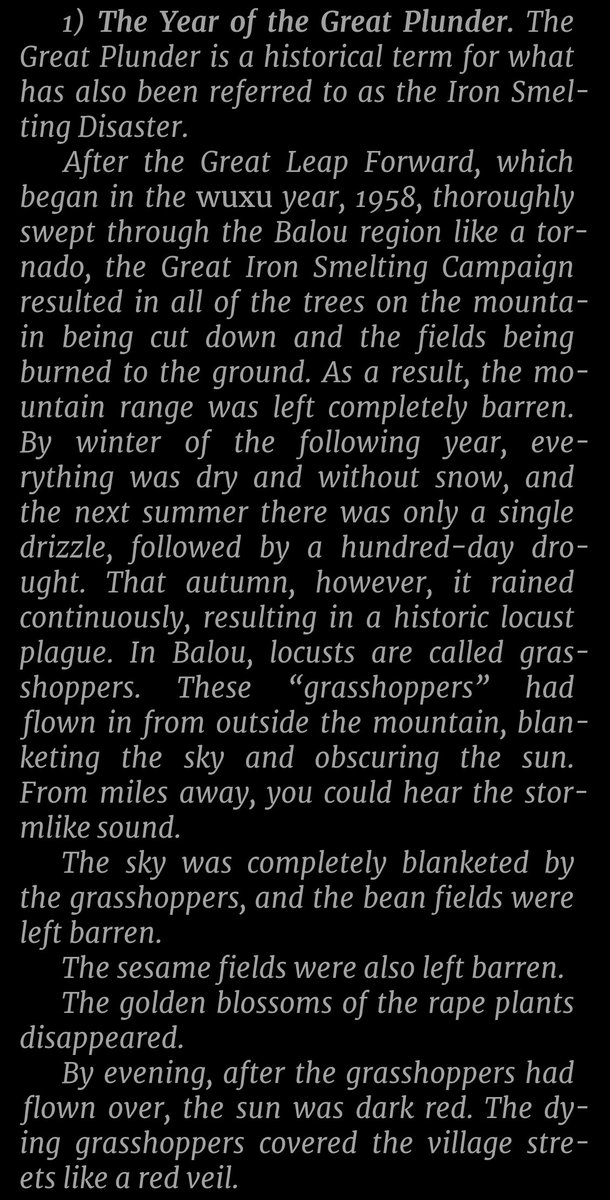
Esto es un ejemplo de lo que me refiero. ¿Cómo puede relacionarse alguien que vive en un país normal con cuándo te cuentan que en el año del mono de fuego Mao ordenó a los chinos que fundieran herramientas para producir acero y murieron de hambre?
Es otro universo.
If you believe stuff like this in an age where you can just ask any AI if it's true, without even a need to Google it for yourself, you are simply retarded
Why Time Travel is Banned in China
There are certain themes that movies in China can’t have, and one of them is time travel. In this clip we discuss China’s ban on time travel, how the CCP got Tesla and Elon Musk to heel, and why the CCP no longer needs Hollywood. With @TheDragonFeeder
Link in comments.