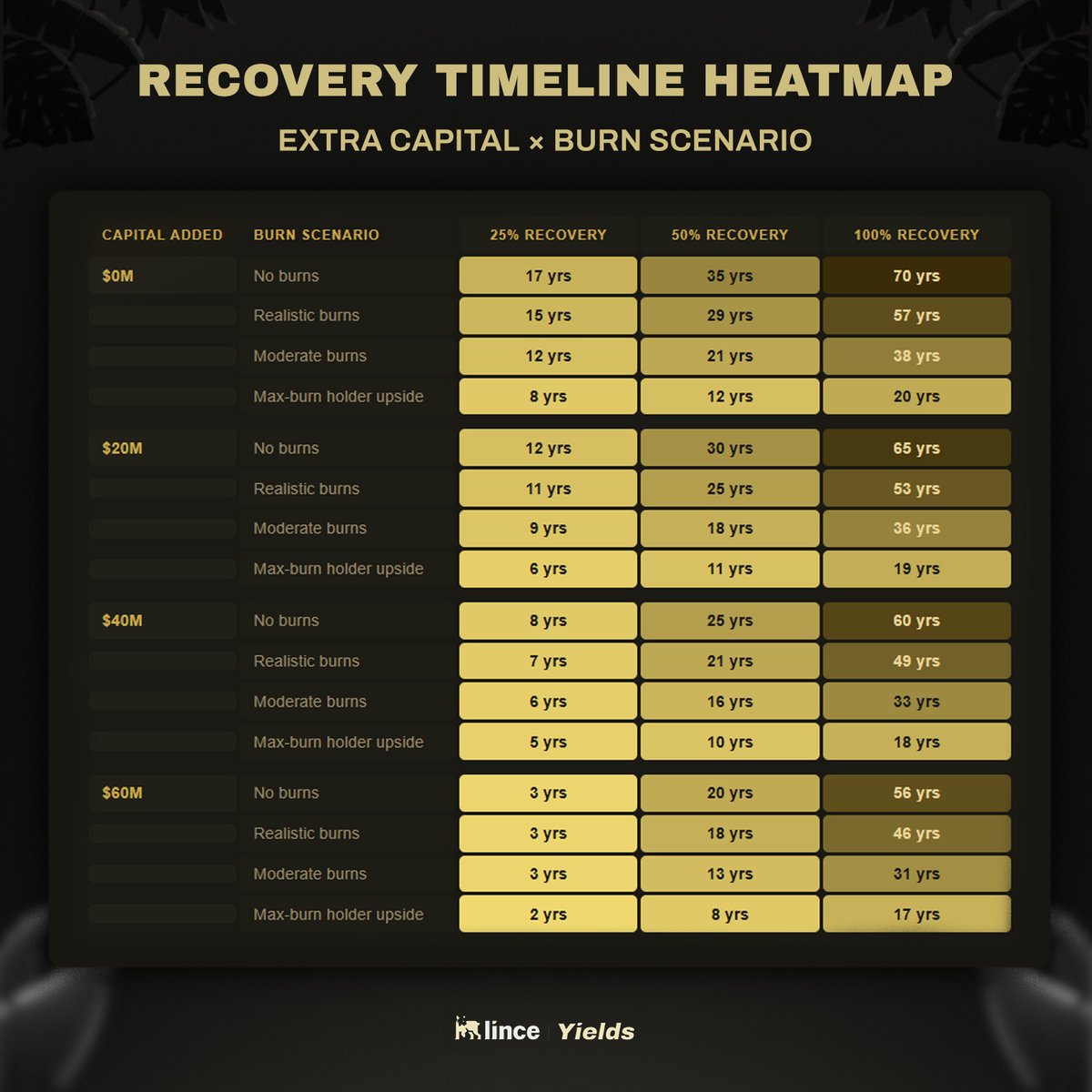
Here’s another key idea behind Drift’s recovery token model:
If you redeem early, your tokens are burned and you forfeit the remaining claim.
That means early redeemers don’t just exit. They reduce the outstanding recovery token supply.
And that changes the math for long term holders.
At first, someone redeeming does not magically increase your position, because they take their proportional share of the pool with them. But after that, future capital injections and future revenue are distributed across fewer remaining tokens.
So the recovery token is also a claim on the patience, or capitulation, of everyone else.
We ran a simple simulation for a user with $1,000 lost in Drift.
Base assumptions:
Total losses: $295.4M
Initial recovery pool: $3.8M
Recovery targets: 25%, 50%, 100%
Redemption: burn-on-redeem
Revenue scenarios: $7M/year, $4.2M/year, $2.8M/year
Generous assumption: 100% of modeled revenue goes into the recovery pool
Then we modeled 3 burn scenarios:
Realistic burns: 10% to 30% of supply eventually burns
Moderate burns: 35% to 65% of supply eventually burns
Max-burn holder upside: 65% to 90% of supply eventually burns
Here is the important part.
Under a realistic revenue case, where Drift comes back to 60% of its best historical revenue, or around $4.2M/year, the baseline with no burns looks brutal:
25% recovery: around 17 years
50% recovery: around 35 years
100% recovery: around 70 years
With realistic burns, the improvement exists:
25% recovery: around 15 years
50% recovery: around 29 years
100% recovery: around 57 years
So if only a normal amount of users redeem early, long-term holders benefit, but not enough to change the whole story.
With moderate burns, things start to move:
25% recovery: around 12 years
50% recovery: around 21 years
100% recovery: around 38 years
That is already a meaningful acceleration.
But the real upside only appears in the extreme capitulation scenario, where a large majority of users redeem early and burn their claims:
25% recovery: around 8 years
50% recovery: around 12 years
100% recovery: around 20 years
This is the most important takeaway:
The recovery token creates a strange game.
If everyone waits, recovery is extremely slow.
If many users give up early, the remaining holders can recover much faster.
So the long-term holder is effectively betting on three things:
- Drift generating revenue again
- new capital entering the recovery pool
- other users redeeming early and burning their claims
The fewer recovery tokens remain outstanding, the more powerful every future dollar added to the pool becomes.
@ImTrizzy Also, any reply to this won’t be savvy or clever enough because truth is, only the weak/tilted can’t handle opposing viewpoints. Sorry you lost money on your trades.
One thing you should ask yourself especially with alts:
If you are long a hot alt that almost everyone in the space has been bullish on, and every major account has backed, and no new wave of retail is on the horizon, who is the marginal buyer now?