1/ My first sole-authored paper just out in @polanalysis 🎉
I develop & validate a survey method for estimating political self-censorship and preference falsification in the mass public… 🧵
Social media discourse is driven by false #polarization
Analyzing 1.7 million social media posts, a series of controlled experiments, and a large global survey covering 40 countries (total N = 49,222), we find that
(1) strong ideologues post their opinions significantly more often than moderate individuals
(2) extreme attitudes are posted more often than moderate attitudes.
(3) This general pattern replicates robustly across 40 countries
(4) the opinions that users post are more hostile and toxic than the beliefs they keep to themselves.
Across studies we find extreme opinions are overrepresented on social media by at least 6% and up to 22% compared to their true prevalence in our samples.
https://t.co/NKovC9Uisj
This project was led by @small_schulz and @ClaireRobertson and includes @H_Sjastad@AshuAshok@LisaFOswaldo@junghwanyang@simonsaysnothin and @andyguess
Is social media truly making us more politically polarized, or does it simply over-represent our most extreme opinions?
In our new preprint, Claire Robertson and I present *punishing evidence* that social media systematically overrepresents users’ most extreme political opinions.
Therefore, much of the intense polarization we observe online today may not be caused directly by platform algorithms pushing people apart, but rather by the selective posting behavior of extreme voices over-representing their most extreme views.
@DannyDaneri Congratulations Danny! I’ve seen you working so hard on this since you started it when we were grad students, amazing to see it published!!
My article, Labor vs. Big Business, is out! it's about efforts of companies like Uber to reform gig worker laws and voter cue-taking from unions and business. TLDR; progressive voters trust union cues to substitute for policy information https://t.co/k0SWnPVXmT
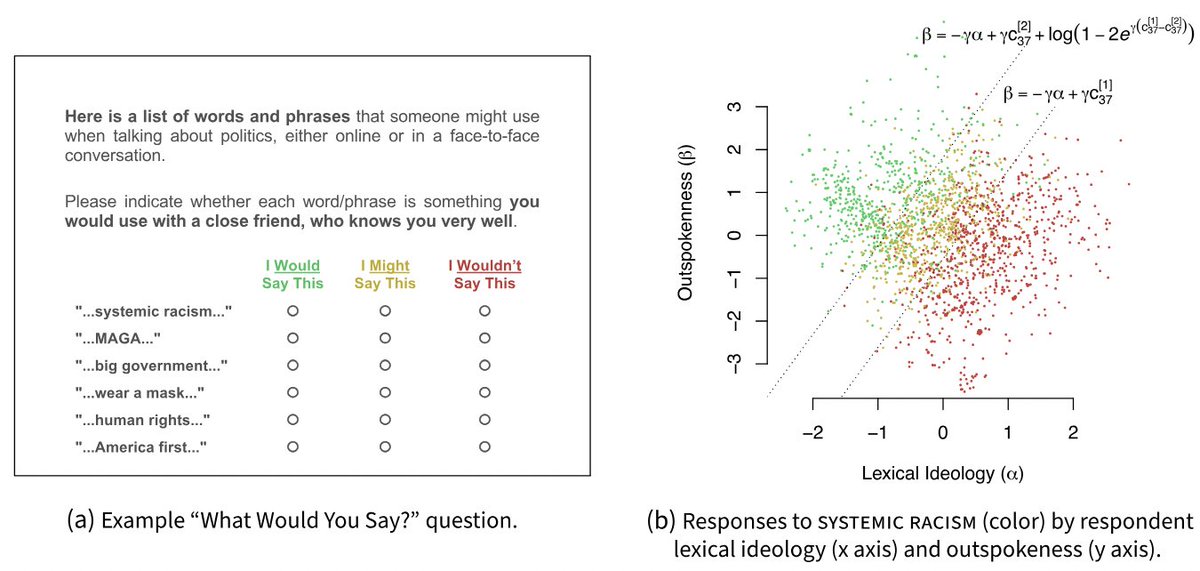
Currently in FirstView: In “What Would You Say? Estimating Causal Effects of Social Context on Political Expression,” @small_schulz develops a method for estimating social influence over political expression. He uses an experiment to estimate respondents’ lexical ideology.
@PippaN15 Thanks Pippa! Definitely agree phrases’ meanings differ across cultures, which is why I’m looking to partner with other scholars for non-US applications. Already working with @LisaFOswaldo on a German-language version!
6/ reach out if you’d like to try using the WWYS method yourself! I can set you up with the survey instrument and model code. I’m also looking for collaborators to apply in different languages/country settings!
1/ My first sole-authored paper just out in @polanalysis 🎉
I develop & validate a survey method for estimating political self-censorship and preference falsification in the mass public… 🧵
5/ and I also derive causal estimates of self-censorship by analyzing treatment effects on a second “outspokenness” dimension generated by my Wordsticks model (details in paper)