1/ The post-election hot takes are missing an important point: the election wasn’t a referendum on crypto. Some crypto champions won and some lost, but we have more pro-crypto candidates elected to Congress than we’ve ever seen in a new member class before. That’s progress.
Excited to announce @CoinbaseAM is bridging the UAE and US with the Soveriegn backed Standard Asset Company in @ADGlobalMarket.
This innovative approach blends bitcoin:native yield bearing collateral with UAE Prime Commercial Real Estate.
Bitcoin has a multitude of benefits- from its role for cash flow, instant liquidity, use as collateral, and of course its store of value vs fiat.
We embarking on a new paradigm where Bitcoin serves as a ballast next to prime UAE real estate in one of the most strategic locations today.
Update: We are honored to support Standard Asset Co. in ADGM as their exclusive Bitcoin asset manager.
With deep respect for the vision of His Highness Sheikh Mohammed Bin Maktoum Bin Juma Al Maktoum, this strategy bridges digital and traditional economies with institutional discipline.
https://t.co/f9Ju8p4qTg
In 2014 I went nearly a week without sleep. I was running PayPal and attackers were inside our corporate network. They'd compromised an eBay employee's laptop, got onto the VPN, taken over a domain controller and made themselves domain admins. eBay and PayPal were one company then, on one Windows network. They stole 145M eBay user records, then came for the segregated vault holding PayPal's card credentials. We fought them off. They never got in, but they got close. Too close.
Yesterday Binance lost ~$6.3B in what looks like the same way. A DevOps engineer's laptop, then a service inside the withdrawal stack, then withdrawals the signer approved because they came from a trusted source. Hot wallets emptied in under four hours. No key was stolen.
Nobody broke cryptography or a ledger. They found someone with access and used the trust that came with it. Banks get hit exactly the same way.
2016: attackers inside Bangladesh Bank used its own SWIFT access to send $951M of payment orders to the NY Fed. $81M was lost. The rest was held because an unrelated sanctions filter tripped on the word "Jupiter". That was luck, and it only worked because wires took days to settle.
June 2025: an IT employee at C&M Software, which connects Brazilian banks to Pix, sold his credentials for about $2,700. Attackers used them to send fake Pix transfers out of six institutions' reserve accounts at the central bank. ~$140M in under three hours.
August 2025: stolen vendor credentials at Sinqia, another Pix connector. ~R$710M out of HSBC and one other institution in a single afternoon. The central bank froze most of it, after it had already moved.
Same attack every time. Speed is what changed. When settlement took days, a filter, a correspondent bank or someone in ops could catch a bad payment. Pix, FedNow, SEPA Instant and blockchains settle in seconds. Payment security was mostly built for the slow world.
PayPal's card and user data survived 2014 because domain admin on the corp network couldn't unlock it quickly enough, and our alerting caught the unusual activity on the network. That's the model. Approval policy no laptop or vendor login can reach. Velocity and anomaly limits enforced outside the system that sends. Dynamic caps on what any one wallet, account or service can move per hour. All of it in real time.
About $3B of what left Binance has been frozen, almost all of it stablecoins. The $1.4B in bitcoin is sitting in 19 wallets and nobody can touch it. I don't think that's the problem. For decades the ability to reverse a wire or a card charge let a lot of weak security slide. You either stop the transfer before it's signed or you eat the loss.
Nothing about the technology failed here. The chains processed exactly the transactions they were handed. Binance's own systems handed them the wrong ones because an engineer's laptop was compromised. That's operational security. eBay in 2014, Bangladesh Bank and two Pix connectors all failed at it on their own rails.
In 2014 the attackers never reached the vault. If they had, the fraud losses would have been the small part. PayPal existed so people could pay without handing their card details to every merchant on the internet. We held those details so they didn't have to. Losing them would have broken the one thing the company was built on, and I'm not sure we would have recovered.
I expect blockchains and digital assets to become the standard way money moves. Every custodian of digital assets, or of fiat on a real-time rail, is in that position now. The controls have to adapt to settlement in seconds, crypto or not.
@CoinbaseAM Clients and Funds are safe. We hold client crypto assets at @coinbase in QC cold storage, segregated wallets with insurance coverage, and off-exchange settlement.
We're on the cusp of major institutional adoption. This means safeguards, controls, and trust must be earned by keeping client funds safe while generating returns.
This is the institutional cycle.
In the same headline we see a @Polymarket hack next to @NYSE integrating @HyperliquidX. Usually the most entertaining outcome is the one that occurs.
Stay safe out there.
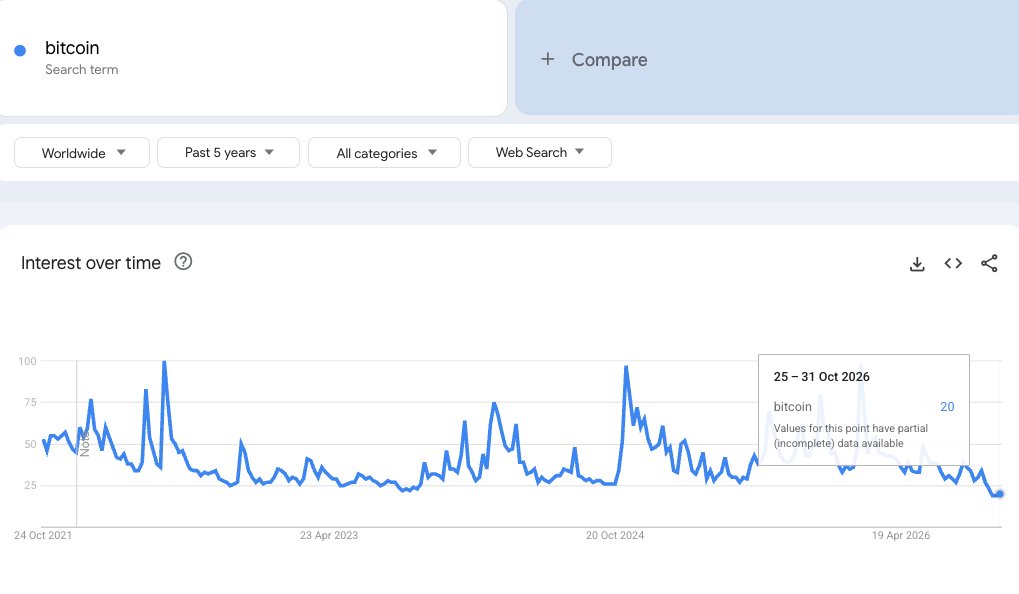
Search Interest in bitcoin at cycle low?
But $btc holds floor at $81k.
The floor keeps rising.
Average holder cost is $59k.
200 week MA is $67k
200 day MA is $72k
INSIGHT: Google searches for Bitcoin have plunged to a FIVE-YEAR LOW as $BTC trades near $81,000.
Similar lows in September 2023 and September 2024 coincided with local Bitcoin price BOTTOMS.
Retail interest in crypto FADING:
- Robinhood's crypto revenue plunged 55% year over year to $120 MILLION in Q3
- Bitcoin wallets holding a balance declined by roughly 30,000 since October 16.
Some analysts see this retail disinterest as a BULLISH signal, suggesting selling pressure may be easing.
However, a bottom remains unconfirmed, with $80,000 emerging as a critical level as markets digest the Fed rate decision and midterms election.
Lightning round with @smartestbeta. Most excited about for 2027: on-chain asset management. Bigger 2027 story: "Stablecoin credit." Most underrated: privacy.
Is this a good time to enter crypto?
"This is not financial advice, but it's a great time to buy Bitcoin."
The five-year cycle was last cycle's big call. @smartestbeta isn't buying it:
"absolutely, that's the wrong call"
On waiting for the perfect entry:
"You're not going to catch the low. You just need to start allocating and do it consistently over time."
@antoniogm Market participants need to revisit their expectation.
7% easy - no such thing as zero credit risk - instant redemption requires a functioning healthy market structure.
Satoshi did not use NIST. The NIST (est 1997) finding is interesting cryptographic history and settles an open question. Of course AI did it in 30min when our meat brains could not in 30 years.
For Bitcoin, it is not relevant.
Keep moving
Glad to see the @USOCC bringing transparency out.
Hopefully steps will be taken to prevent weaponizing our banking system with the next administration.
bombshell report from the OCC out today confirming what we all suspected:
between 2020 and 2025, based on a review of 100,000 complaints, America’s largest banks systematically denied banking to lawful businesses based on political and reputational considerations rather than objective financial risk, effectively appointing themselves arbiters of which industries deserved access to the financial system. digital assets was specifically named as one of the six most affected industries.
TLDR: we weren't imagining it. OCP2.0 was real.