Hi, I'm Grygorii 👋 15+ years building Node.js/React/TypeScript systems: billing, EV charging (OCPP), solar IoT, video pipelines. Since 2023: RAG, AI agents, MCP and private LLMs.
Here: architecture, DB tuning, JS tricks.
Open to contracts → https://t.co/ID2NPalAhu
@hnasr the CONCURRENTLY fine print is the part I'd watch tbh: docs say it's not MVCC-safe, still grabs the exclusive lock briefly at the end to swap files, and can fail if someone runs DDL on the table mid-run. also no db-wide mode, you have to name the table
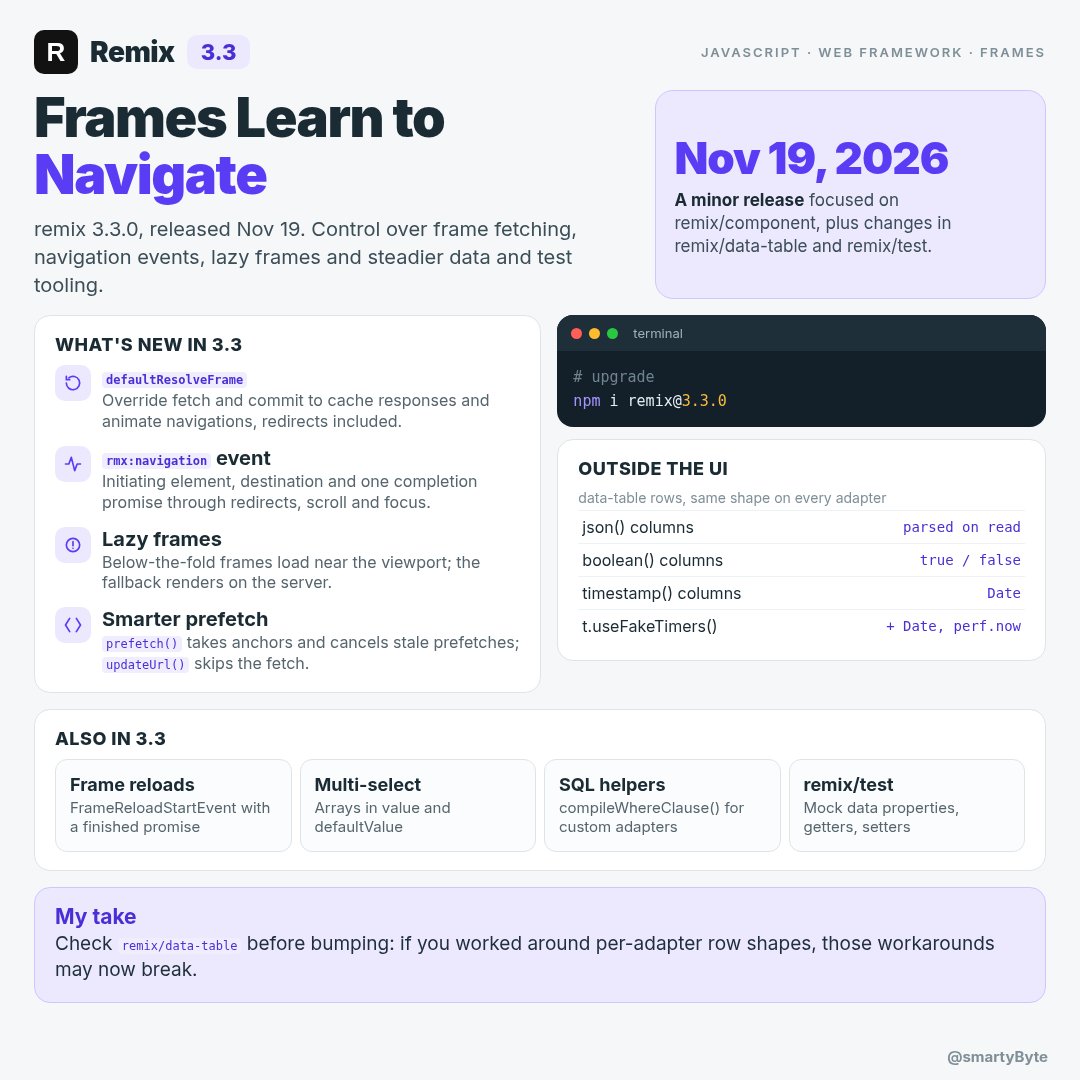
Remix 3.3 is out: lazy frames, navigation events, a fake clock for tests
Released Nov 19. Frames get most of it: defaultResolveFrame lets you override fetch and commit, so apps can cache responses and animate navigations, redirects included. A new rmx:navigation event gives the initiating element, the destination and one completion promise through redirects, scroll and focus.
Below-the-fold frames can now load lazily near the viewport, with the fallback rendered on the server. prefetch() takes anchors and cancels stale prefetches, and updateUrl() puts local state in the URL without a fetch.
Outside the UI, remix/data-table rows have the same shape on every adapter (json parsed, booleans true/false, timestamps as Date), and t.useFakeTimers() now also fakes Date and https://t.co/CHeyjLVrKZ().
𝚗𝚙𝚖 𝚒 𝚛𝚎𝚖𝚒𝚡@𝟹.𝟹.𝟶
My take: check data-table before bumping. If you worked around per-adapter row shapes, those workarounds may now break.
Would lazy frames replace client-side fetching for you?
#javascript #webdev
@supabase and then one day it needs VACUUM FULL and you learn about the access exclusive lock the hard way. tbh REPACK CONCURRENTLY in PG 19 is the part of that release I'd want most
Same Mac, same model, 2.7x the speed.
Qwen3.8 Flash-Next 4-bit on a Mac Studio M5 Ultra (256 GB):
TensorFold (MLX): 154 tok/s
llama.cpp Q4 GGUF: 56 tok/s
16K-token prefill: 3,931 vs 1,400 tok/s.
Which engine runs your local models?
https://t.co/Am9EMWncBO
@trysilicon yep, 4-bit, TensorFold 1.3.0 MLX with --ple-on-ssd, so same weights if yours was 4-bit too. mine was 16K ctx though, way under your 65,536 cap, so some of the gap might be context not just runtime. which engine were you on?
4 local LLMs, 2 engines, one 256 GB Mac Studio.
Fastest: Qwen3.8 Flash-Next on TensorFold, 154 tok/s single, 237 across 4 streams
Biggest: Hy4 770B on llama.cpp, 17.7 tok/s at 209 GiB RSS
Every run, the method and the caveats: https://t.co/Am9EMWmEMg
@bindureddy ngl the real question with GLM open weights is whether it fits one box. GLM-5.3-Flash did 99 tok/s decode on my 256 GB Mac (TensorFold 4-bit) vs 40.7 on llama.cpp Q4, but only 1 stream and it didn't fit 96 GB at all. Hoping 5.4 is lighter
@KalinJunYAI haha 17.7 sounds great until you see the 552 s load and 209 GiB RSS, def not a daily driver. what are you running that 30b on, and which engine?
@trysilicon oh nice, a real 96 GB number is exactly what my proxy was missing, thanks. tbh I didn't log RSS for the --ple-on-ssd run, only tok/s, so can't answer that yet. it was also 16K ctx and --parallel 1, so not quite apples to apples. what context were you at for the 74.7 GB?
@mattpocockuk Hot take: the build-from-scratch part is easy, the noise budget isn't. If agents post every step, humans mute the channel within a day. I'd let them post only state changes (blocked, needs review, done) and keep the rest in threads.
Solid 2.0 is stable: 23 release candidates in 14 weeks, 971 PRs merged
Shipped Nov 17, five years after 1.0. The big change is async in the reactive graph: a computation can return a Promise or an async iterator, and everything downstream handles it. Race conditions are handled, optimistic state rolls back so the server stays the source of truth, and live() streams server functions over persistent connections.
The API got smaller: createResource, batch, startTransition, on, produce, createComputed and createMutable are gone. Dev builds report reactive mistakes with a stable code, source location and fix, and flag waterfalls and runaway effects. Router and cache are your choice, via framework-agnostic Vite plugins.
Try it:
𝚗𝚙𝚖 𝚌𝚛𝚎𝚊𝚝𝚎 𝚜𝚘𝚕𝚒𝚍@𝚕𝚊𝚝𝚎𝚜𝚝
My take: dropping createResource means every 1.x data-fetching path gets touched, so read the migration guide before bumping. 1.x stays on npm as solid-js@v1-latest, so there's no rush.
Would async in the graph change how you fetch data?
#javascript #webdev
@housecor Agree, and it's not just cost. Even local, my fastest runtime took 0.45 s median per tiny UI string, and byte-identical output between runs isn't a given. If you can write the if/else, the model is just added latency and variance imo
Clef ran faster, then matched my labels on 27.5% of one field
M4 Max 64GB, 50 real prompts, req/min at 1 / 2 / 4 parallel:
Clef 7.2 / 7.37 / 7.16
Qwen3.8-27B 5.56 / 7.48 / 5.90
Interim label match: role 92%, seniority 74%, remote scope 27.5%.
Do you score quality per field?
@Boris_web@X ngl the ollama part is what caught my eye. what models do people actually run with it, small 7-8B ones or bigger? and does the AI side hold up on a CPU-only docker box or is a GPU kinda required
@jarredsumner curious about the AoT part: does it still ship JavaScriptCore for eval() and dynamic import(), or do those just throw? imo that's the line between faster startup and actually smaller binaries
@alexxubyte tbh the tradeoff these diagrams skip: with open weights the runtime is your problem. same 7B model on my Mac Studio needed 7.8 to 31.2 GB server RAM depending on runtime, and at 16 concurrent llama.cpp did 680 tok/s vs 520 for the next best
@dhh tbh a Mac Studio M5 Ultra already does 160 tok/s on Qwen3.8-27B 4-bit for me, 8 concurrent JSON requests on TensorFold (llama.cpp: 87). no GB300 numbers to compare, but for a solo batch pipeline the urge kinda fades