I sent out $18k in @SMB_Ops proposals last week.
The last one was sent while I was with my family at a Halloween event in town.
1. Grok read my Granola transcript from the call
2. I sent Grok a voice note on changes I'd like to make to the proposal based on that conversation.
3. It used my proposal template, populated the information and created a draft to them in my Gmail.
4. I sanity checked the information on my phone and hit send 10 min. after the call ended.
The best part is they were looking for a speed-to-lead system.
No better way to prove you can handle their use-case than showing it's how you already power your own.
4 Upwork proposals out, cold email deliverability half broken, and I'm texting a roofing company owner about maybe sending me referrals.
That's the whole business right now.
I don't know which channel is going to work. Cold email has volume but my domain reputation is shaky. Referral partners feel right but I can't control when they send someone. Upwork is a pricing guessing game.
So I'm just running all three and seeing what sticks first.
We're redoing our entire backyard right now. Electricians, plumbers, masonry, construction suppliers. I've talked to probably 15 different companies in the last month.
The electrician texts me updates before I even ask. Shows up on the day he says. Sends photos of progress while I'm at work.
The masonry company ghosted me for two weeks after taking a deposit. Had to call three times just to get a start date.
Both licensed. Both came recommended.
The difference is literally just operations. Showing up on time, sending a text confirmation, following up after the job. That's it. The bar in home services is on the floor and the guys who figure out even basic systems are going to run laps around everyone else.
This is exactly why I started @SMB_Ops.
Growing up, my brother and I helped my uncle with real projects every summer.
Dig out a new pool. Move a boat engine across the yard. Surprise Grandma by redoing every ceiling in her house over a weekend.
None of that taught me how to be a contractor.
It taught me that hard things aren't scary. That stuff doesn't just happen by magic. That when something breaks, you don't freeze. You just figure it out.
Put your kids on real projects with real adults. Not chores. Projects. The kind where they're tired and dirty at the end.
That's all it takes.
I get on discovery calls with business owners and it's the same thing every time.
"My team keeps dropping the ball."
"Nobody follows through."
"I can't find good people."
Then we look at how the work actually moves through the business. There's no real process. Stuff lives in someone's head or a group text. The "people problem" is a process problem every single time.
What's yours?
Most professional services firms doing $3M-$15M in revenue are spending $80K-$350K a year on manual work that could be automated.
Billing prep, document collection, client onboarding, internal coordination. Stuff that eats 10-20 hours a week from their most senior people.
Every firm I've talked to assumes this is just how it works. Then they see the actual number and it changes the conversation.
Built a free calculator that maps it out. Link in the reply below.
Upwork job: "PandaDoc Proposal & Contract Automation Specialist"
Client is a commercial cleaning company in Idaho. 25+ years in business, 90+ facilities, 1,500+ cleanings a month, ~55 employees.
They're building every single bid, proposal, and contract in Canva. Manually. For 90+ facilities.
That means someone is opening Canva, copy/pasting service descriptions, updating pricing, fixing contact info, and exporting a PDF every time they need to send a proposal. Multiply that across annual renewals and new bids and you've got someone spending hours a week on document assembly.
Here's how I'd actually solve this:
→ PandaDoc with templates, not static documents. Build 2 to 3 core templates (proposal, service agreement, renewal) with variables for pricing, scope, schedule, contacts, and terms. Every new document pulls from the template and auto fills.
→ A single Google Sheet or Airtable as the source of truth for client data, pricing tiers, and service descriptions. One place to update, and every document downstream reflects the change.
→ Connect the sheet to PandaDoc through Zapier or Make. When a row is added or updated, a new document drafts itself with the right data already in place. Add e-signature fields so the client can sign without printing anything.
→ For annual renewals, build a simple date trigger. 60 days before a contract expires, auto-generate the renewal doc with updated pricing and send it for review.
The whole setup takes maybe 2 to 3 weeks if you're being thorough with the templates. The ongoing time savings compound every single month.
This company has been cleaning buildings for 25 years and the business clearly works. The only bottleneck is document creation, and that's a solved problem.
If your business has a version of this problem, that's what @SMB_Ops is for.
Seems like everyone is reintroducing themselves, so here’s mine.
I’m Drew. I’ve been building software for 11+ years and currently lead engineering teams while building my own businesses.
A few things I’m working on:
→ @SMB_Ops
I help small and midsize businesses use AI, automation, and custom software to fix broken workflows and run more efficiently.
→ @ReviewRoverCo
A SaaS platform that helps local businesses generate more reviews and turn customer feedback into growth.
→ Building in public
I’m exploring local service businesses, AI agents, SaaS, and the systems behind profitable small businesses.
I’m especially interested in the messy operational problems that live between spreadsheets, inboxes, CRMs, and all the other tools businesses have duct-taped together over the years.
If you’re building a business, working with AI and automation, or interested in how technology is changing small business, we’ll probably have a lot to talk about.
Here’s a pic of my boy’s first carousel ride this week
We are deep into peak home service season right now. I'm looking out my window and I see a landscaper, a tree company, a sprinkler crew, and an AC repair on my block.
If you're in home services, growing and looking to keep the organic coming, put those reviews on autopilot with @ReviewRoverCo .
If you're feeling like the volume is starting to get to you and things are starting to break, reach out to @SMB_Ops and we can audit your existing workflows to get you sorted
You're driving around town and pass a wrapped truck for “Drew’s Roof Repair.”
You think: “I should look them up later.”
Then you forget.
So I built this:
(I'm going to be using this every day going forward)
Step 1⃣: Send a message to Telegram via Carplay.
"Send a Telegram message to Dispatch, Drew's Roof Repair. Two trucks. Looks like they do commercial. Located in Farmingdale."
Step 2⃣: AI Extraction to pull out + identify Company name, industry, and any other context from my original message
Step 3⃣: Create a lead record in my CRM
Step 4⃣: New CRM Record triggers Data Enrichment with website, company phone, estimated headcount, est. revenue, and more
Step 5⃣: AI Qualification Engine
In our target industry? Est. Revenue in our target range? and more qualifiers
Step 6⃣: Campaign Enrollment
Start outreach emails.
🔥🔥🔥
I saw a lead in the real world and my system captured, enriched, qualified, and started outreach before I got home. 🤯
Good operations create confidence.
Not just for the owner.
For the team too.
When people know the process is consistent, they stop checking whether something was done.
They trust the system.
That trust is a multiplier.
It lowers stress.
It reduces errors.
It speeds everything up.
Most owners think they need better people.
A lot of the time they just need better process design.
Strong people inside weak systems still produce weak results.
Weak handoffs create dropped balls.
Messy intake creates bad data.
Slow feedback creates rework.
System design shapes team performance more than most people admit.
The phrase "we’ll remember to do that" should make every owner nervous.
Anything important that depends on memory should be moved into a system.
If a step matters, it should trigger automatically or appear in a tracked workflow.
Memory does not scale.
Systems do.
Most “AI automation” looks good in a demo.
Then nothing changes in the business.
That’s the problem.
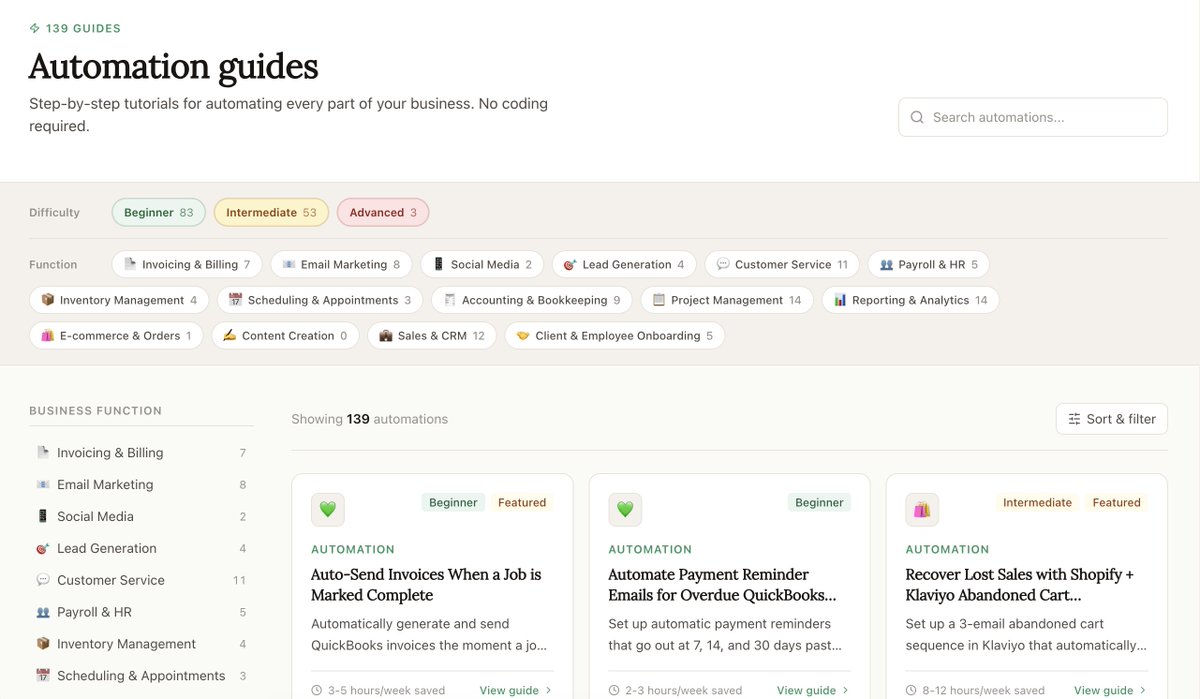
We built https://t.co/G2YHpEKIfh to fix it:
• Practical automations
• Proven prompts (copy + paste)
• Step-by-step tutorials
For real SMB operators.
https://t.co/G2YHpEKIfh, powered by @SMB_Ops
If your team says, "That’s just how we do it," pay attention.
That sentence hides a lot of operational debt.
Usually behind it you will find:
• duplicate work
• long delays
• invisible handoffs
• zero tracking
• tasks nobody owns
Those are all solvable.
But only after they are visible.
Sound like exactly what your business is looking for?
Come chat with us. This is exactly the work we specialize in.
We will map your workflows, show you opportunities for AI and Automation in your business.
Book a discovery call below 👇🏻
Best money I've ever spent as a CEO... an internal AI transformation hire.
He doesn't care about title. He just wants to ship. And he goes across your entire org, sales, revenue, hr, apps, tech and kills stupid manual processes.
Such an underrated unlock I have since hired 2 more.