@XuanIsBoosted Cheese and butter for sure. Milk is ok, but you can use water from the cooking if you like (you get a lighter mash). Onions, never heard of it. IDK on that one, but we do enjoy classic bangers and mash - with brown onion gravy!
@quinnjin2009@publicaddress Notwithstanding the propaganda I found it remarkably easy to answer truthfully and signal my preference for a left coalition.
@BarnabyHistory You’ve overlooked Operation Hannibal (Germany 1945) in your “largest water evacuation in history” claim. The Manhattan evacuation may be “largest in a single day” but I’ve not checked that.
@mcnaughthelen1 I can’t stand his voice and turned him off. But not before I heard him answer the Q. “Where did the $67,225 youth benefit cut-off come from?” by saying something like “That’s the limit of family income before the benefit is cut off”. As always, he said nothing! Is he breathing?
794 bodies recovered. Thousands still unaccounted for. Tell us, what was their crime?
I am writing this from the Himalayas from a country responsible for only around 0.1% of global greenhouse-gas emissions. Nearly 46% of our land is covered by forests. Around 94% of our installed electricity capacity comes from hydropower. We are rapidly moving away from fossil-fuel vehicles too: EVs accounted for about 74% of Nepal’s four-wheeled passenger vehicle imports in 2025/26. We protect forests. We generate electricity from our rivers. We are embracing electric mobility at a pace few countries in the world have matched. Yet today, our people are digging through mud, searching rivers and waiting beside phones for the names of their loved ones.
The Bhote Koshi flash flood has shown us what it means to live beneath a rapidly changing cryosphere. Our glaciers are retreating, our frozen mountains are becoming increasingly unstable, and the rivers that generate our clean electricity can also carry destruction into communities below. We did not build our prosperity by burning generations of coal and oil. We contributed almost nothing to creating the climate crisis at this scale. But we are being forced to survive its consequences. The people whose bodies are being pulled from rivers did not cause this crisis. The families still waiting for thousands of missing people did not cause it. The children, farmers, workers and mountain communities who lost everything did not cause it.
So from the Himalayas, we ask the industrialised world: how many Himalayan bodies will be enough? How many mothers must wait for children who never return? How many villages must disappear before “climate justice” becomes more than a speech at another conference? Do not come to us only with sympathy after the bodies have been counted. Come with responsibility. Come with climate finance, adaptation, loss-and-damage support and the courage to cut emissions at the scale this emergency demands. We want climate justice. We want the right to survive in our own mountains. We want a world where being born in the Himalayas is not a death sentence for a crisis we did not create.
Those kiwis have poked their noses ahead of the Aussies in terms of consumer sentiment. Things have soured a bit in Australia as past hikes (and perhaps a realisation of more in the future) have bitten into household sentiment. Whereas in NZ there are growing signs the NZ consumer might be adjusting to higher fuel prices and be ready to "Shake it off" and get back to business.
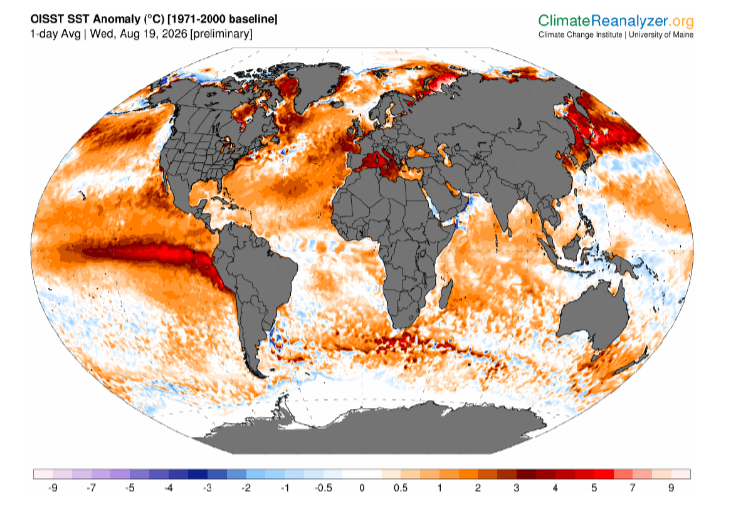
The El Nino is off the charts. Can people see the real issue and accept the implications? We may be getting closer. See the Bigger Problem – https://t.co/rsyLt8z4XS
Also available on Substack:
https://t.co/lqgU6bog2i