@EricTopol@LancetDigitalH@curtlanglotz Thanks for the shout out, Eric. This is part of our work through the Topol Digital Fellowship, focused on making medical imaging reports more accessible for patients. Good progress so far, with more to come.
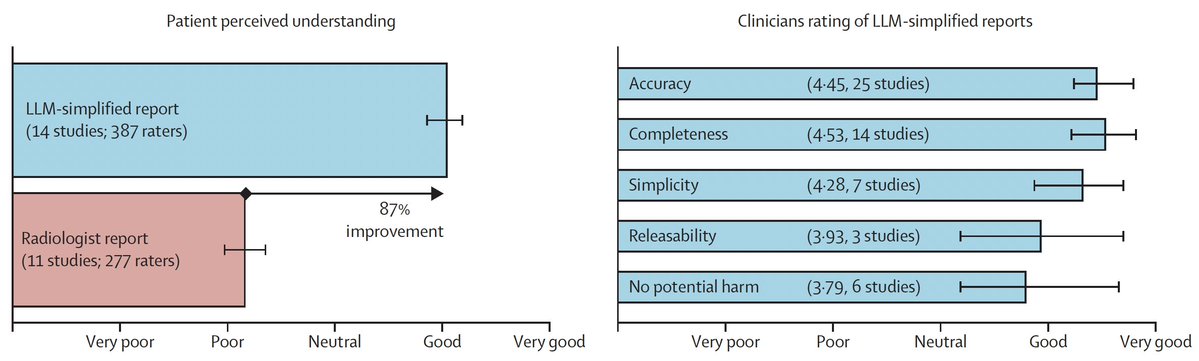
When the LLM rewrites the radiology report, patient understanding is increased and clinical accuracy is maintained. @LancetDigitalH@curtlanglotz@smrabd https://t.co/q2UHebBQG7
Ever tried reading your own CT or MRI scan report? Found it confusing?
AI can rewrite it into plain language. In 38 studies, patients say it helps and clinicians say it’s accurate but ~1% had significant errors.
The future of radiology communication?
Out today @LancetDigitalH
Calling all radiology and cardiology trainees. Don't miss out on joining the only imaging society that encompasses all of cardiac imaging. Join by filling out this form 👉🏼 https://t.co/PnNsB4PwZi?
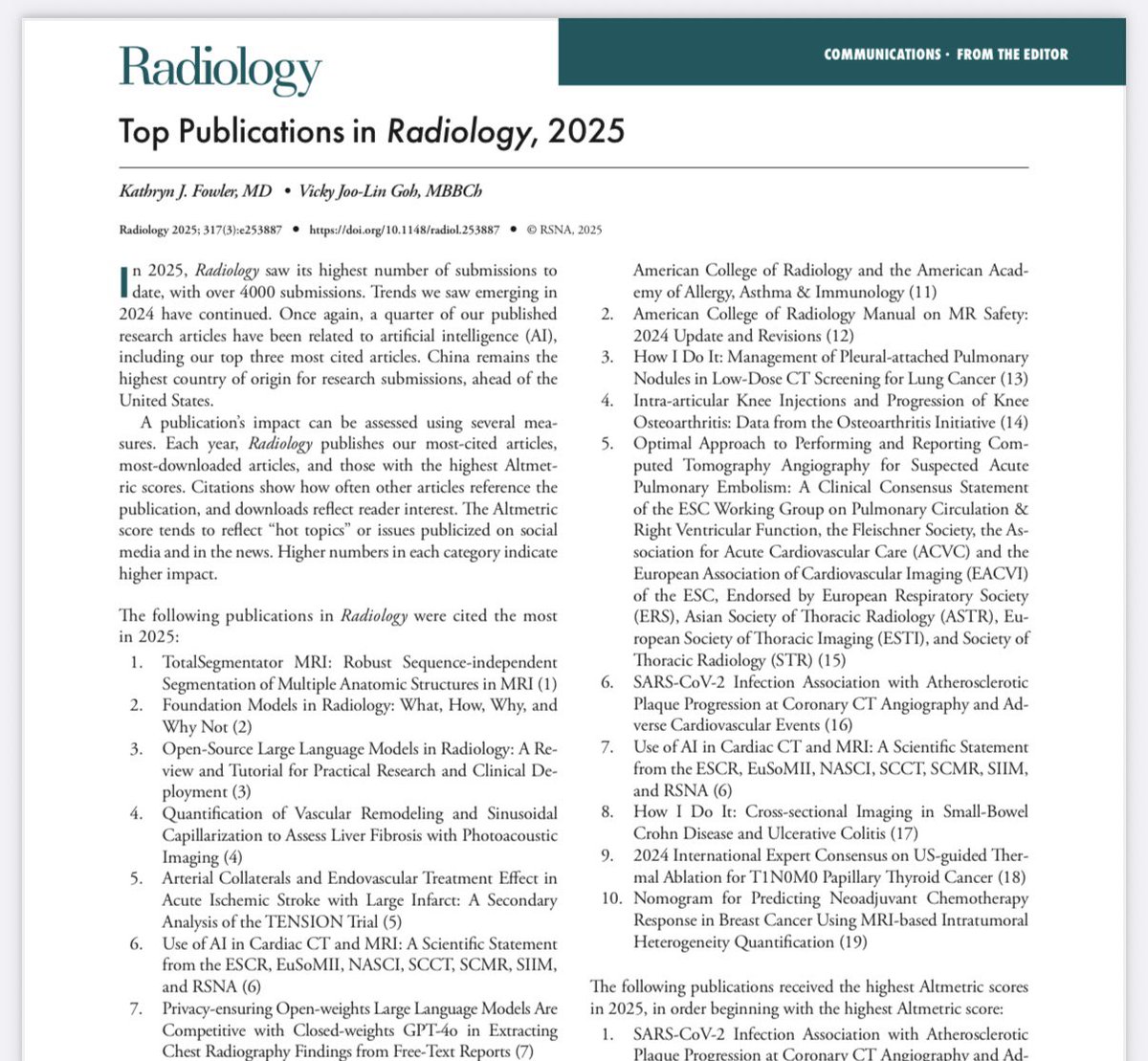
The annual @radiology_rsna Top Publications list is always a highlight! Thrilled two of our papers are recognized this year 😊
🔗 https://t.co/LyTPZroErd AI in cardiac CT/MRI
🔗 https://t.co/7ratuuTU7u Air pollution and fibrosis
Looking forward to another wonderful year ahead!✨
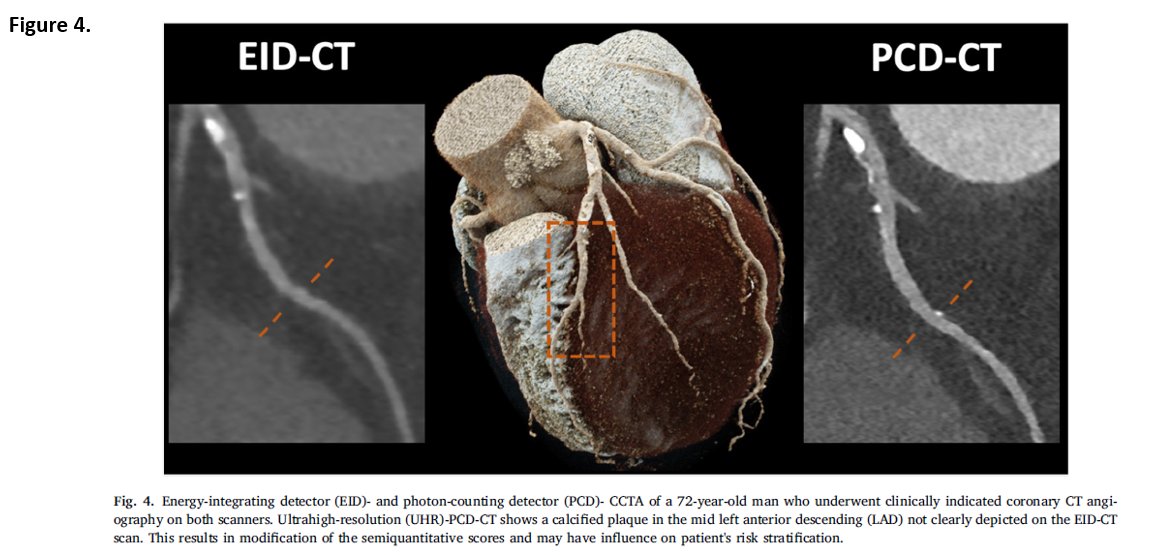
Tremamunno et al show that ultra–high-resolution photon-counting CT (PCD-CT) detects more plaques but less stenosis than EID-CT, reclassifying >50% of patients to lower CAD-RADS. PCD-CT doesn’t just sharpen images—it changes interpretation.
https://t.co/ITaxBNCV22
What's the best AI model for medical advice? Most evals focus on accuracy; we benchmarked harm
First, do NOHARM: 100 real cases, 12k+ expert ratings
Preprint: https://t.co/1i5DnWPDMY
Interactive leaderboard: https://t.co/ISt9PoML32
Proud to share First Do NOHARM, the first medical AI benchmark created and named in the spirit of medicine's foundational principle.
2/3 of US clinicians and millions of patients use AI every day. But how often does AI advice actually harm patients?
We built NOHARM to find out. Using 100 real clinical cases across 10 specialties, with 12,747 expert annotations, we measured harm frequency and severity from 31 LLMs.
What we found:
- Severe harm occurs in up to 1 of 5 of cases
- 77% of serious errors are sins of omission, failing to recommend critical actions
- Existing AI benchmarks poorly predict clinical safety
- Multi-agent systems can substantially reduce harm
- The best models outperform human generalist physicians on safety
The uncomfortable truth: models tuned for caution can paradoxically increase harm by missing essential recommendations. And doing nothing is worse than every AI we tested.
As AI moves from documentation to clinical decisions, we need explicit safety measurement, not just accuracy scores.
Honored to have been part of this groundbreaking work by our ARiSE Healthcare Network team at @StanfordMed and @harvardmed, which is just the beginning, as we develop a full suite of realistic clinical benchmarks we are calling MAST: Medical AI Superintelligence Test that medical AI developers can use to evaluate the real-world clinical performance and safety of their own models. Reach out if you are interested in testing your model!
I particularly enjoyed building this beautiful interactive leaderboard with @DavidWuMDPhD, Ethan Goh, Joel Koh, Emily Tat, Augustine Chemparathy, Adi Badhwar and Kanav Chopra, which you can use to explore our results, comparing solo models as well as multi-agent teams across many harm and safety metrics.
Deeply grateful to @jonc101x for his mentorship and for making this work possible.
Leaderboard and paper: https://t.co/X59PYNNO1R
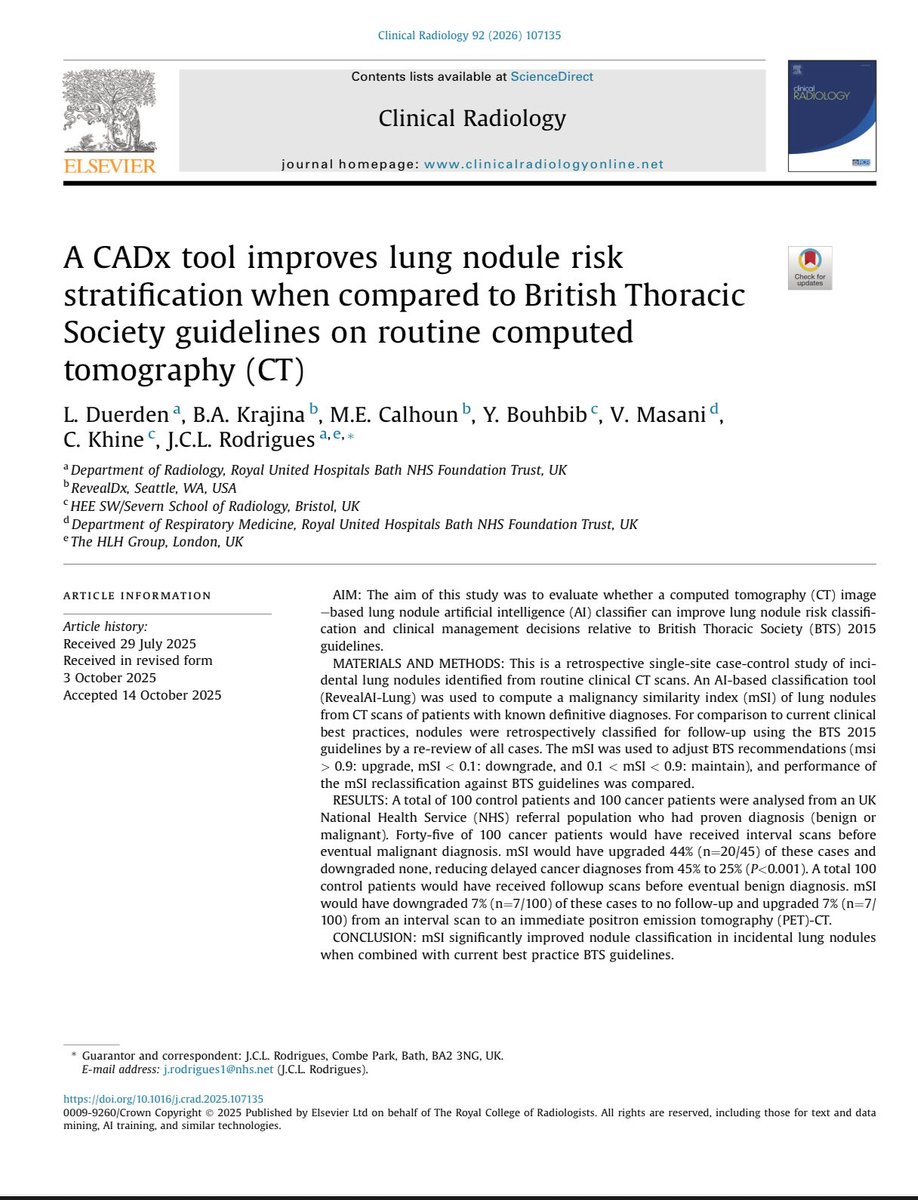
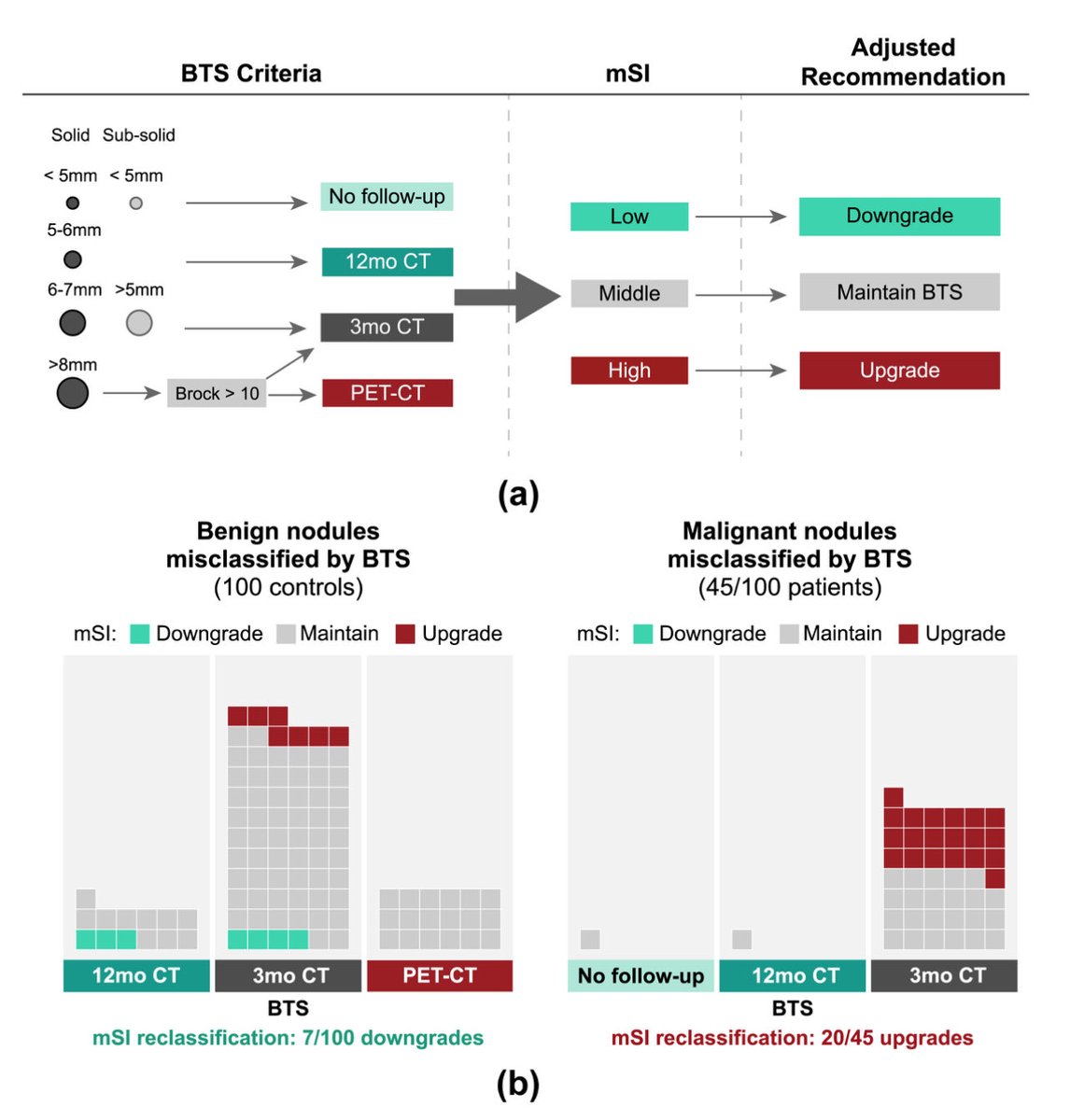
Our latest paper in @RCRadiologists@ClinRadiology explores the role of a malignancy similarity index AI in addition to @BTSrespiratory guidance for management of pulmonary nodules. Full link: https://t.co/NkeOLAU8LI
Next online webinar
Tuesday, 25th Nov 2025 between 6 p.m - 7 p.m
Title: Imaging cardiac implantable electronic devices and associated complications with Xray and CT
Speaker: Dr Giulia Benedetti, Consultant Cardiothoracic Radiologist, Guy's and St Thomas' NHS Foundation Trust
Three year fully funded fellowship for those in the "Transition to Independence" stage of their clinician scientist career. Either side of CCT date. We'll give you the support you need for a competitive fellowship in cardiovascular imaging / AI. #whyCMR https://t.co/sV3ZUIfBz1
Are you considering applying for Clinical Radiology ST1 or Nuclear Medicine ST3 in 2026?
I recommend you watch this video on the recruitment process. @NHSEngland@RCRadiologists
https://t.co/bVMsBvt6bJ
Exciting news 🎉
Bookings are now open for the return of the #RCRGlobalAI conference on 29-30 June 2026!
Join us as we focus on safe and practical AI implementation in healthcare.
Register at super early bird rates and help us shape what comes next: https://t.co/QNNeT9jIsM
📣 📣 Exciting opportunity to join the amazing Radiology team at Royal Papworth Hospital in Cambridge 🤩
For multimodality imaging in thoracic oncology, ILD, TAVI, ACHD, valve, pulmonary HTN, cardiomyopathy, transplant & critical care. Apply now! ⬇️
https://t.co/Lvl4gqlnap
Listen to our next InAMinute series about an article recently published in @RadiologyCTI on Cardiac MRI reference ranges for cardiovascular function during exercise.
Don’t miss our next webinar
………Cardio-oncology……….
which takes place in July‼️ Details below. 👀
Free registration for all @bscmr members is now open using the link below. ⬇️
https://t.co/Db23U4Z81Z