Australia is proposing a 2.25% tax on major tech platforms like Meta, Google, and TikTok unless they reach agreements to pay local media companies for using their content. This move is designed to ensure that tech giants contribute fairly to the news ecosystem they benefit from. Under the draft legislation, the tax would take effect in the 2025–26 financial year.
Watch: https://t.co/tPOeNd1nbC
#Australia #BigTech #Meta #Google #TikTok #MediaDeals #TechTax #CNBCTV18Digital
“To be successful at anything, you don’t have to be special. You just have to be what most people aren’t: consistent, determined and willing to work for it. No shortcuts.”
— Tom Brady
Mark Cuban just described the largest wealth transfer of the AI era.
Almost nobody understood what he said.
Cuban: “There are 33 million companies in this country. Aren’t going to have AI budgets. Aren’t going to have AI experts.”
Not tech startups.
The shoe store. The regional trucking outfit. The accounting firm with 12 employees.
The businesses that actually run the physical economy.
They know AI is coming. They have no idea what to do with it.
Cuban: “You’ve got the head of Microsoft saying software is dead because everything’s going to be customized to your unique utilization.”
Software is dead.
The SaaS era ran on one rule. Build a generic product. Force millions of companies to bend their workflows around it. Charge rent forever.
AI ends the contract.
The business stops bending to the software. The intelligence bends to the business.
But customized by whom.
The third-generation manufacturer cannot tell Claude from Gemini. The county hospital is staring at a reactor asking where the light switch is.
Cuban: “Who’s going to do it for them?”
That question is worth more than the frontier models themselves.
Hundreds of billions are being burned to build the foundation. The smartest engineers alive are locked in a bloodbath over who owns the base layer.
Let them fight.
Let them burn the capital. Let them drive the cost of raw intelligence toward zero.
Because the wealth does not collect where the brain is built.
It collects where the brain meets the business.
Every ambitious kid in college right now thinks survival means a seat at OpenAI or Anthropic.
Cuban is staring at the other 99 percent of the economy.
Learn the models. Then learn the messy, unglamorous reality of how a 50-person company actually operates.
Walk through the door. Understand their problems. Wire the intelligence directly into their revenue.
That is not a job title. That is an entire economic class being born.
You do not need to build the brain. You need to build the nervous system.
The biggest winners of the electricity era were not the engineers who built the generators. They were the ones who walked into dark factories and showed the owners where to plug in.
33 million companies are standing in the dark right now.
Silicon Valley is racing to build the god. The fortunes will belong to whoever teaches him a trade.
My daughter turned thirteen this year. Which means she is now old enough to go out on her own, school-supervised excursions (the bus drops her back at school at 7), or hang out with friends at the mall. I am the parent-Uber, pulling up to the entrance and watching her disappear into the crowd without a backward glance. Then my wife and I enter the mall and just "casually" shop around, being careful not to run into my daughter, because that would be embarrassing for her in front of her friends and embarrassing for me, since I said I would be going back home.
This means my transformation into my own parents has hastened. I have tools my mother did not have, chief among them the location of my daughter's phone, which she believes I have turned on for "the day", but which is actually on "indefinitely".
I tell her to be careful crossing the street, not to get into any trouble, not to lose her money, and definitely not the phone.
But more than the worry, I am happy. For so long, she has seen the world through us, going where we went, eating what we ate, following the decisions we took. Her map was our map. Now her world is slowly diverging from ours, text by text, inside joke by inside joke. And I am happy that it is so, for that is how it has been.
I am sad too. For I know what this is: the beginning of her moving away. The only thing I can do is to close my eyes, be mindful of it all, and recognize the value of every moment that I have with her, before they, too, are gone, till all I will have left are memories in an empty nest.
But most of all, I am thankful. I am thankful for this precise bittersweet emotion, of proudly watching my child slowly fluttering her wings, waiting to fly, knowing that she will meet headwinds along the way, but that she will find her way still, riding the slipstreams, and make her own nest somewhere, and then track locations of her own.
Because love, it turns out, is a blue dot on a map through space and time.
The strength of India Inc. will be shaped by how inclusively it grows.
Sunil Kant Munjal (Hero Enterprise) will take the stage at the Future Female Forward Launch Gala to share why equity is central to building resilient, future-ready enterprises.
Watch him LIVE on CNBC-TV18 | 23rd April, 5:00 PM onwards! Tune-in!
@HSBC_IN | @Cognizant
#FutureFemaleForward #FFFSeason4 #EquityMatters #PowerOfEquity #FFF #empowerment #parity #Progress #Nation #markets #equity #FFF4
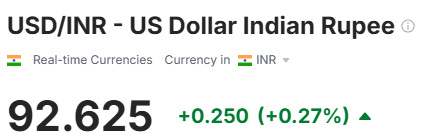
Rupee @ new lows !
Reports earlier suggested that the RBI may have spent $18-20 billion in a single week to absorb the USD demand..
Relentless demand !
#IranWar#Trump#Nifty#BankNifty@CNBCTV18News
@DaikinIndia such pathetic response to customer issues. No update. No calls. No recourse. Your dealers are equally bad. Stuck with an “in warranty” air conditioner that you are neither repairing nor replacing. So so so disappointing. Complete customer harassment.
@DaikinIndia horrible service of products within the warranty period and your service center staff is clueless and rude and inefficient. Absolutely disappointed and will never buy @DaikinIndia products again.
We seemed to be waging a war against education, literacy and scientific temper. This is no way to become a Vishwaguru or reap our demographic dividend!
The North vs South divide in the approach clearly shows the priorities. Watch..
#BudgetWithCNBCTV18 | Samir Arora (@isamirarora) of Helios Capital (@IndiaHelios) shares his first reaction to #Budget2026
‘#India grossly underperforming. No story to tell if the market goes down 2% on a Sunday, Expect #Rupee to fall tomorrow’
#PostBudget#PostBudgetAnalysis #Budget2026 #UnionBudget #UnionBudget2026 #ReformPerformTransform #ViksitBharat #BudgetSession2026 #ViksitBharatBudget #ViksitBharat2047 #CNBCTV18Marke
A single platform. Many perspectives. One Budget.
CNBC-TV18 Budget Vision 2026 brings together India’s leading business and policy voices to articulate expectations from Budget 2026. Catch the conversation live from 10 AM onwards on CNBC-TV18’s YouTube channel -
https://t.co/0SUMWO4Gn1
#CNBCTV18BudgetVision #WhatIndiaWants #UnionBudget #CNBCTV18 #Budget2026 #BudgetTownhall #BudgetWithCNBCTV18
Last one on this topic, and I have been holding this in myself for a while.
For centuries, class divides kept the labor of the poor invisible to the rich. Factory workers toiled behind walls, farmers in distant fields, domestic help in backrooms. The wealthy consumed the fruits of that labor without ever seeing the faces or the fatigue behind it. No direct encounter, no personal guilt.
The gig economy shattered that invisibility, at unprecedented scale.
Suddenly, the poor aren't hidden away. They're at your doorstep: the delivery partner handing over your ₹1000+ biryani, late-night groceries, or quick-commerce essentials. You see them in the rain, heat, traffic, often on borrowed bikes, working 8–10 hours for earnings that give them sustenance. You see their exhaustion, their polite smile masking frustration with life in general.
This is the first time in history at this scale that the working class and consuming class interact face-to-face, transaction after transaction. And that discomfort with our own selves is why we are uncomfortable about the gig economy. We want these people to look our part, so that the guilt we feel while taking orders from them feels less.
We aren't just debating economics. We are confronting guilt. That ₹800 order might equal their entire day's earnings after fuel, bike rent, and app cuts. We tip awkwardly, or avoid eye contact, because the inequality is no longer abstract. It's personal.
Pre-gig era, the rich could enjoy luxury without moral discomfort. Labor was out of sight. Now, every doorbell ring is a reminder of systemic inequality. That's why debates explode. It's not just policy. It's emotional reckoning. Some defend the system (“they choose it”), others demand change (“this isn't progress, its exploitation”).
And here’s the uncomfortable twist: the unsaid ask of clumsy ‘solutions’ isn’t dignity. It is about returning to invisibility.
Ban gig work and you don’t solve inequality. You remove livelihoods. These jobs don’t magically reappear as formal, protected employment the next day. They disappear, or they get pushed back into the informal economy where there are even fewer protections and even less accountability. Over-regulate it until the model breaks, and you achieve the same outcome through paperwork instead of slogans: the work evaporates, prices rise, demand collapses, and the people we claim to protect are the first to lose income.
And then what happens?
The rich get their old comfort back. Convenience returns without faces. Guilt dissolves. We go back to clean abstractions and moral posturing from a distance. The poor don’t become safer, they become invisible again: back in cash economies, back in backrooms, back in shadows where regulation rarely reaches and dignity isn’t even debated.
The gig economy just exposed the reality of inequality to the people who previously had the luxury of not seeing it. The doorbell is not the problem. The question is what we do after opening the door.
Visibility is the price of progress. We can either use this discomfort to build something better (which we keep doing continuously as delivery partners are our backbone), or we can ban and over-regulate our way back into ignorance. One of those choices improves lives. The other simply helps the consuming class feel virtuous in the dark.
In a first, CEOs of all @MahindraRise businesses come together to share the growth map to 2030. @anishshah21 tells me ‘When we started the journey on #growthgems, collectively they were worth ₹8000 crores in March 2020. Today, they're worth ₹56000 crores, which is a 7x growth in a little more than five years. #Mahindra share in them because some of them are listed is ₹48000 crores and the value of our growth gems to Mahindra today is higher than the value of @TechMahindra or @Mahindrafinance. And much of that value is not even captured because analysts don't give too much value to unlisted entities. And that's something that you will see in a value unlocking going forward. Catch the #CNBCTV18Exclusive @CNBCTV18Live@CNBCTV18News #OnTheRecord #MahindraGroup
Top 0.1% of households account for 31% of annual income (wealth effect will be more)
Top 5.1% of households account for 54% of annual income
Per capita income is <$900 for bottom 90% of Indians.