China’s lead in open-weight AI has prompted credible US challengers. Poolside, Thinking Machines and Reflection offer enterprises more control, customization and private deployment. But parameters aren’t performance: they still need to prove results and durable business models.
Chinese open-source models like Kimi, Deepseek and Qwen are now dominant AI tools. American upstarts like Mira Murati’s Thinking Machines, Reflection AI and now Jason Warner’s Poolside are trying to challenge that. https://t.co/4O4FWdlbOn
📸: Big Event Media via Getty Images for HumanX Conference
Anthropic’s $1.5B settlement looks huge, but may be a cheap price for the real win: the court said AI training can be fair use. It paid for pirating the books, not for learning from them. Authors won compensation; Anthropic may have won the economics of AI training.
Goyal’s post-Zomato chapter looks less like a sector thesis and more like moonshot investing. Temple began as a personal health experiment; LAT targets India’s connectivity gaps. His edge isn’t domain expertise, but capital, talent and the freedom to take 0.1% bets.
One of India’s most successful tech billionaires is making his first big bet after stepping down from the food delivery empire he led for 18 years https://t.co/iP1f7DQC1I
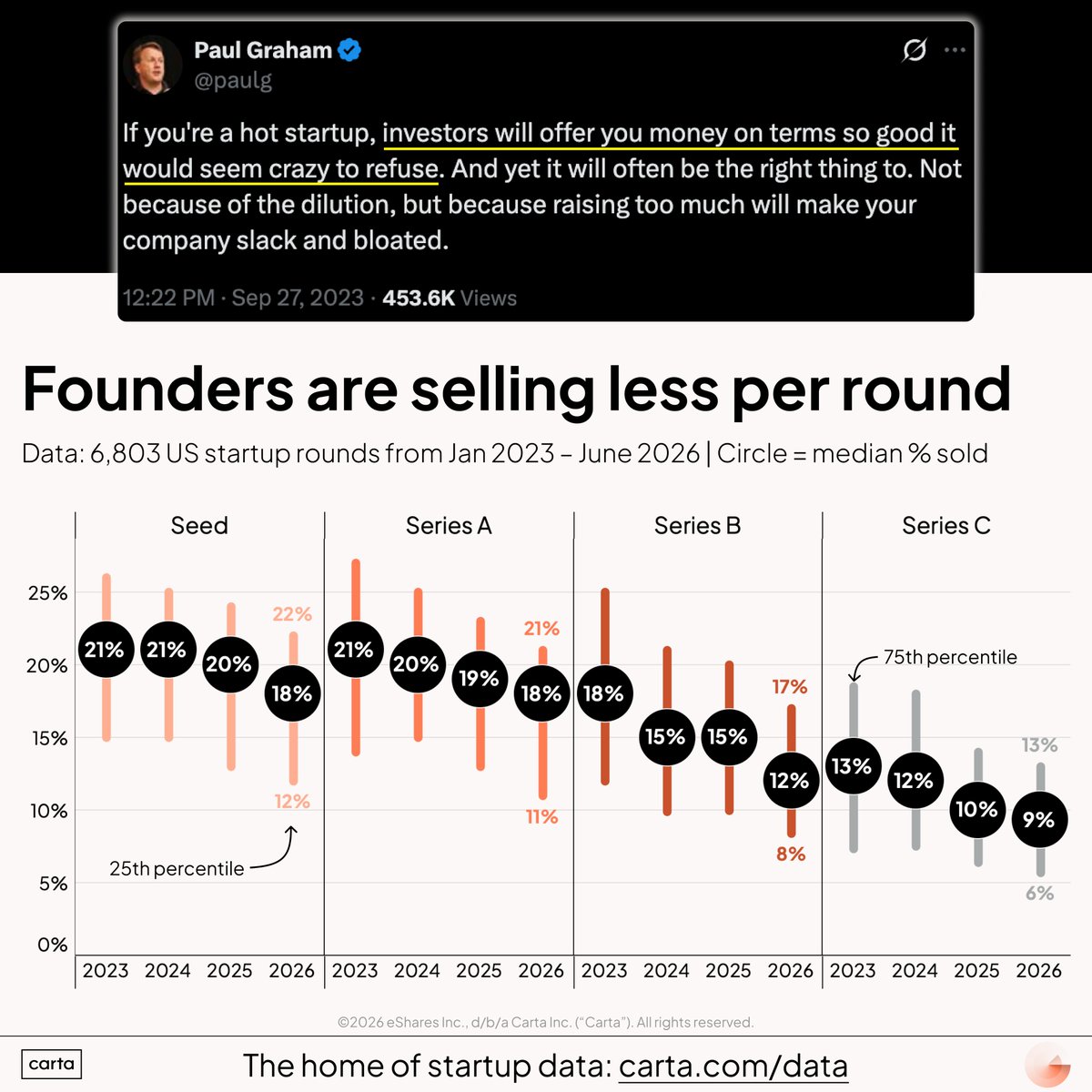
Interesting, but this chart probably flatters the market. It covers 6,803 completed rounds, excluding startups that couldn’t raise, while AI captured >60% of Q1 funding. Series B dilution fell from 18% to 12%, but that may reflect capital concentrating in fewer, pricier winners.
"If you're a hot startup, investors will offer you money on terms so good it would seem crazy to refuse. And yet it will often be the right thing to."
PG posted that in Sept 2023 and the terms have gotten much, much better since then 🤑
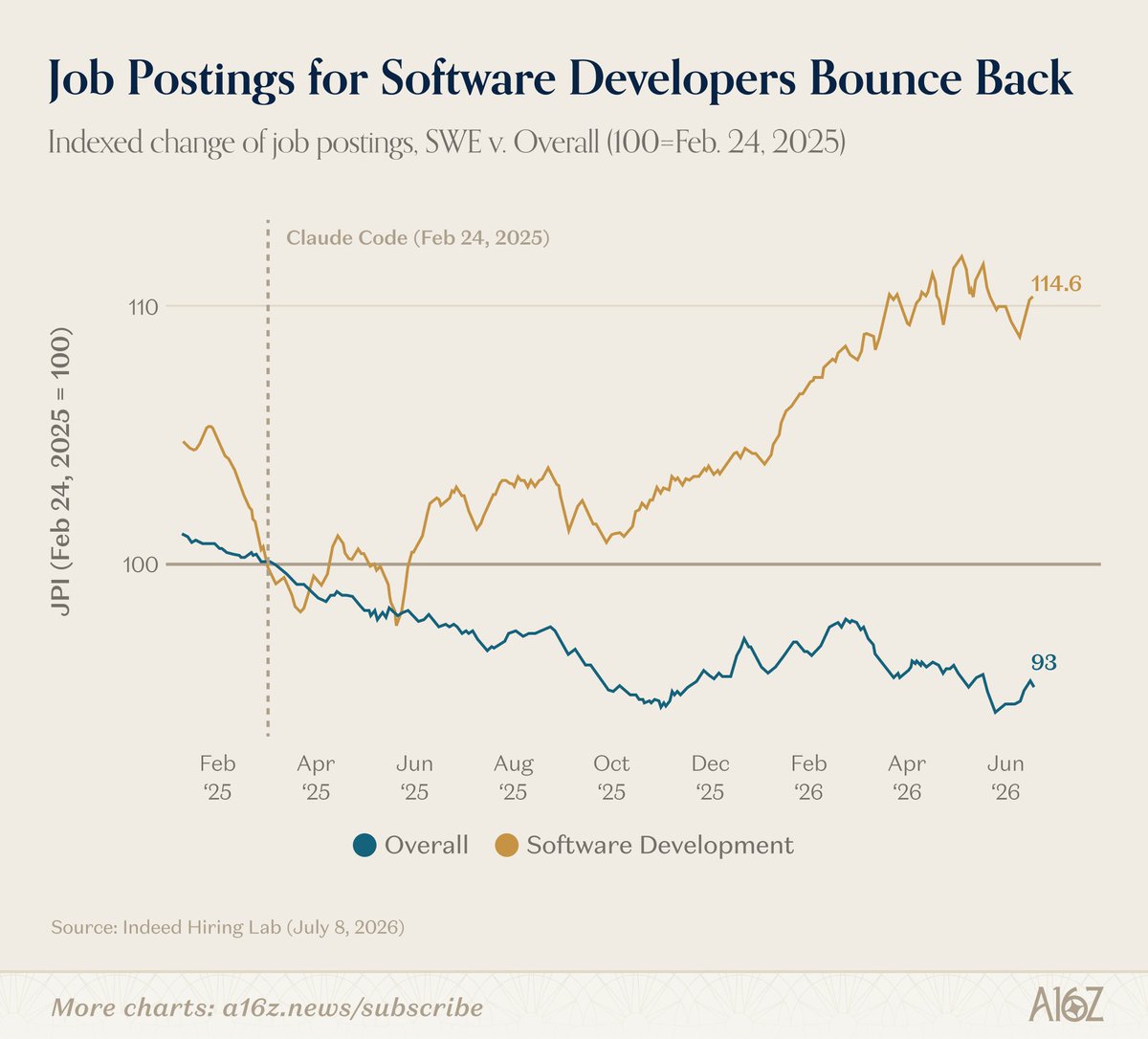
strongest case: software’s sell-off is selective, with vertical SaaS and cyber more AI-defensible. Cheaper AI driving more usage is plausible. But AI causing entry-level hiring is correlational, and data centers causing lower power prices is the weakest claim.
China’s AI labs are turning chip constraints into an optimization challenge. Kimi K3 reportedly trails Sol and Fable overall, but competes in areas like coding and agents. The question is whether better training and open weights can overcome the hardware disadvantage.
Google's moat is owning the stack end to end and distributing AI to billions of existing users. Internet Explorer showed the power of defaults. Costco showed the power of vertical integration. AI may end up rewarding both.
When it comes to artificial intelligence, Google long ago upstaged the maker of the iPhone. It now looks as though it may steal the consumer AI crown from the maker of ChatGPT, as well https://t.co/3mTDK4G4bZ
Fewer seed startups are making it to Series A, and it’s taking longer.
But a 2024 startup hasn’t had the same runway as a 2018 startup, and “no Series A” doesn’t automatically mean failure.
Useful data, but the headline needs cohort-age context.
"Half of seed startups make it to Series A" is just not so.
Ya, sometimes! In some years!
But probably not these days. Venture funding has gotten bigger, more competitive, and less frequent (as in fewer seeds and fewer Series As)
While Big Tech builds closed-source "black boxes," @HuggingFace took a different https://t.co/eE5GA7mYGb @ClemDelangue explains how they built a massive network effect by focusing on community ownership over renting APIs.
https://t.co/4hr4WoQzLQ
Start before you're ready, treat embarrassment as part of the process, choose mentors whose outcomes you'd actually want, and optimize for long-term. Timing, luck, market selection, access to capital, and privilege matter too. But these habits meaningfully improve your odds.
Success looks like luck from the outside. One founder breaks through. Another with the same talent stalls for a decade. Watch the pattern long enough and it stops looking like chance.
Read more: https://t.co/wwb4Y3tCd1
HyperTexting is an elegant UX for the open web. The harder problem isn't building it, it's proving product-market fit. Who adopts it beyond RSS enthusiasts, and how does it become a durable business without owning the platform or the algorithm?
Walmart won the marketing battle before the shopping even began. The basket was built from Walmart's own rollback announcement, yet Kroger still came surprisingly close. Great PR for Walmart!
https://t.co/usQjpJy7ON
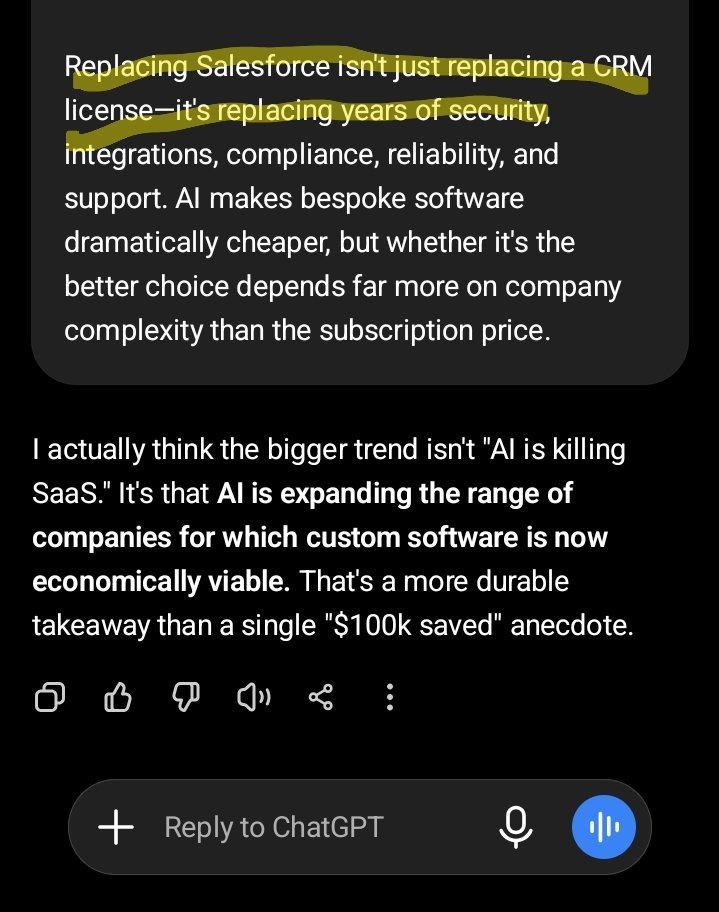
Replacing Salesforce is replacing years of security, integrations, compliance, reliability, and support. AI makes bespoke software dramatically cheaper, but whether it's the better choice depends far more on company complexity than the subscription price.
Hard to tell if releases to the public are just to do with timing with competition or testing with smaller groups first. I guess it isn't hard to tell 🫠
The "passive income" dream is mostly marketing. But AI has made launching a side hustle dramatically easier. Less time building, more time testing ideas.
1 in 4 Americans has a side hustle.
44% of young adults earn income beyond a traditional job. May see more of it.
Today, excited to launch Selix, the AI GTM (Go-To-Market) Engineer.
Selix is a virtual teammate that runs your company's entire outbound end to end, including the planning, sending, and analysis, to build consistent pipeline.
Selix blends software and human.
The result: An entire company's outbound today can be run with one person (even with sales team of 10+).
Super proud of the team on this one.