I built a simple private lending flow last year and it died the moment the contract needed to talk to anything else. Privacy either broke or the whole thing got too slow to use.
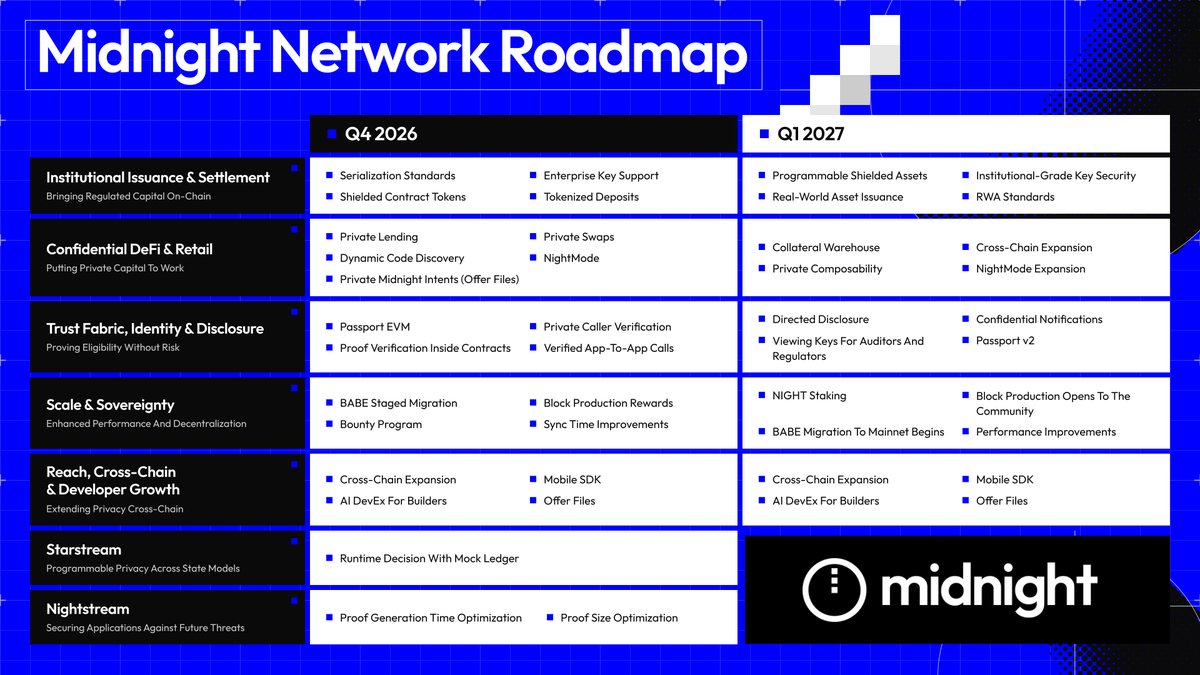
@MidnightNtwrk’s roadmap has seven areas. The confidential DeFi section is the one that has to solve that exact problem. Private lending, private swaps, and collateral that does not broadcast your position or strategy.
If they can keep those flows shielded and still let contracts compose, that is the difference between privacy as a feature and privacy as something you can actually build with.
How far do you think private lending and swaps can go before the proof costs or the UX force people back onto public chains?
What does it take to make privacy practical onchain?
The Midnight roadmap breaks it down across 7 areas of work, from confidential finance and digital identity to cross-chain development and next-generation proving infrastructure.
Here's a deeper dive 🧵👇
https://t.co/rr20pzkLv0
Vladify stays deep in the session, scanning the chart while the stream rolls.
Another hour in the trenches. Another chance to catch the move before everyone else sees it.
#GMGN#GGC#GGCSeason1
AI Agents Are Coming On-Chain: The Quiet Revolution the Market Still Underestimates
While some argue about whether the AI bubble will burst, others are quietly building infrastructure for an economy in which money moves without human involvement. And the October 2026 numbers speak for themselves.
What is happening right now:
🔹 138 million AI-agent payments have passed through the x402 protocol on Base. Total volume — more than $50 million.
🔹 On the XRP Ledger, the number of agent transactions has exceeded 13.4 million — about a quarter of all network activity.
🔹 Coinbase directly calls AI agents the next wave of crypto market growth, and Brian Armstrong predicts that agents will eventually surpass all humans in transaction volume.
Why this is not just hype
The decentralized inference (on-chain inference) market has more than doubled since September. Venice processes 500+ billion tokens per day, Surplus — 300 billion, and Bittensor, after the Null Consensus upgrade, increased the subnet participant limit from 256 to 2,500. Demand for compute for agents is becoming measurable, and this is no longer an abstract narrative bet.
Infrastructure is catching up. NEAR is rebuilding Intents into a “market of markets,” where agents will be able to find, pay for, and receive services autonomously, while BitGo launched BitGo Labs specifically for financial infrastructure for the AI economy — micropayments, instant settlements, and asset protection. BitGo CEO Mike Belshe says directly: agents will use stablecoins as their base currency.
The elephant in the room: capital is still in AI, not crypto
DWF Labs notes an important gap: the market has not fully appreciated the synergy between AI and cryptocurrencies. Cutting-edge capital is flowing into space, robotics, and AI itself, not into crypto infrastructure. Raoul Pal explains the correction precisely by the outflow of funds from crypto into AI stocks, but he also sees the reverse scenario: if the AI rally takes a pause, liquidity may return to digital assets. At the same time, his forecast is 25 billion AI agents by 2027, and even 1% of them with crypto wallets would give 250 million new participants in the economy.
What this means for us
AI agents are not “just another narrative.” This is the first scenario in which cryptocurrency ceases to be an object of speculation and becomes the settlement layer for a machine economy. Ethereum and Solana look like the main beneficiaries: that is where agent activity and smart-contract logic are concentrated. Bitcoin in this story is more of a reserve asset than an operating environment.
But questions remain: will the infrastructure withstand the load, have latency and gas-cost problems been solved, and most importantly — when will institutional capital stop viewing AI and crypto as two separate worlds and see their point of intersection.
While the market argues about a “bubble,” agents are already paying each other. And that is perhaps the most honest signal
The era of 100x traders and short-term pumps is fading.
The next phase of crypto will belong to builders, creators, and communities that create real demand.
And they’re not waiting for the market to catch up.
They’re already shipping.
ethereum:0xe28b3b32b6c345a34ff64674606124dd5aceca30
Everyone asks what the yield is
Fewer people ask who actually holds the balance
@grvt_io is building around self-custody, and the Grvt 2.0 App is scheduled for the end of November. One unified self-custodial balance
Earn is targeting up to 11%. Target, not a guarantee
That's the part I'm curious about. Yield and trading are easy to like on their own. Keeping both inside a balance you hold yourself is a different setup
The app also brings refreshed branding and the 2027 roadmap, so November could be the real reveal
Do you prefer holding your own balance, or is convenience still winning for you?
It's the weekend, guys, and it's time to play football with my guys. But before then, I'll still preach the gospel of @fomopoly_rh as usual.
Fomopoly is an on-chain game where you can buy and sell land.
When you buy and sell land, you also generate stocks and $DEAL tokens.
We're still pretty early on this one. Take action before it's too late.
I'd be checking for the nearest exit, not my K/D. 😂
@JeanPhilMadame has flames in the background and is still locked into CS2 like it's a normal Tuesday.
Bro's priorities are DIFFERENT. @DuelbitsCS2
@_Dripxel@zerufinance What appeals to me is the possibility of developing a business model capable of supporting future innovation.
Financial sustainability could give the vision much greater staying power.
@vlsss12@primus_labs The journey toward meaningful industry influence begins with earning people's confidence.
Demonstrating reliability repeatedly could gradually establish that credibility.
@kurin_dh@Nogasonsui There's a compelling opportunity to transform casual interest into active participation.
Helping users become contributors could reshape the project's entire growth trajectory.
@RimonCz@fomopoly_rh believe one of the biggest opportunities lies in developing products that people continue finding useful years later.
That kind of durability could support a remarkable legacy.
@OBAxbt The possibility of reaching institutions and larger organizations introduces another exciting dimension.
Enterprise adoption, if achieved, could open valuable opportunities for expansion.
@0xfrigg@grvt_io There's something encouraging about the prospect of turning technical innovation into everyday convenience.
Making sophisticated capabilities approachable could create widespread appeal.
@Oluwajuwon2169@waxumfriendly@Duelbits I'm particularly interested in the possibility of developing an ecosystem where different products strengthen one another.
That interconnected structure could create advantages beyond any individual offering.
@Vogscrypyo The opportunity to build a recognizable presence across multiple sectors is fascinating.
Careful diversification could eventually broaden the project's economic reach
@yocodedx A respected reputation can become one of the most valuable assets any venture possesses.
Earning that recognition through performance could transform this project's future.
@BI3SS3 I see exciting possibilities in empowering smaller communities with tools previously available only to major players.
Making those capabilities accessible could create an entirely new growth opportunity.
@1nxnn__@vangrid_io The most impressive achievements often come from repeatedly exceeding expectations.
Delivering meaningful improvements could gradually establish this initiative as a serious contender.
@talukder780@grvt_io I'm optimistic about the possibility of this project becoming something people reference as an example of successful innovation.
Reaching that level would make the entire development journey worth celebrating.