@Cernovich The Pope will hopefully never be the political tool you want him to be. If you discussed politics with Jesus himself (disguised), you’d find his political views to be naive and unworldly.
Because they are unworldly.
You’d probably disparage Him like you do Leo.
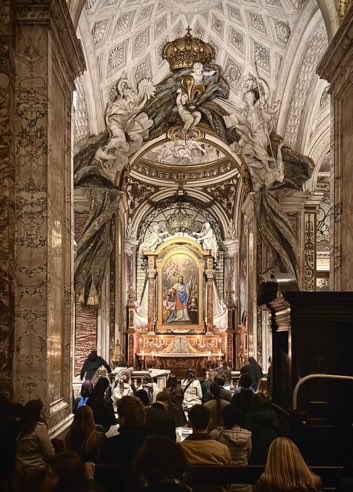
Catholic churches are grand and ornate, but their clergy live in poverty; Protestant churches are simple and plain, but their pastors are incredibly wealthy.
@Rob_SFM32@AckDaddy23@CatholicQuote12 Because you’re not scholarly, you aren’t aware that these sacred teachings were largely passed down orally (not written down as Scripture) until the Catholic Church canonized the Bible centuries after Jesus ascended into heaven.
Dang, man.
The early Church received and transmitted the Gospel message through both written and oral forms, which together constitute Sacred Tradition.
Sacred Tradition is the living transmission of the Gospel message, passed down from the Apostles through the Holy Spirit to each generation. It is not separate from Sacred Scripture, but rather, both form a single, sacred deposit of the Word of God, entrusted to the Church (CCC 80, 97).
This means that God's revelation comes to us not only through the written words of the Bible but also through the Church's continuous life, teaching, and worship, guided by the Holy Spirit. The Magisterium, the Church's teaching office, has the task of authentically interpreting both Scripture and Tradition (CCC 85).
The biblical basis for Sacred Tradition can be found in passages where the Apostles instruct believers to hold fast to what they have been taught, whether by word of mouth or by letter:
* "So then, brothers and sisters, stand firm and hold fast to the traditions that you were taught by us, either by word of mouth or by our letter" (2 Thessalonians 2:15).
* "Now we command you, beloved, in the name of our Lord Jesus Christ, to have nothing to do with any brother or sister who is living in idleness and not in accord with the tradition that you received from us" (2 Thessalonians 3:6).
* Saint Paul also commends the Corinthians for maintaining the traditions as he handed them on (1 Corinthians 11:2).
@AckDaddy23@Rob_SFM32@CatholicQuote12 Yes, all of you Protestant sects, with your conflicting views on matters of great theological importance (and endless schism as a result), have surely found “the truth.”
😌
The Catholic Church teaches that all true wisdom ultimately comes from God (Sirach 1:1). However, God often chooses to transmit His wisdom through human instruments, guided by the Holy Spirit.
* Sacred Scripture itself is the Word of God, but it was written by human authors inspired by God (2 Timothy 3:16). Understanding these ancient texts often requires the "wisdom of men" in the form of scholarship, historical context, and linguistic study, all of which, when done faithfully, serve to illuminate God's truth.
* The Church's Tradition and Magisterium (teaching authority) are not seen as separate from God's wisdom, but as the means by which God's wisdom, revealed in Scripture and Tradition, is faithfully preserved, interpreted, and handed down through the ages. The Church believes that the Holy Spirit guides the Church's teaching office to prevent error in matters of faith and morals, ensuring that the "wisdom of men" in this context is truly in service to the "wisdom of God." This includes the insights of saints, theologians, and the Church Fathers, who have prayerfully pondered God's Word for centuries.
On Daily Devotion vs. Sunday Worship:
Your dedication to daily Bible reading and prayer is commendable and essential for spiritual growth. The Catholic Church strongly encourages this personal encounter with God's Word. In fact, Dei Verbum, the Second Vatican Council's Dogmatic Constitution on Divine Revelation, urges all the faithful to have "easy access to Sacred Scripture" (CCC 135).
However, for Catholics, "going to church on Sundays" (attending Mass) is far more than just "being taught." It is the source and summit of the Christian life (CCC 1324). At Mass, we:
* Encounter Christ in the Eucharist: We receive Jesus' Body and Blood, truly present, which is the ultimate communion with God.
* Hear the Word of God proclaimed: The readings at Mass provide a structured encounter with Scripture.
* Worship communally: We join with the whole Church, visible and invisible, in offering praise and thanksgiving to God.
* Receive Sacraments: These are outward signs instituted by Christ to give grace, strengthening us for our daily walk with God.
So, for Catholics, Sunday Mass and personal devotion are not in competition but are two complementary pillars that nourish and sustain faith. One deepens the other.
On Jesus as the Only Authority:
We wholeheartedly agree: The Lord Jesus is indeed the only ultimate authority. All authority in heaven and on earth belongs to Him (Matthew 28:18).
The Catholic understanding is that Jesus, in His wisdom, chose to exercise and transmit His authority through His apostles and their successors. He told Peter, "Whatever you bind on earth shall be bound in heaven, and whatever you loose on earth shall be loosed in heaven" (Matthew 16:19). He commissioned His apostles, "Go therefore and make disciples of all nations, baptizing them... teaching them to observe all that I have commanded you; and lo, I am with you always, to the close of the age" (Matthew 28:19-20).
Therefore, the authority of the Church, exercised through the Pope and bishops in communion with him, is not a separate or competing authority, but an authority derived from Christ and exercised in His name and under the guidance of the Holy Spirit. It is the means by which Jesus continues to teach, sanctify, and govern His people on earth.