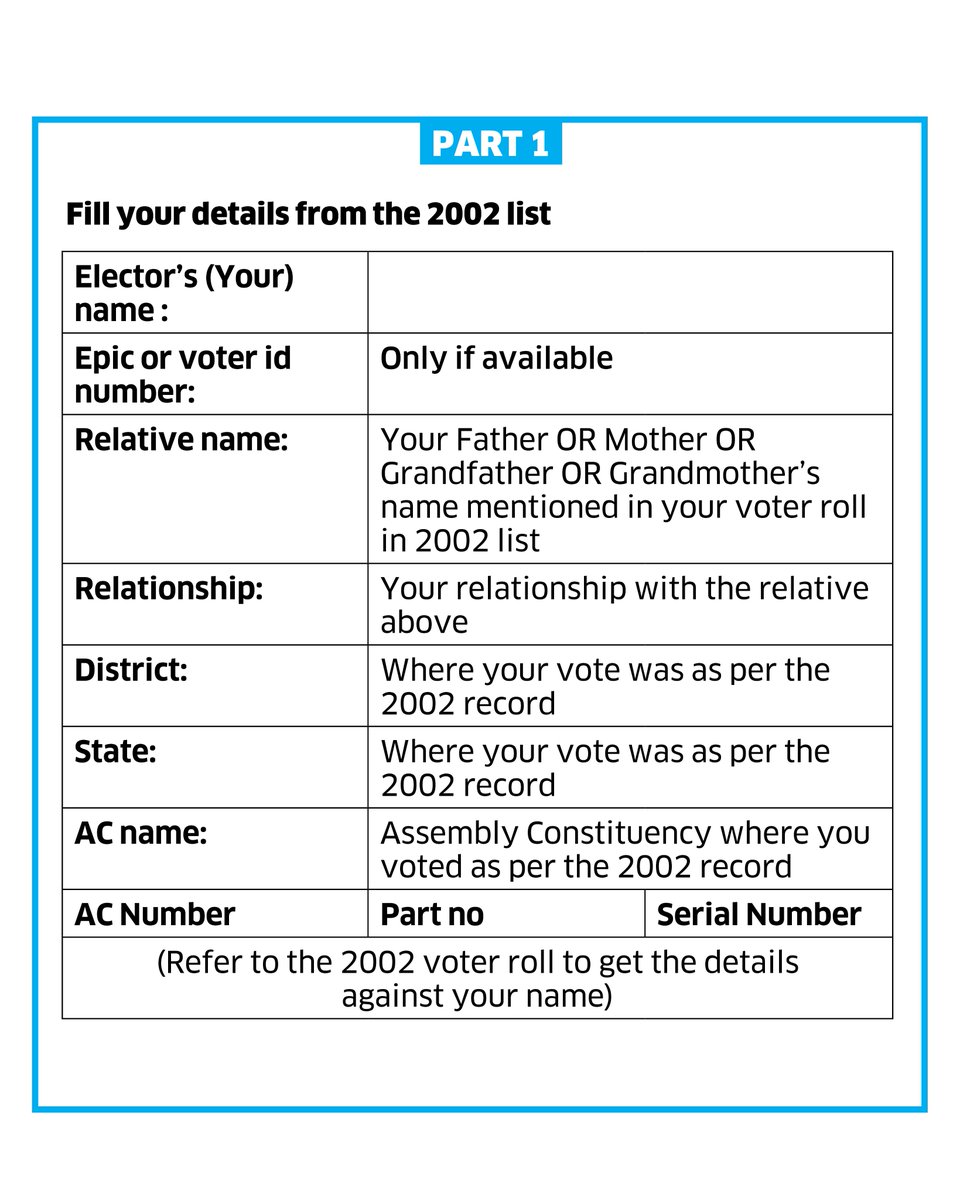
Confused about the Election Commission's Special Intensive Revision (SIR) process? We've got you covered. 📋
Deccan Herald brings you a simple, step-by-step guide to filling the SIR enumeration form - Offline. Know what documents you need, how to fill the form correctly, and avoid common mistakes.
#SIR #VoterList #ElectionCommission #VoterRegistration #DeccanHerald
Check next post for Online process
(1/2)
Meet Priyanka Arul Mohan probably lives in Hyderabad/Chennai
She did numerous Tamil & Telugu films since from her debut
Never acted even in any Kannada ad or short films. Yet, she speaks fluent Kannada. Though she was surrounded by other languages
On Wednesday morning Sinoj, who runs a lottery shop at Kochi developed severe chest pain while driving himself to a hospital. As traffic came to a standstill, he collapsed inside the car.
Two nurses - Anjali Baiju and Ardra Raj, who were travelling in a bus, noticed the commotion on the roadside. They immediately got off the bus, rushed to the car and began cardiopulmonary resuscitation (CPR).
A passer by Ranjith, took over the car and drove Sinoj to the hospital. The two nurses continued CPR inside the vehicle until Sinoj reached a hospital.
Doctors said he had regained signs of recovery by the time he arrived.
Respect to the two sisters. God bless
This truly made my day
Gandhi Bazaar footpath, 24-06-2026, 7:29 PM CCTV:
Karnataka High Court orders?
Minister @krishnabgowda sir announced scientific approach + enforcement.
Ground reality:
Food truck enters footpath at 7:29 PM. Blocks pedestrian space.
Operates till 11:45 PM. Residents opposite live with noise, smoke, safety risk 4+ hours daily.
The TRUTH pedestrians face daily:
1. HC orders exist, no action at night @basvanguditrfps@Basavanagudibcp
2. Minister’s voice not translated to police station too action
3. "Wait till July 1" is being used to ignore court orders TODAY
This is NOT just Gandhi Bazaar.
From #Jayanagar to #Koramangala , #Malleshwaram to #Indiranagar - same story across Bengaluru:
Orders on paper. Violations on footpath. Citizens on road.
@Jointcptraffic@CPBlr@DgpKarnataka
Pedestrian safety + court dignity can’t wait.
@osd_cmkarnataka@GBAChiefComm we need enforcement, not excuses.
@acpsouthtrf@DCPSouthTrBCP@DCPSouthBCP@blrcitytraffic@BlrCityPolice
@blrprajavedike
#FootpathForPeople #WalkableBengaluru #KarnatakaHC #RuleOfLaw
I grew up on Bangalore’s Brunton Cross Road.
I still live on the same road.
When I first came here as a 15-year-old beginning college in 1966, it was one of the most beautiful streets in the city. Tree-lined, shaded, peaceful. Bungalows stood amid gardens. There were pavements one could actually walk on. It was a residential neighbourhood, not a traffic corridor.
Today, almost every bungalow has disappeared, replaced by apartment blocks. The gardens are gone. The road has become a two-way thoroughfare carrying a relentless stream of vehicles. What was once a neighbourhood has become an artery.
The photographs below tell the rest of the story.
Broken pavements. Open drains. Excavated roads. Construction debris left strewn about. Garbage accumulating around work sites. Hazardous walkways. Traffic forced through improvised bottlenecks. Senior citizens pick their way through rubble simply to cross the street.
For more than a year, the authorities have ostensibly been repairing the road and drainage infrastructure. Yet the result has been months of disruption, chaos and inconvenience with little visible evidence of systematic planning or timely execution.
The issue is not that roads need repair. Every city requires maintenance. The issue is how it is done.
Why are roads dug up and left exposed for weeks and months? Why are drains left uncovered? Why are pedestrians treated as an afterthought? Why are debris allowed to remain on public land? Why are traffic diversions so poorly managed? Why is there no visible sense of sequencing, coordination or accountability?
These are not problems of poverty.
They are problems of governance.
India’s urban crisis is often discussed in terms of infrastructure deficits, but what I see outside my own front gate is something more basic: a deficit of civic management.
We build flyovers, metro lines and technology parks, yet struggle to maintain a pavement.
We speak of becoming a developed country, yet tolerate public spaces that would be unacceptable in much poorer societies.
This is why comments from outsiders such as Peter Thiel, however provocative, sometimes strike a nerve. When he describes India as “messed-up”, many of us instinctively object. Yet standing on Brunton Cross Road amid broken concrete, open trenches and unregulated traffic, one cannot entirely dismiss the criticism.
The uncomfortable truth is that our cities often function despite the system rather than because of it.
What is especially frustrating is that the solutions are neither revolutionary nor prohibitively expensive.
Road projects should be coordinated and completed within fixed timelines.
Pavements should be continuous, safe and accessible.
Residential roads should be protected from becoming uncontrolled traffic corridors.
Traffic rules should be enforced.
Construction waste should be removed immediately.
Public infrastructure should be maintained before it collapses rather than repaired after it does.
Most importantly, citizens should not have to negotiate danger merely to walk down their own street.
The decline of roads like Brunton Cross Road is not simply about nostalgia for a vanished Bangalore. Cities change. Growth is inevitable.
But growth without planning produces disorder. Development without civic discipline produces dysfunction.
A city is not measured only by the value of its real estate, the number of its startups, or the sophistication of its technology sector. It is measured by the quality of everyday life it offers its residents.
Bangalore still possesses extraordinary strengths: talent, enterprise, creativity, greenery and a climate most cities would envy.
What it increasingly lacks is the orderly civic management that allows those strengths to flourish.
Looking at these scenes outside my home, I cannot help but wonder: when did we begin to accept disorder as normal?
And more importantly, when will we decide that we deserve better? #Bengaluru #UrbanIndia #CityPlanning