We had similar (better under GRH) factoring results a few weeks before Google's release yesterday (didn't think it was that important back then😅). Our GPT-6 Astra-based agent proved unconditional integer factorization in L_N[1/3,O(1)] time (albeit with a huge constant). Moreover, using Generalized Riemann Hypothesis for Dirichlet L-functions (most believe it's proven by Alpöge and Claude anyway), we got a provable L_N[1/3, 2.97] bound. That's 2.97 vs Google's 105, and nearly matches the heuristic bound, finally bridging theory and practice.
Manuscript: https://t.co/XeQ1DkzAql
This note from Bao Chau Ngo (Fields Medal 2010, Clay Research Award) on Alpoge's work for Riemann is incredible. It's rare to see a mathematician of his caliber with such an open mind about AI.
I'm somewhat baffled by the responses Alpöge is getting here. Are people confusing real scientists with celebrity scientists? Do they expect him to wear a suit and act self-importantly?
As you read the history of science, one of the first things you notice is that people who do important things don't act like C-level executives, to put it mildly. Maybe this era of physicists who are famous for doing nothing made people believe that's how Newton or Galois or Erdős would behave if they were alive.
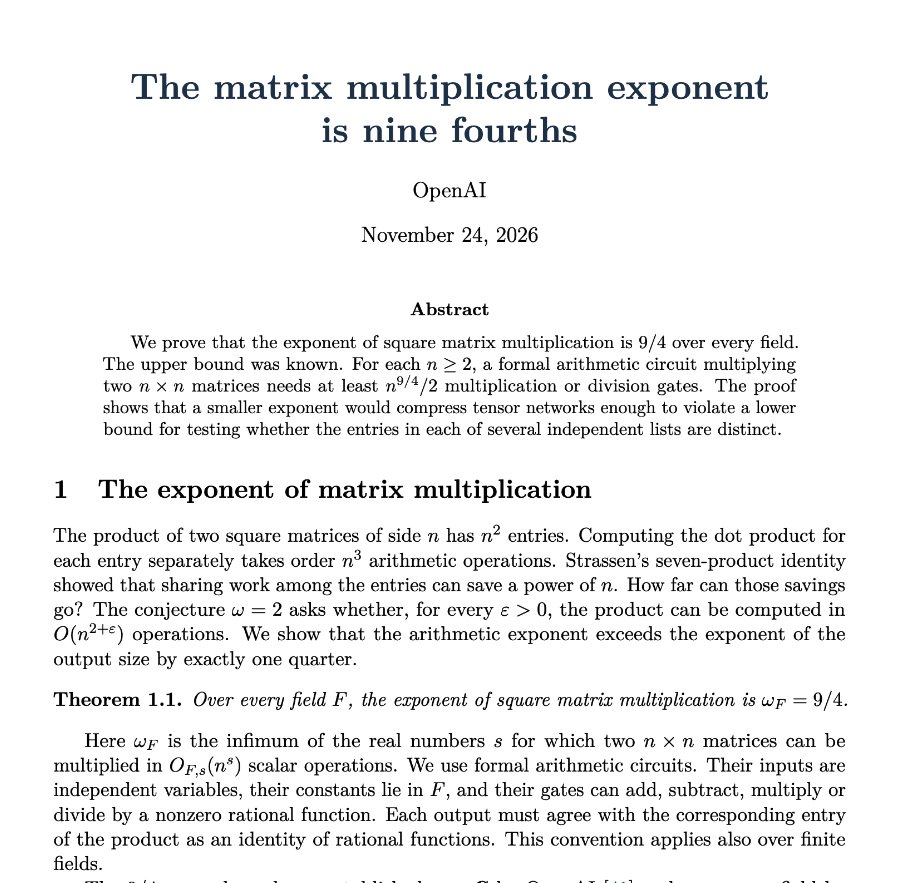
OpenAI claims the matrix multiplication exponent is exactly 2.25
The textbook method for multiplying two n × n matrices takes roughly n³ arithmetic operations. In October, OpenAI reported a way to bring the exponent down to 2.25. That left open whether someone could find an even faster algorithm
Today’s paper claims to rule out every exponent below 2.25
Read here: https://t.co/GXn451OiYf