Wharton Professor; Born & Bred in 905/519/734/215; One of Many Aspiring Canadian Hip-Hop Artists w/out Auto-Tune. Studying how we respond to adversity at work.
Excited to share my work on how to achieve success when you're an underdog at work. Thankful to all of my colleagues, friends and family who have supported me as I pursued this research over 7+ years--I hope the final product makes them proud and does NOT prove them wrong :)
Being the favorite can make you complacent. Being the underdog can make you persistent.
Evidence: low expectations can fuel high performance.
When people underestimate you, ask whether they really know you and the task. Then prove them wrong.
@snurmo https://t.co/wMADXqL9fO
Reposting--the remarkable
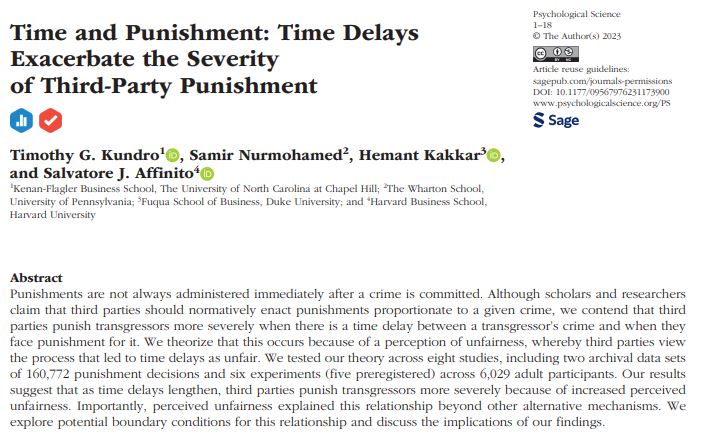
@timkundro synthesizing our new paper on the impact of time delays on punishment. Maybe someone can teach us how to share it on Threads?
Our Psych Science is in press (@snurmo@SalAffinito)
Across two archival samples and six experiments, we investigate how and why time increases third-party punishment severity.
Rather than only emphasizing the need for diversity efforts, consider inviting allies to contribute to the efforts. Tailoring diversity efforts to involve allies reduces those concerns and increases their involvement. We all have a role to play https://t.co/TNz3pjxUH6 #poweritup
🚨New preprint!🚨
Organizational diversity efforts often lack ally involvement. We find this is partly because White ppl are unsure if they have a place in or can contribute to DEI efforts. Fortunately, we also found an easy way to improve this (1/x)
https://t.co/EIbwb1Sx7R
Work moralizers don't underperform at creative tasks. They just take a different route to arrive at creative ideas. New paper by @timkundro#WhartonOBPlace2Be https://t.co/Os7OmqNCok
My work is in press at AMJ!: Current perspectives suggest that morality is overwhelming and burdensome, decreasing creativity. My research pushes back against this narrative, and suggests that in some cases, morality can actually drive high levels of creativity. (1/4)
In other words, to experience less retaliation, high-powered women should use a rationale that explains how their objections stand to benefit others and their organizations when speaking out at work. 4/4
#Power often protects people when they speak out against #unethical behavior. But does power shield women as much as it shields men who speak out against unethical behavior? https://t.co/3Oq62RjCul #poweritup 1/4
As an antidote, they find that women can use an organizational frame (e.g., "these hiring practices will impede our organization's ability to hire talent") rather than a standard frame (e.g., "these hiring practices are immoral") to mitigate the retaliation they experience. 3/4
A day after #ElizabethHolmes was found guilty, it seems timely to mention this new paper with @maemcdonnell. It starts with a basic question: why are some individuals punished more vs. less severely for behaving unethically than the organizations at which they work? 1/4
New article with @snurmo asking, When are Organizations Punished for Organizational Misconduct? We review the rich work on the topic ranging from sociology to psychology and call for new research bridging micro- and macro-approaches to punishment.
https://t.co/ENoebbaONM
We hope it encourages more collaborations between micro and macro #organizationalbehavior as crossing levels of analysis is crucial to understanding the punishment of unethical behavior and misconduct better. It's open access so you can download it and send it to your mom! 4/4
We propose a mezzo level theory of punishment, highlighting the role of #blame attributions and three key mechanisms: status, character and reputation, and embeddedness. 3/4
How do individuals persist in face of prior experiences of #discrimination? One way is through the stories they tell themselves. #Underdog & #favorite narratives feature similar endings (#success) but have different beginnings & narrative arcs https://t.co/zlRdM2Yf5R 1/5 at OBHDP
@Wharton@whartonknows@NDBusiness@JHUCarey@AOM_OB@ELSpsychology@Penn@NotreDame@JohnsHopkins Underdog narratives involve defying others’ low expectations whereas fav narratives affirm others’ high expectations. We find that UD narratives (vs fav narratives) more effectively offset repercussions of prior discrimination on performance via efficacy among job seekers 2/5
How do we learn from others’ experiences when work is increasingly dispersed, dynamic & ambiguous? One way is to tell stories! In this in-press @ASQJournal paper, I explore how storytelling supports vicarious learning among air medical transport crews. A🧵https://t.co/mnxg6rknyC
What happens when an academic and a comedian get together to discuss your research? You learn a lot and laugh your head off while listening! Thank you @DanCable1@AkinOmobitan
You probably already know about “Pygmalion effects” of expecting t best from someone. But do you know about the “Underdog effect” where people get motivated to “prove the naysayers wrong?” Thanks @snurmo@Penn@Wharton https://t.co/SbJoNbvqYC
#poweritup we talked about this previously in class, and how women in the Obama White House did this. Glad to see some empirical data to shed light on its effectiveness!
In too many meetings, great ideas get overlooked because people fail to support them.
New data: amplifying others' ideas helps them get heard... and makes you look good.
One of the best ways to elevate the group—and earn respect—is to champion voices that aren't being valued.