Late Stage Capitalism in the Onchain Economy & Its Pending French Revolution
Contrary to popular opinion about the state of onchain (the whole world is coming etc.), I think you are witnessing a form of late stage capitalism onchain in a fully unregulated market
Backdrop
2021 normalized crypto and brought it to the forefront of retail's psyche, championing the "WAGMI" narrative primarily driven by the world coming onchain for the "Future of Finance" (DeFi) and "Global Coordination Systems" (Smart Contract Infrastructure).
But what actually happened?
>Founders & funds created PMFless tech
>Minted a token out of thin air
>Sold for billions w/ no incentive to deliver on their promises
Why were they able to do this? These people have influence, which caused bid & price appreciation, which caused further interest. However, the memecoin supercycle was a death blow to the longevity of this approach. Why should retail play at your casino when they can play at their own?
However, what this did was accelerate the inevitable outcome of crony capitalism -> Elimination of the middle class & further division of the two remaining classes
In essence, we have 1 to 1 replicated the VC model via onchain new pairs
So Where Does This Leave Us Today?
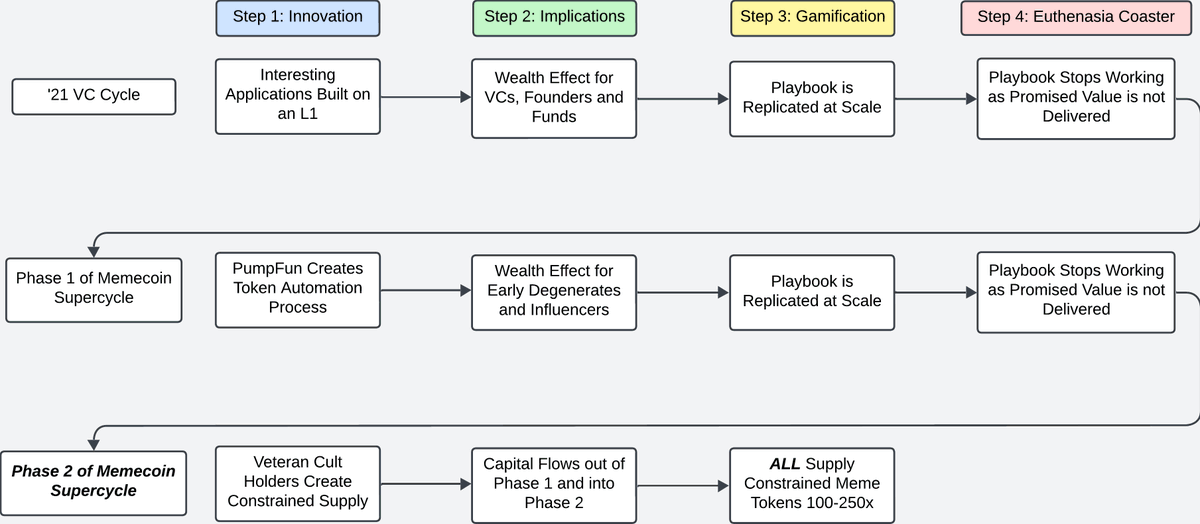
See Graphic 1. Unequal outcomes tend to accelerate. The highest class also has influence, and therefore have more incentive to utilize said influence. They are then satiated w/ less % gains on higher capital bases, while retail is put in the opposite situation, and are hence skewed to be more and more conservative, and therefore bearish, b/c they have more to lose from things going down than things going up, and have experience market cycles (see: euphoria) of turning $1M -> 5M on ai16z or fartcoin, while retail turned $1000->$2000 and then $350
They can no longer relate to or understand the common experience onchain sans insider group chats and large size
What Does This Look Like?
This creates a near opposite, late-stage capitalist experience onchain
Lower Class: Retail POV (Any participant that does not have edge)
1. Ever Decreasing Fresh Bid (-UPNL)
2. Ever Increasing Skepticism
3. Forced Further out on The Risk Curve
4. Feelings of "Hopelessness"
High Class: KOL / Cabal POV (Any paticipant w/ inherent advantages like coordination, audience and/or asymmetric information that creates edge)
1. game theory introduces faster time to rug & lower required return
2. scarcity mindset amongst very groups coordinating
3. Decentralized VC esque structure onchain w/ individual influencers mobilizing against the broader herd
What Happens Next?
The exact model you came to hate about VCs is now replicated onchain, but VCs have been replaced by KOLs who have no cost basis & no long term interest in the projects that they're shilling
The K-Shaped Recovery I outlined here is inevitable: https://t.co/JaGwyvG5Gk
Why?
This accelerating class division forces "retail" out of the economy and into a state of rebellion as their win rate moves faster and faster toward 0%. 2nd order thinking suggest the most likely outcome is a "Trench French Revolution" of sorts occurs
Retail is forced to stop touching the burning stove and start to participate in the few coins with the most constrained supply, and lowest rug likelihood to continue playing but avoid the negative consequences of bidding cabal tokens. The top 5-10 movement coins are quite literally their only hope of making the returns they aspire to, and these tokens have the most constrained supply and elastic demand, which becomes a self-fulfilling prophecy
Liquidity will concentrate in these top 5-20 neo-religions, as people pick their "grassroots" sports teams in attempt to overthrow the royal class
just as you saw in '24, Cult Tokens are to Cabal Memes what Memcoins were to VC Tokens
I expect the memes that have survived this apocalypse will 100-250x by the end of the year
After studying the people behind all popular tokens for ~12 months, these are my top bets w/ the highest concentration of "retail" holders
#spx6900
$sigma
$giga
$lockin
$apu
$mog
$bitcoin
$popcat
$glorp
$hehe
@cz_binance
Seriously? Biggest wipeout in history all because you needed to clear out billions in leveraged trades. You are the ones who offered them in the first place!
I’ve noticed a lot of discussions around market makers and their role in liquidations.
It raises an interesting question: are there any cases of market makers collaborating with exchanges to deliberately amplify liquidation events by aggressively selling into price pressure?
If so, could this be a strategic move benefiting the exchanges at the expense of traders?
Just a thought.
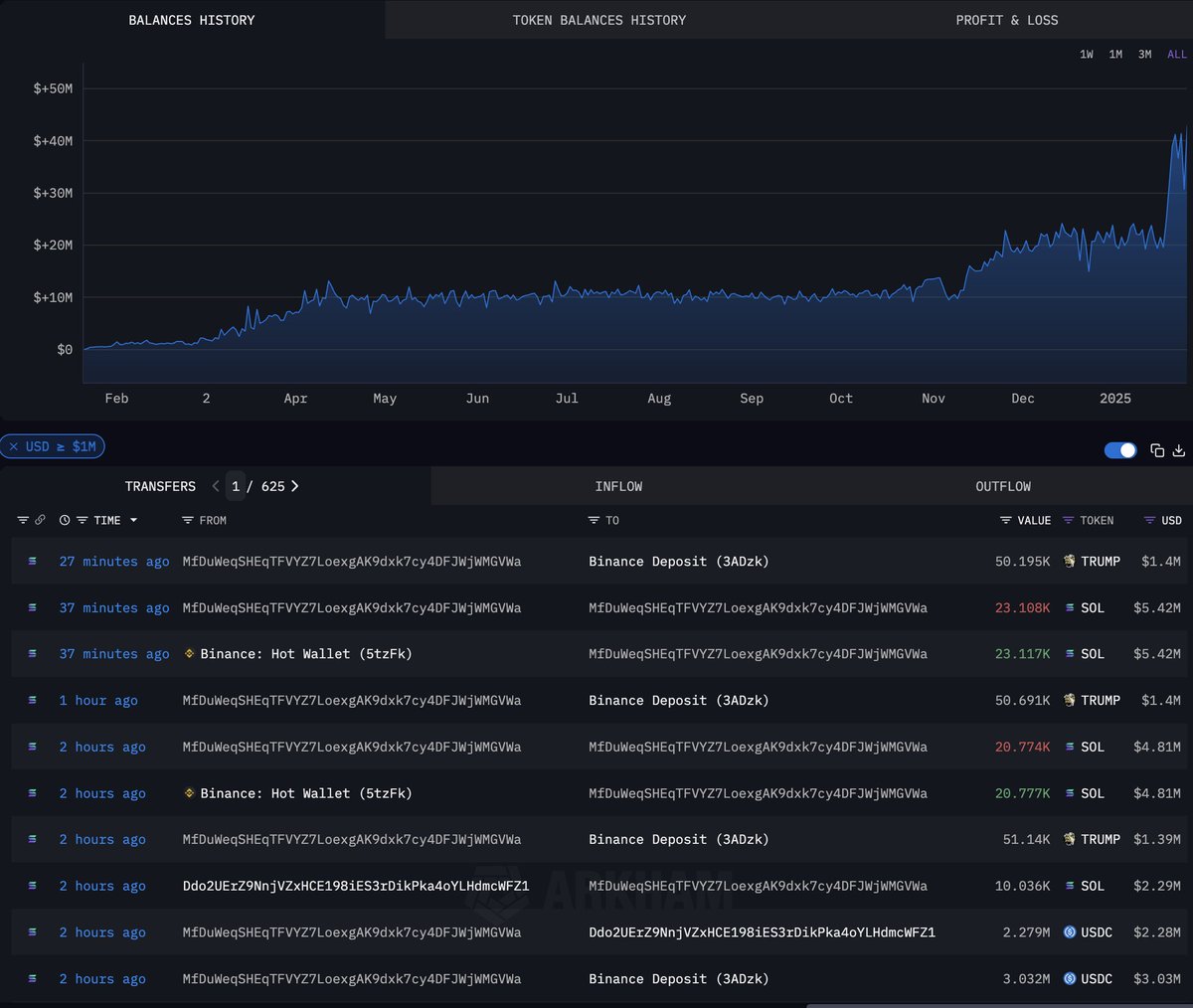
MM Update: We have uncovered this "sneaky" marketmaker wallet we believe is #Wintermute unindexed wallet. #Binance is sending assets there now in addition to their known wallets.
@arkham track this wallet please let us know what entity this is.
MfDuWeqSHEqTFVYZ7LoexgAK9dxk7cy4DFJWjWMGVWa
https://t.co/JvtMhnHKpG
Look at the volume of $TRUMP moving into and out of this wallet.
@tbass_aus That’s good to know, perhaps that needed to be broadcasted to the community to avoid a sell off. Tbh it’s getting a little tiresome constantly searching for a bottom.
Are you sick of 70-90% bundled launches and scamming devs?
Are you tired of dog meme #653?
Are you fed up with KOL’s shilling a coin just to dump their bag right after?
Are you irritated with trading and just want to hold something for longer than a week?
————————————————
$SPX has no dev (seriously, he left back in august 2023). 0/0 tax, contract renounced, liquidity locked for 69 years.
$SPX is an authentic and culture driven meme to hijack the S&P 500 ticker and troll our way in taking back the financial future that boomer tradfi took from us. Think of $GME on steroids, but this time we have cute girls helping.
$SPX is completely decentralized and community ran. Anything you see from $SPX is done from 100% free cult labor. Our power of belief and hard work shines though, regardless of price action.
$SPX still has the core community since the summer of 2023 and won’t leave until the job is finished ($37 Trillion market cap). We have fun and work hard. We want to bring meme coins and crypto back to its roots.
Stop trading and believe in something.
#SPX6900
Analysis on $MSTR Preferred Stock Target Raise
*MicroStrategy to Target a Capital Raise of Up to $2 Billion of Preferred Stock*
link: https://t.co/MuXKBTFXOa
(Very long post, trigger warning)
First, what is a preferred stock? If you want a good primer, here's a @PrestonPysh video from 12 years ago going through the basics: https://t.co/862SIn9Ydm
So what is a 'Perpetual' preferred stock, and what might it mean for $MSTR??
TLDR: A perpetual preferred stock is a hybrid financial instrument that combines features of debt and equity, offering fixed dividend payments with no maturity date. It sits between debt and common stock on a company's capital structure, meaning preferred shareholders are paid dividends before common shareholders (no dividends for common shareholders in this case) but after debt holders.
In liquidation, they also have priority over common stockholders. While preferred shareholders usually lack voting rights, they benefit from a more stable income stream and greater security in dividend payments. This structure allows companies to raise capital without diluting voting control (!!!!!), while offering investors a balance of income and relative safety.
The most important thing to understand is that as the preferred stock is perpetual, there is no lump sum principal repayment. There will be an annual dividend, and depending on the rate it is issued at, it is equivalent to pulling forward 10-20 years of buying power.
At a 5% rate, you are essentially pulling forward 20 years of cash.
So lets dive into the profile of preferreds:
Preferred stocks are low volatility, and provide less upside than common equity typically. Banks, Utility companies, REITs, etc.
For some numbers:
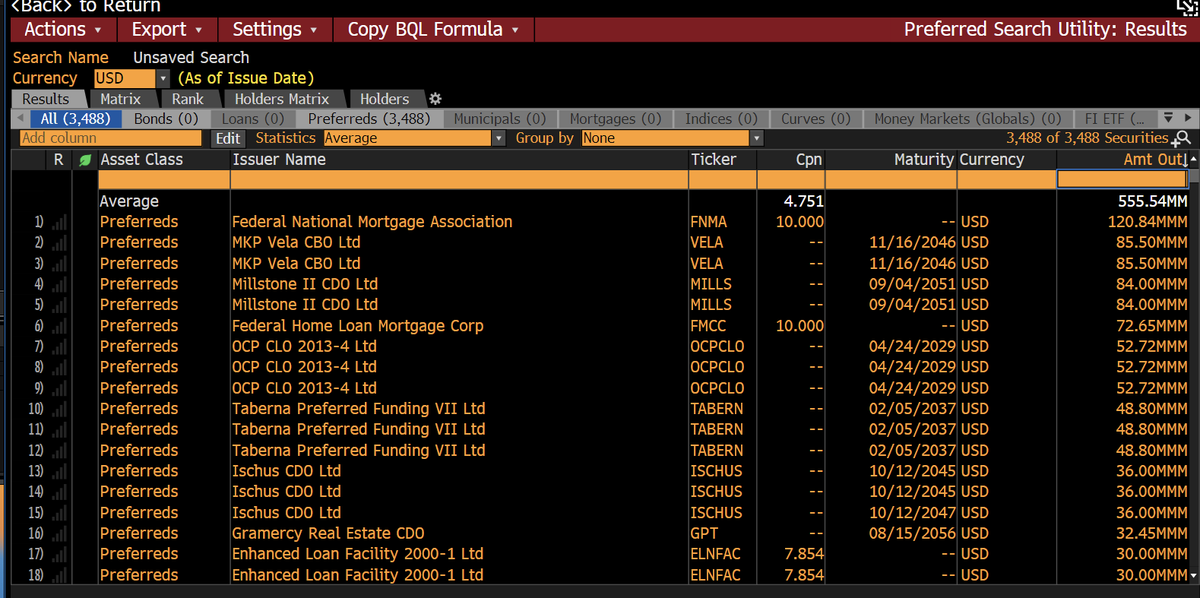
Globally, there is 3,488 issues of preferred stock worth over $1m outstanding. On average, $555m per issue, worth approximately $1.93 trillion in aggregate.
More specifically, if we narrow it down to parameters that match where $MSTR likely targets, there are currently 306 securities that check the following boxes:
- Exchange listed
- Perpetual
- U.S. listed issuer
- $378m avg. value per issue
- $115.69 billion in aggregate across 306 issues
- Avg. initial dividend rate of 6.283%
So who is the target buyer for preferred stock?
- Insurance companies
- Pension funds
- Mutual funds
- Banks
Notably, preferred stock can be held as Tier 1 or Tier 2 capital on bank balance sheets under Basel III banking regulations.
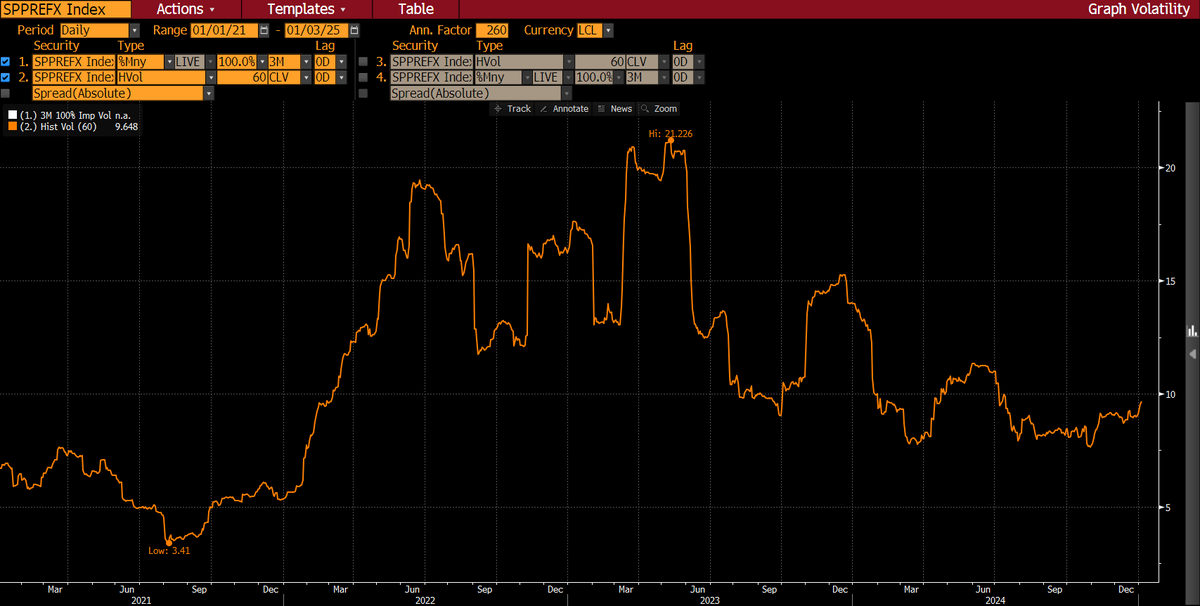
Preferred stocks are low volatility, low performance, income generating securities. Shown below is the 60-day historical volatility of a preferred stock index. 10% volatility, or about 1/10th of $MSTR currently.
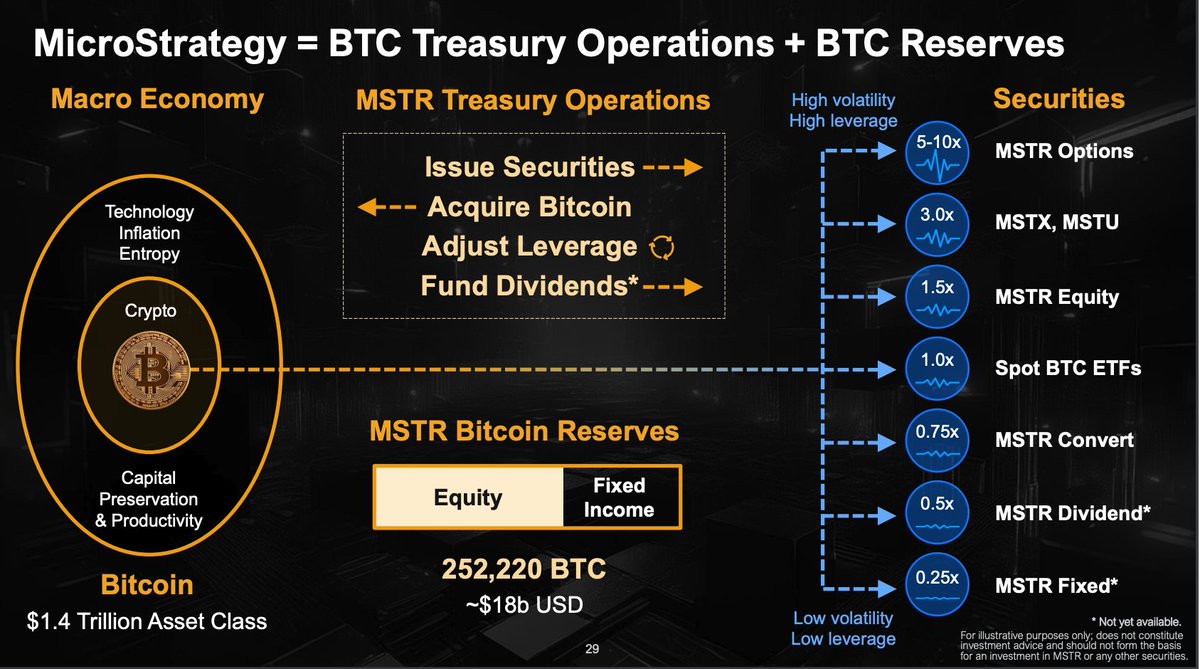
This will be the first time we are seeing what falls under the '$MSTR Dividend*' category that MicroStrategy teased on its Q3 earnings presentation.
Slide 29: https://t.co/FDkL5lIv9l
However, there is an extremely important advantage that $MSTR has compared to nearly all other preferred issuers:
Volatility. (Not to mention subsequent common stock liquidity, performance, and $BTC exposure)
"The perpetual preferred stock may include features such as (i) convertibility to our class A common stock." - MSTR Preferred Stock filing https://t.co/MuXKBTFXOa
What $MSTR can provide to fixed income investors is an indefinite $BTC backed call option
Let's do some option math:
The value of MSTR calls options with the market implied vol (87%), based on a reference price of $332 per share of $MSTR :
+50% out of the money:
- 1-year expiry: $89.56 (26.36% of price today)
- 5-year expiry: $222.13 (65.4%)
- 10-year expiry: $286.28 (84.28%)
- 20-year expiry: $326.42 (96.10%)
Now, let's do something much MUCH further out of the money, just for the sake of the example.
The value of +500% (!) out of the money calls options with the market implied vol (87%), based on a reference price of $332 per share of $MSTR :
- 1-year expiry: $20.93 (6.16% of price today)
- 5-year expiry: $140.97 (41.50%)
- 10-year expiry: $243.16 (71.59%)
- 20-year expiry: $314.73 (92.66%)
Are you starting to understand how valuable an indefinite call option on a ~90% volatility $BTC beta stock can be for fixed income investors??
The right tail 'risk" is massive for an indefinite call option on a hyper-volatile stock.
The path forward for Saylor and Co. is selling volatility, this time, to preferred stock investors. It's not debt that has to be paid down outside of the annual dividend, and even if we generously assume they pay an average preferred rate of ~6% (I would bet they fetch below average), that would only be $120m per year in dividends on a $2 billion raise, for a company that raised > $15b in equity capital alone in 2024. Non-issue.
We have no idea what the pricing will look like i.e. where $MSTR will place the strike, or what the initial dividend rate will be, so we are just sort of approximating for now.
I can't see $MSTR issuing preferred without a conversion option at some ratio to common stock. After-all, volatility is THE product, and BTC Yield is the Key Performance Indicator. The indefinite optionality is THE most interesting product that MSTR can sell to the fixed income market.
Thus, given the immense theoretical value of the imbedded indefinite call, it might make sense to apply a conversion ratio less than 1.0 for every preferred share to common.
Something like 0.50, or 0.20 conversion into common for every share of preferred for a conversion ratio (i.e 2 or 5 shares of preferred stock convert into 1 share of common stock) could make sense; but again, we can't know until its been priced and placed.
But what we do know is how much Saylor and team emphasize the value of volatility.
"Volatility is vitality."
The treasury team has spoken at length about selling volatility (only through convert issues thus far) and recycling the proceeds back into BTC.
This selling of volatility is how they take the preferred market by storm.
Using our example from above, if an $MSTR call option was striked +500% out of the money (approx $2000/share currently), with 5 shares of preferred converting to 1 share of common stock, the theoretical call option in each preferred share (with a 10-year expiry just for the sake of the math) would be $48.63 of value. For just the option, nevermind the dividend paying component of the preferred share (!!!!). Now, instead of 10 years make it indefinite...
The most interesting thing to watch for will be the provisions that the conversion contains in the preferred offering.
In the past, when $MSTR has issued convertible bonds, the bond has contained all sorts of provisions for the convertible component; a put option imbedded for the buyer of the debt, a call option that $MSTR can redeem if the bonds rise past a certain value after a period of time, etc. I posted some of that theoretical math here: https://t.co/4g9KwIN6Ds
The point of all these provisions is to essentially cap the upside and the downside of the convertible option.
The imbedded 5-6 year call option in the convertible debt is purposefully neutered, because the convert buyers aren't actually interested in the directional exposure.
These convert arb desks are in the business of 'gamma-trading', as they look to delta hedge out their exposure almost instantly. Nevermind exposure for six years, not even six months, weeks or days. These buyers hedge exposure on day 1.
So, they neutralize the value of the call so as to target something like approx 50% delta, so for every $1 billion of bonds that are issued, the convert bond arbitrage desks will short sell something like $500m of equity to lock in immediate gains.
But, the preferred stock could be a bit different.
Given the indefinite nature of the option (read: PERPETUAL preferred), an uncapped call would hold EXTREME value, even if the call was striked laughably far out of the money, given the immense volatility and time value of the option (as laid out above).
Stepping back, the preffered market is just a relative larger scale than converts. For scale, the total size of the convert market in the United States for listed securities is 1,360 bonds worth $302 billion, compared to $572 billion in total for all preferred stock.
However, narrowing the parameters to what $MSTR is looking for: a 0% coupon issue attractive to arb desks is a much smaller market. There is a total of $50 billion of zero coupon convertible debt for listed companies in the United States. $MSTR is already far and away the largest and most active issuer in this market.
Time to level up to a larger pool of capital.
The market for preferred stock in the U.S. is large, and the allocator class is entirely different, with much deeper pockets.
A question to all preferred stock buyers by forced mandate: Would you like exposure to a random tranche of the thousandth largest regional bank, Utility companies, and/or REITs, or would you like low volatility, high sharpe ratio upside exposure to the world's preeminent Bitcoin Treasury Company?
No comparison.
So, what's it all mean?
In essence, $BTC has infiltrated the fixed income market; and the dreaded uncertainty (read: volatility) that every smug TradFi allocator spent the past 15 years making fun of, is the very reason that these $MSTR preferreds will likely be the top performing preferred security in the market before long, just like the $MSTR converts and the common stock have been.
$MSTR bears have no idea what just hit them.
Oh, and don't get me started on the potential BTC Yield here...
END/