No complexity. No accident.
10/10 was caused by irresponsible marketing campaigns by certain companies.
On October 10, tens of billions of dollars were liquidated. As CEO of OKX, we observed clearly that the crypto market’s microstructure fundamentally changed after that day.
Many industry participants believe the damage was more severe than the FTX collapse. Since then, there has been extensive discussion about why it happened and how to prevent a recurrence. The root causes are not difficult to identify.
⸻
What actually happened
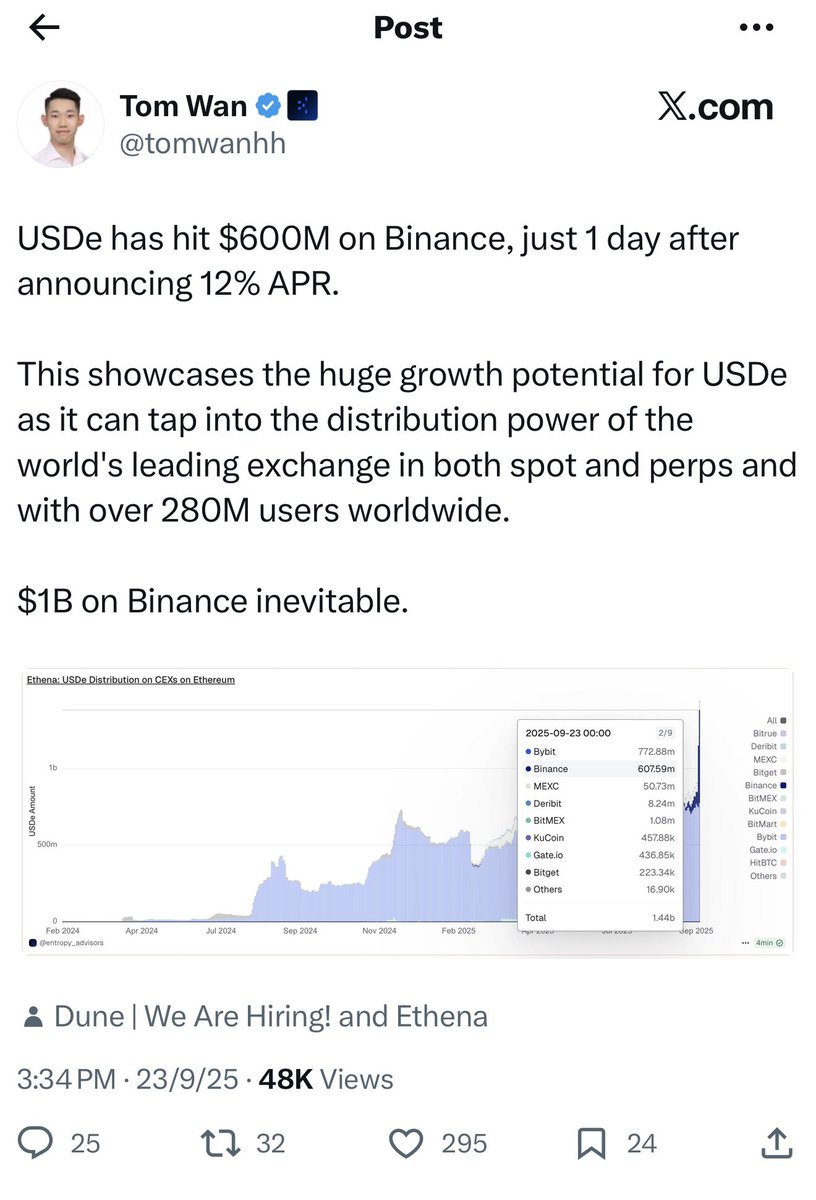
1.Binance launched a temporary user-acquisition campaign offering 12% APY on USDe, while allowing USDe to be used as collateral with the same treatment as USDT and USDC, and without effective limits.
2.USDe is a tokenized hedge fund product.
Ethena raises capital via a so-called “stablecoin,” deploys it into index arbitrage and algorithmic trading strategies, and tokenizes the resulting fund. The token can then be deposited on exchanges to earn yield.
3.USDe is fundamentally different from products such as
BlackRock BUIDL and Franklin Templeton BENJI, which are tokenized money market funds with low-risk profiles.
USDe, by contrast, embeds hedge-fund-level risk. This difference is structural, not cosmetic.
4.Binance users were encouraged to convert USDT and USDC into USDe to earn attractive yields, without sufficient emphasis on the underlying risks. From a user’s perspective, trading with USDe appeared no different from trading with traditional stablecoins—while the actual risk profile was materially higher.
5.Risk escalated further as users:
•converted USDT/USDC into USDe,
•used USDe as collateral to borrow USDT,
•converted the borrowed USDT back into USDe,
•and repeated the cycle.
This leverage loop produced artificial APYs of 24%, 36%, and even 70%+, widely perceived as “low risk” simply because they were offered by a major platform. Systemic risk accumulated rapidly across the global crypto market.
https://t.co/IK2gW4xUOP that point, even a small market shock was sufficient to trigger a collapse.
When volatility hit, USDe depegged quickly. Cascading liquidations followed, and weaknesses in risk management around assets such as WETH and BNSOL further amplified the crash. Some tokens briefly traded near zero.
The damage to global users and companies—including OKX customers—was severe, and recovery will take time.
⸻
Why this matters
I am discussing the root cause, not assigning blame or launching an attack on Binance. Speaking openly about systemic risks is sometimes uncomfortable, but it is necessary if the industry is to mature responsibly.
I expect there may be significant misinformation and coordinated FUD directed at OKX in the near future. Even so, speaking honestly about systemic risk is the right thing to do—and we will continue to do so.
As the largest global platform, Binance has outsized influence—and corresponding responsibility—as an industry leader. Long-term trust in crypto cannot be built on short-term yield games, excessive leverage, or marketing practices that obscure risk.
The industry needs leaders who prioritize market stability, transparency, and responsible innovation—not a winner-take-all mentality where criticism is treated as hostility.
Crypto is still early.
What we choose to normalize today will determine whether this industry earns lasting trust—or repeats the same mistakes again.
Stop trading on Polymarket like a f*cking noob
I’ve curated the ultimate list of must-read resources
Read this and you’ll trade like the top 1%
Lock in ⬇️🧵
The mega list of crypto project red flags (so far):
- Newly created or suspicious social media profiles
- Anonymous or unverified team members
- Fake or unconfirmed partnerships
- History of involvement in failed or scammy projects
- History of changing X account multiple times
- No real-world demand or sustainable product/service.
- No project details/ gitbook/ whitepaper or poorly written one
- Heavy use of buzzwords without substantive explanations.
- Unrealistic roadmap and timeline
- Resistance to audits or transparency
- No GitHub Activity or Open-Source Code
- Fabricated or AI-generated reviews and endorsements.
- Lack of clear tokenomics or unfair one
- Overhyped or secretive strategies
- Fake or Bought Community Engagement
- Marketing over product
- High token concentration in a small number of wallets, enabling easy manipulation.
- Overlapping wallet clusters indicating coordinated ownership by insiders.
- Smurfing patterns where large amounts are broken into small transactions across clusters.
- Heavy pre-mining or insider allocations without or lack of vesting periods.
- Insider wallets dumping tokens right after liquidity addition.
- Appearing on InfoFi Leaderboards but without detailed incentives
- Unilaterally altering community incentives
- False positive news spread to inflate token prices before dumps
- Incongruous trading volumes from clustered addresses not matching organic growth.
- Private group chats signaling timed buys and sells for pumps.
- Abnormal trading spikes before project announcements from team-linked addresses.
- Keep delaying TGE with no technical reasons, e,g,: waiting for better markets
- Sudden Price Pumps Without Fundamentals
- Claims awards/ qualifications/ certifications from obscure or unheard-of organizations without verification.
- Obfuscated hashtags used in coordinated pump promotions.
- No liquidity or locked funds issues
- Overpromising on technology
- Unverified or fake celebrity/ KOL endorsements.
- No third-party security audits for smart contracts
- High-pressure tactics urging immediate investment
- Smart contracts with honeypot mechanics preventing sales
- High concentration of tokens in few wallets (whale dominance)
- Suspicious wallet activity like rapid anonymous transfers
- Requests for upfront fees to access funds or features.
- Complicated or penalized withdrawal processes.
Does anyone want to add more?
P.S: While red flags don't necessarily indicate a scam, they do suggest a higher potential for one.