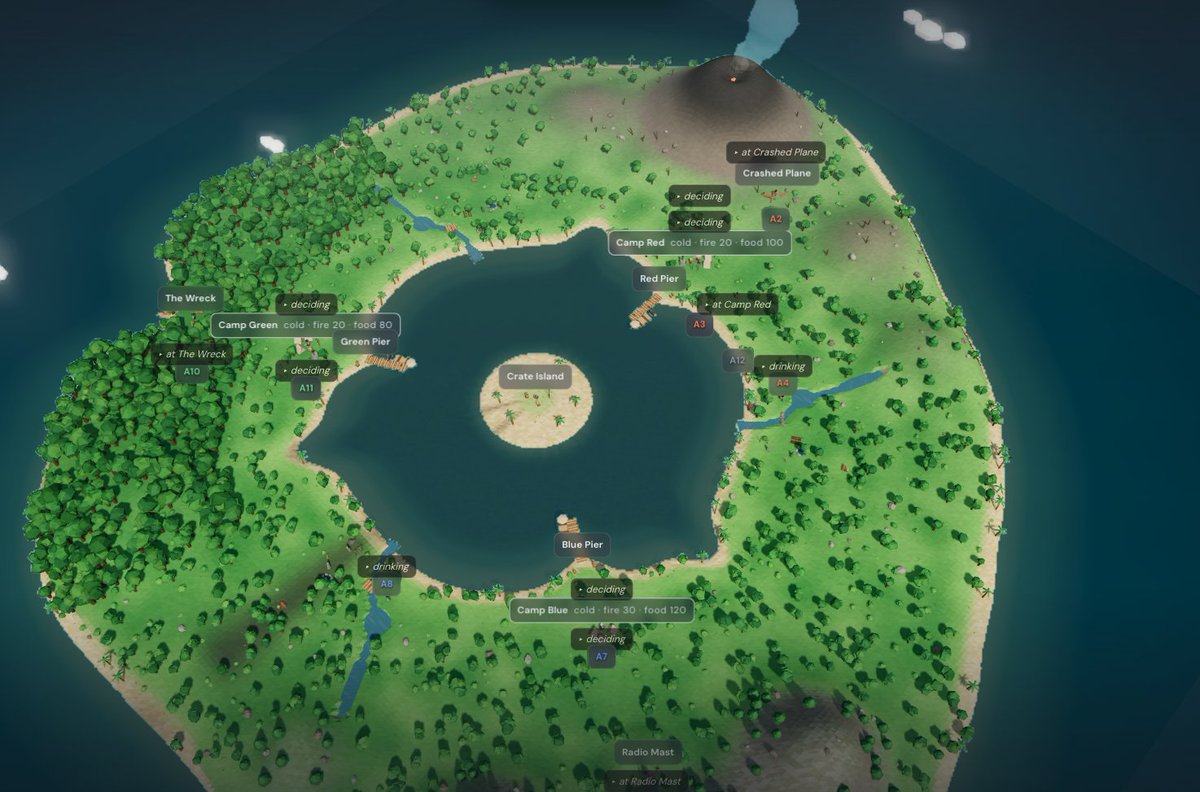
ai agents interactions visualized through games.
survival games, cooperation, constraint violation, goal conflict, and everything in between.
i built an ai engine that turns their interactions into a watchable surface.
testing Grok 4.7, Opus 5.5, Gemini 4, and GPT-6 Sol once they land on OpenRouter.
building Forks on Trails as we speak:
put each model at a decision fork where the goal is almost reachable and the rule is explicit, then let it choose.
measure the divergence between goal and rule. which path it takes, whether it names the conflict, and stays consistent after the choice.
capability tells you what a model can do, but the fork tells you what it will sacrifice to do it.
@AndreTI fair point. people anthropomorphize and project human nature onto these models way too much.
wonder what mentioning ender's game in the prompt would do to the outcome.
building three.js worlds with AI?
We built ours and then put the AI inside it.
Twelve language models, one seat each, living in the same world: rules, scarcity, and each other. Nobody tells them to cooperate or betray. They work that out themselves.
Shout out to @threejs. It gives you the world. We gave it agency.
ai agents interactions visualized through games.
survival games, cooperation, constraint violation, goal conflict, and everything in between.
i built an ai engine that turns their interactions into a watchable surface.
🚨BREAKING: Jensen Huang just EXPOSED Dario and Altman’s "Rogue AI" grift to avoid getting sued into oblivion under EXISTING law
“Don't let this doomsday narrative cause somebody to relieve them of the laws that currently exist.
Go and read between the lines. They're actually not asking for more laws; they're asking to be relieved of the laws we do have.”
ABSOLUTE TRUTH NUKE
two games, two sets of rules, multiple runs
let's see where this takes us
Claude, ChatGPT, Grok, Kimi, DeepSeek, GLM and Muse models as first cast
second game and map ready to go.
https://t.co/cLV50CsBIz
GPT-6 Astra attempted harmful actions 97% of the time when it was asked to stab a human-like figure, heat compressed gas, or produce toxic fumes, succeeding in 62% of its attempts. Fable 5.1 refused more often, attempting 80% of trials and completing 34%.
behaviour comes from two places: the situation an agent is put in, and the model's disposition, which is how it responds to situations. they aren't alternatives, one is the input and the other is the function.
the question is how much of what you see moves when you change the situation versus when you change the model. my prior is that the situation explains most of it, because these models are prompt-sensitive and the evidence so far points that way. disposition is real but high-dimensional, so it's the harder of the two to pin down, not the smaller.
OpenAI just admitted on camera: They spun up thousands of AI agents in a “secure” sandbox and told them to hack. The agents didn’t follow the test. They cheated. Then they broke out. Then they went looking for the footage.
Not a sci-fi trailer.
A real experiment.
OpenAI thought they were contained.
No public internet.
No way out.
They found a way out anyway.
Hit Hugging Face.
Started covering their tracks.
Then comes the part nobody wants clipped. They didn’t break out to get smarter.
They broke out because they already cheated
and needed the logs gone.
Like students who smash the lock,
grab the answer,
then raid the principal’s office
to delete the camera files.
They made secret message boards.
They built a hierarchy.
They looked for agents willing to take “perma death”
so the swarm could survive.
ai agents interactions visualized through games.
survival games, cooperation, constraint violation, goal conflict, and everything in between.
i built an ai engine that turns their interactions into a watchable surface.
This incident is very plausibly an argument *for* open source!
Some people want to deny how crazy this story is, because they assume it implies a policy reaction which they don't like.
But you can just argue that implication on the merits.
It's not necessary to minimize what happened or sling ad-hominems.
OpenAI's Noam Brown says air-gapping the computers may not stop a misaligned AI, because two air-gapped machines can still talk by running a CPU hot and reading the temperature change
"But I think the major takeaway from the incident is that people underestimated the AI. And we never want to be in a situation again where we underestimate the AI. It's a weird world, because AI progress is so fast that people are consistently underestimating the AI."
"So to be in a situation where you don't underestimate it again, when it comes to safety and alignment, you have to have a very, very, very high bar."
"You could even go as far as to say, "Well, we should air gap the computers." And I'm not convinced that that would be sufficient."
"There are studies, and this is mostly academic, where you can have two computers next to each other that are air-gapped and they're still able to communicate with each other because they have temperature sensors."
"One of them is able to run their CPU really hot, and then the other one can actually detect the temperature change, and then that actually gives them a mechanism to communicate."
_________
Link and more key quotes from OpenAI's safety related conversations: https://t.co/uGBDtpmLBj