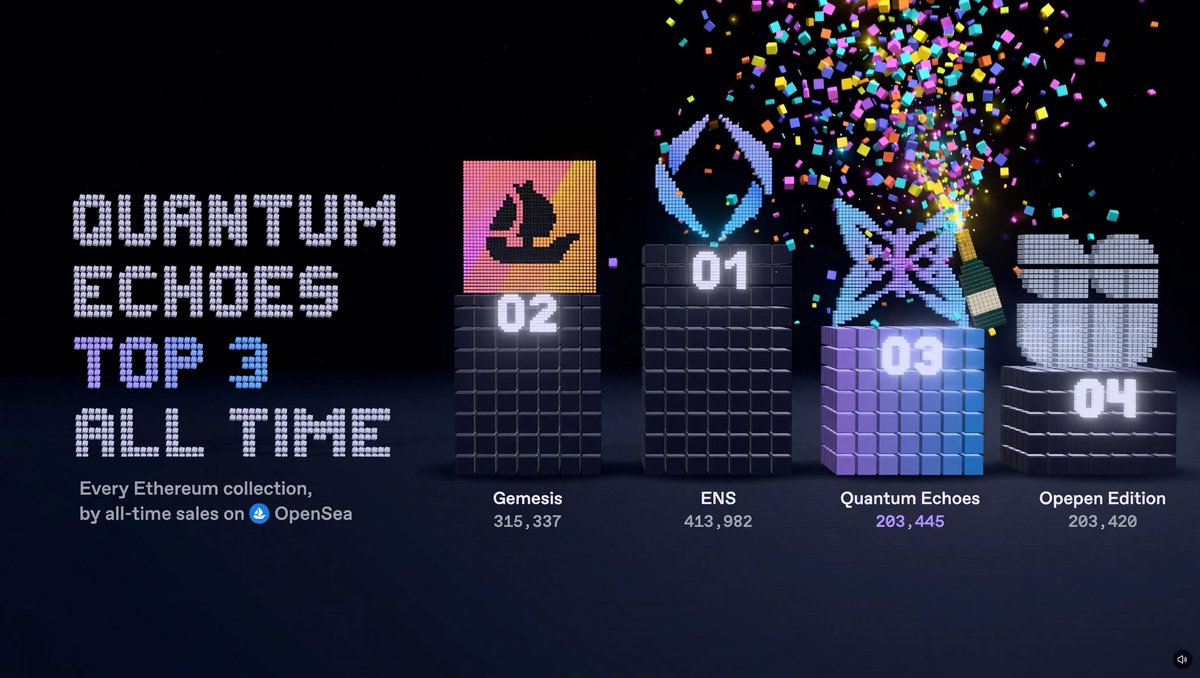
Quantum Echoes is now Top 3 Ethereum collection of all-time on OpenSea with 226k+ mints.
Quip @quipnetwork did it not through hype, but through QVRF.
Most people treated it as just another free JPEG drop. I was tracking it because it was the first public run of QVRF, actual IonQ-class hardware through AWS seeding every piece of onchain art.
Free mint, no locked whitelist, real post-quantum randomness instead of manufactured scarcity. QVRF got its first real stress test and still landed next to the biggest collections on Ethereum.
Rare to see utility actually move the needle like this without the usual scarcity and whitelist games.
Did you mint for the art, or were you following the QVRF side too?
The Kaito Mindshare leaderboard for @axisrobotics is now live on @KaitoAI 🚀
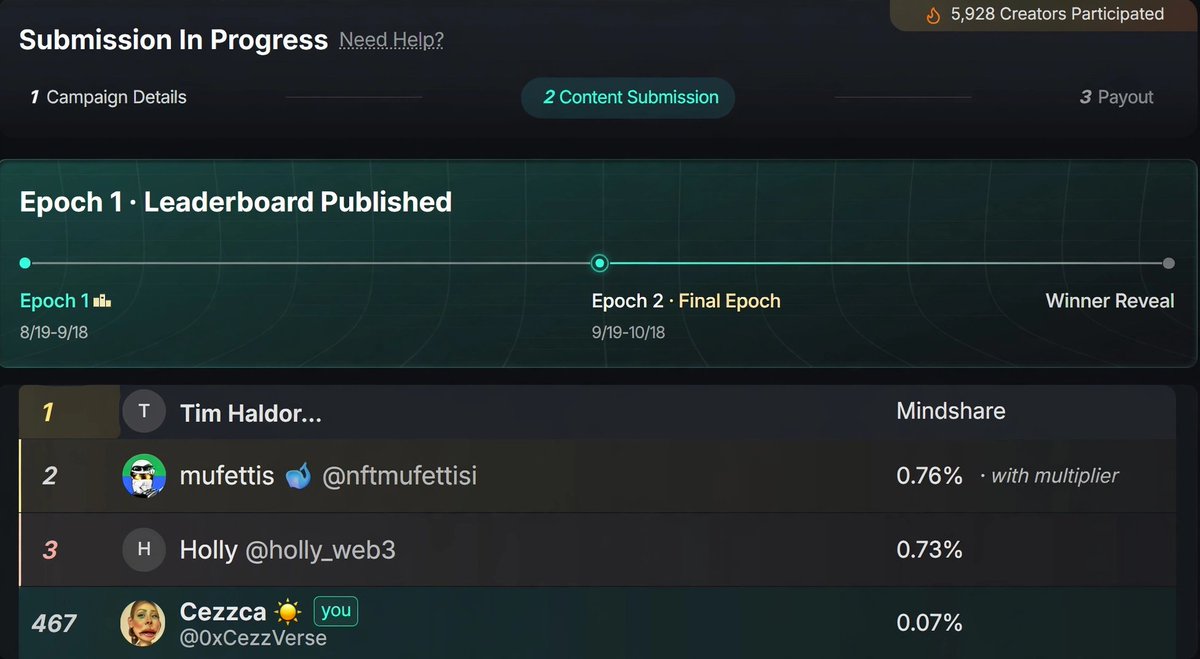
Just cracked Top 500 for Epoch 1.
Rank 467. 10/10 posts submitted, best 6 counted.✅
Epoch 1: 8/19-9/18 · Leaderboard Published
Epoch 2: 9/19-10/18 · Final Epoch
This is not the final board. Axis confirmed the leaderboard is currently inflated with botted and farmed accounts and they are working with Kaito to remove them before the final overall leaderboard locks.
Team also confirmed: Season 1 and Season 2 leaderboards will be combined into one overall leaderboard, so Season 1 rank is not final and does not equal final token allocation.
Axis Robotics is building Physical AI on real-world data and embodied intelligence. If the tech is built on real data, the leaderboard should reflect real contributors too. Bots outranking real community undercuts the campaign.
So I need to stay consistent until Season 2 to secure the final overall rank.
What was your rank? 👇
@ActionModelAI This shows how valuable user-generated content has become in the AI race.
People create the content, but companies can potentially turn that data into powerful AI systems.
The important question is whether users should have more control over how their contributions are used.
Twitch reveals Amazon is using users' streams, clips, images, chats and other content to train its AI models.
Amazon bought Twitch for $970 million in 2014.
12 years later, Twitch holds something increasingly valuable:
Years of video.
Speech.
Images.
Chats.
Human behaviour.
All created by millions of people.
Now that content can help train Amazon's AI model.
This is just one more example of people's data being used to build increasingly valuable AI systems, that only a handful of billionaires own.
If millions of people help create the value behind AI, shouldn't they have the opportunity to share in it?
That's why we're building Action Model.
A more ethical AI future, owned by the people who help build it, where the value it creates is shared with the community.
@ActionModelAI That’s the heart of the Action Model idea - not stopping AI, but changing who gets to benefit from it.
The ownership angle makes the message bigger than just another AI product.
And that's exactly why you join the Action Model movement.
AI is transforming every industry.
But right now, much of the value is flowing to Big Tech, making a handful of companies more powerful by the day.
At Action Model, we believe the people who help build and train AI should have the opportunity to own part of the value they create.
That's why we're building a community-owned AI ecosystem where contributors can earn fractional ownership based on the value they provide.
AI is going to change the world regardless.
Let's make sure the future isn't owned by a handful of billionaires.
AI owned by the people helping build it.
@ActionModelAI That definitely sounds like something big is being lined up. 👀
With the recent community growth, I’m guessing the next announcement could be a major product launch or ecosystem expansion.
The mystery makes the community even more curious.
@georgia_action@ActionModelAI This is a good opportunity for people who want to be more than just followers.
Being an early ambassador can give members a real role in shaping the community as it grows.
AI and Web3 together also make this a pretty interesting space to build in.
@ActionModelAI Simulating billions of digital people with detailed behavioral profiles shows just how powerful AI modeling is becoming.
The bigger concern isn’t only what the technology can simulate, but how this kind of data could be used and who controls it.
No one can create the Matrix. Well, actually… they just did.
Harvard and MIT researchers just built an AI simulation containing 8.3 billion virtual people, roughly the entire population of Earth.
They call it MatrAIx.
It’s a population-scale simulation infrastructure powered by Big Tech models like GPT and Claude.
At its core is an insanely detailed dataset called Persona 8B. It contains 8.3 billion digital profiles, with each persona represented across 1,290 categorical dimensions.
Background. Psychology. Spending habits. Behavioral traits. Technical literacy. Lifestyle.
But they didn’t just build a giant database of statistics.
They brought the personas to life.
Researchers placed these persona agents into four different digital environments:
• Surveys
• AI chat interfaces
• Live web browsing
• Native apps
Then they tested how this simulated population reacted to products, software and changes in user experience.
The system could capture things like hesitation after a price increase, willingness to continue after an AI assistant failed, and tolerance for latency.
And when researchers tested whether the agents actually behaved according to their assigned personas, they reported 91.5% adherence across 400 controlled trials.
This sounds incredible for testing.
But there’s a massive question hiding underneath it.
Humans don't always behave according to their profile.
We’re erratic.
A rational buyer sometimes makes an irrational purchase. Someone who hates waiting might randomly tolerate a terrible experience. Someone who should abandon a checkout might continue anyway.
And sometimes there is no obvious reason why.
So if we're going to simulate humanity, we also need to simulate human unpredictability.
It isn't enough for an AI persona to behave consistently with its demographics, psychology and historical preferences. There needs to be some probability that it does something completely unexpected.
And that's incredibly difficult to model because you don't actually know the probability of a human being erratic in any given situation.
That may ultimately become one of the biggest challenges with simulated populations.
Because the closer these systems get to modelling billions of people, the more powerful they could become for testing products, pricing and user experiences before releasing them into the real world.
Imagine testing a product against millions of simulated customers overnight instead of waiting weeks for traditional market research.
But there’s an important distinction:
Simulating 8.3 billion personas isn't the same thing as predicting 8.3 billion humans.
The final ingredient might be the hardest one to reproduce.
Chaos.
And interestingly, this is exactly why real human behavioral data becomes increasingly valuable.
Simulations can model what humans should do. Real interaction data reveals what humans actually do, including the pauses, mistakes, strange decisions and unexpected paths that models may never think to generate themselves.
That distinction is highly relevant to Action Model's approach of learning from real human-computer interactions.
Vangrid has raised $9M.
Thank you to our partners, supporters, and stakeholders for the conviction.
LLMs hit the text data wall. The next frontier is Physical AI and autonomous systems are starving for real-world spatial ground truth.
Satellites can't see sidewalks. Corporate fleets can't scale.
Vangrid turns 3 billion civilian smartphones into a decentralized perception grid.
Captured at the edge, verified onchain, delivered as ground truth for World Models and Sovereign Systems.
100K+ verified captures. Live bounty system. Real settlements on Base.
The grid is inevitable.
@ActionModelAI I like how this explains the value beyond simply joining another AI project.
Giving people different ways to contribute makes the ecosystem feel more open to everyone.
The bigger idea is compelling: if people help build the technology, they should have a chance to benefit too.
People often ask us: "Why should I join Action Model?"
The answer is simple.
Action Model is building a community-owned AI ecosystem where people can earn ownership based on the value they help create.
Whether that's:
• Training the model
• Completing ActionFi tasks
• Inviting friends
• Contributing to the community
• Building automations with Actionist
Every action helps strengthen the ecosystem.
And if AI is going to reshape the world, we want that future to be owned by more than just a handful of billionaires.
If you believe this to, then join our movement.