📽 Five weeks of russian terror in a 57-second video.
This is what everyday life looks like for ordinary people in Ukraine today. A glimpse of what we go through, day after day.
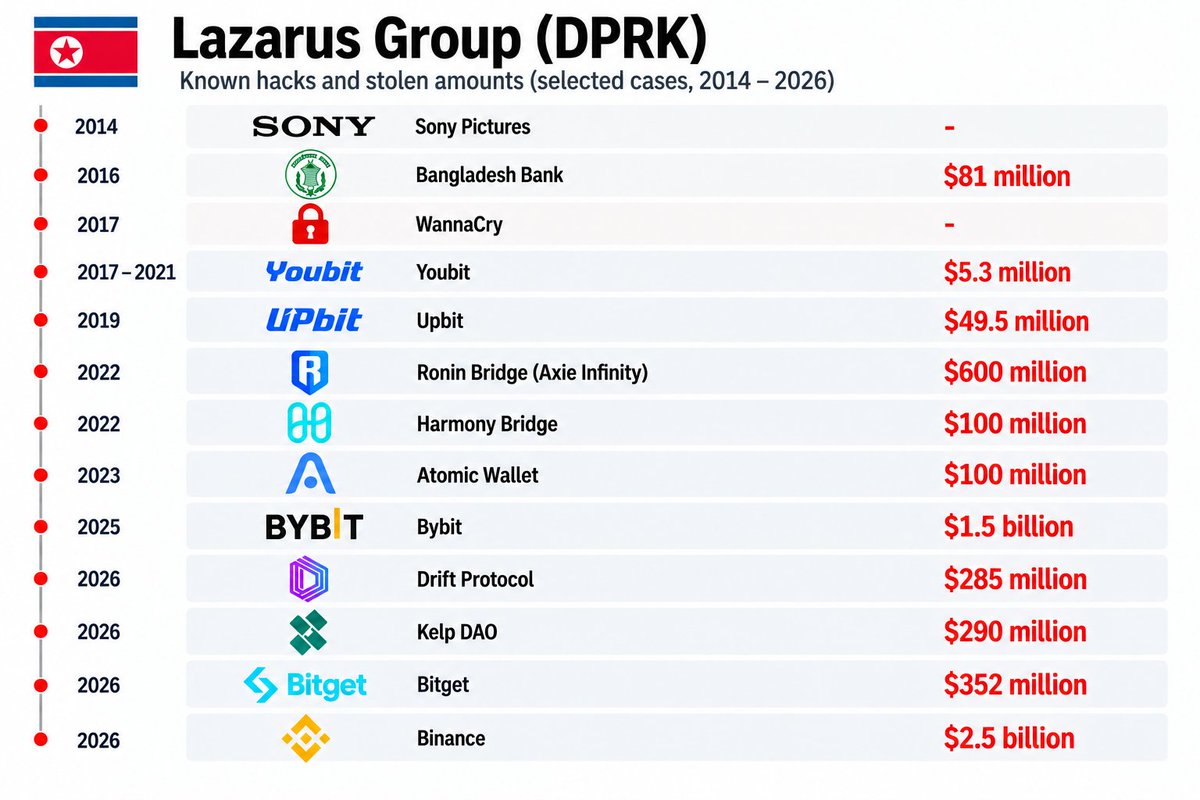
@DriftFDN whole founding team left and now the lead protocol engineer is leaving too.
Wtf is going on? Is @VelocityDEX dead? Is the recovery effort still ongoing? What is left of the team?
Can someone say something please @davijlu@0xahzam
Some personal news. In June I decided to join the @VelocityDEX team to help them relaunch after Drift was exploited. Over the following months we worked through STRIDE, several refactors to the protocol, and a complete re-audit of the smart contracts that surfaced many opportunities for improvement. I’m proud of the work the team accomplished; we paid away the technical debt and got the protocol relaunched.
Now it is time for a new challenge. I am joining @SolanaFndn as Head of Product Engineering under @vibhu. I’ve spent the better part of the last 5 years complaining to various devrels about the things that need to be built on Solana. Now that I’ve infiltrated Foundation, the shipping will continue until morale improves.
FULL CONVERSATION: The Backpack Bull Thesis with CEO Armani Ferrante
solana:BPxxfRCXkUVhig4HS1Lh7kZqV6SPJhzfEk4x6fVBjPCy
@armaniferrante@Backpack@therollupco
I'm on an uber so I'll write a longer post
this discourse overlooks many key points and is oriented around a comically small time horizon
here's how I think about it:
- more things will come onchain over time
- those things are varied. they are not just RWAs, or just perps, or just payments, they are all finance and commerce
- to enable this, you need scale, obviously
- solana is the most scalable chain, has demonstrated the most competence in this area, and has the strongest scaling vision for the future
- you need the physics and incentives to support these businesses. solana is unparalleled here. there is a reason why it births a disproportionate amount of successful startups and is top 2-3 in every functional metric in existence
- the lack of central company control reduces counterparty risk for a large % of businesses building on top (e.g stripe competitors wouldn't build on stripe chain)
- the construction of the chain allows startups, businesses, and institutions to benefit from a large arsenal of integrations, tooling, and distribution -- you may think of it as a "business-friendly" jurisdiction IRL like old Hong Kong
- that is all to say, it has the strongest claim of becoming the capital of an internet economy -- a sovereign economical nation-state on the cloud
- now, much of the discourse has been midcurved into buybacks. these are useful. but they provide a floor rather than a ceiling
- it is rather like valuing facebook or google in year 3 around their operational economics rather than underwriting their future scale
- don't get me wrong, value accrual is important. and what many seem to not know about solana is that the token holder gets real productive yield from onchain transaction fees and mev through staking
- but overfitting on it on a quarterly basis is an inherently pessimistic exercise and assumes crypto has realized full adoption today. obviously wrong
- further, cryptocurrencies are currencies. regardless of if a neobank represents gas in USD, the underlying fundamentally transacts in SOL
- which is to say that SOL is the currency for doing internet finance, commerce, and trading
- importantly, this is not just the case for regular users, it is much more the case for businesses. e.g if citadel wants to compete onchain, they must acquire SOL to scale their low-risk HFT strategies and so must their competitors. can they hedge? absolutely. must they bid on blockspace? also absolutely
- so in the end, you are left with an asset that is not only a yield-bearing asset from onchain trading and finance but one that serves as the underlying currency for a colossal economic powerhouse born on the internet
the risk here comes not from 'value-accrual' mechanisms of today but the execution of the ecosystem to remain and expand in the top 2 as crypto adoption grows 100x throughout the planet
NEW EPISODE - The Complete Zcash Roadmap
@Zcash co-founder @ebfull and Zcash protocol contributor @zkDragon break down what's next for $ZEC: scaling with Tachyon, preparing for quantum threats, and the future of private money.
The complete Zcash deep dive for everyone curious about where the project is headed.
CHAPTERS
---
0:00 Why Zcash Matters Now
07:53 AI Makes Privacy Urgent
11:20 The Zcash Development Roadmap
17:33 Privacy Without Compromises
25:26 Scaling Zcash With Tachyon
39:42 Private Wallets and Proof of Work
41:06 Zcash's Quantum Defense Roadmap
1:00:53 AI Threats and Formal Verification
1:12:53 Security Through Multiple Assumptions
1:19:37 Why Payments Come First
1:25:54 Funding Proof-of-Work Security
1:29:34 Governance and Coinholder Voting
1:34:53 ZEC Price and Protocol Threats
While Binance is messing about with Ethereum, @Google is building on @solana which does not have a fragile architecture.
On October 28 Alphabet announced it is securing its own digital assets on @solana $SOL using a new system called Google Multi-Party Compute. It’s a custody and transaction-signing tool that splits private keys across separate environments so no single machine ever holds the full key enough shares have to agree before anything moves.
It’s in private preview with major banks now, with commercial launch targeted for early twenty twenty-seven, and at launch it’ll support Ed25519, which is Solana’s signature scheme.
Google Cloud’s been on Solana since twenty twenty-two running a validator, and they pipe Solana data into BigQuery for analytics. Google didn’t say which assets Alphabet holds or how much.
The interesting part is the framing - CoinDesk’s coverage ties it to growing AI threats, meaning Google sees AI-driven attacks on crypto infrastructure as a real enough risk to build distributed key management for.
Now if you remember I interviewed @ikadotxyz who moved to Solana in early 2026 with their radical MPC architecture - hmm. 🤔
@therealchaseeb With all the hacks you need extraordinary incentives to get traders to move from platforms that have the funds to bail you out. BAIL OUT DRIFT USERS
https://t.co/LvWXvcYVzt
All these hacks show that you should only be trading on platforms that have the capability of bailing you out. That cuts out a majority of perp dexes, small CEXs and small defi protocols.
If there is any future for perp dexes on solana it should begin with bailing out users from the @DriftFDN hack and coordinating with all defi protocols to set up an allied user protection fund as insurance from future hacks.
Without extraordinary incentives it is not worth the risk to trade on perp dexes.
@solana@SolanaFndn@toly you are not doing enough to protect users.
NEW: @Binance says it has reserved over $6.34B to cover hack losses, with $5B held in affected tokens and the rest being bought through market and OTC channels.
A separate $3B has been frozen amid recovery efforts.
Google is previewing Multi-Party Compute, a custody service that lets banks hold and move crypto without any single machine ever holding a complete private key.
Google says Alphabet has begun using it to secure its own assets on Ethereum and Solana.
Its public docs still list Solana signing as coming soon. Commercial launch is planned for early 2027.
Kazakhstan hosts one of the most crypto-forward jurisdictions on earth 🇰🇿
Solana founders, take note. Thanks to all who joined the first-ever SEZ Kazakhstan!
Ken Griffin on the rise of DSA, Paris riots and looting in Chicago
I'm not so worried about it. It's a New York, Illinois, Michigan, California bit of a bubble.
If you want to see where socialism leads to, look at France last weekend.
It's the socialist dream. The country spends 60% of GDP at the government level.
BTW Paris looked pretty damn similar to Chicago in 2021-22.
It’s a people… (that) are very willing to riot and protest anything. Is that really the future that the US might be looking at?
It’s the future. I lived in Chicago.
I could look out my window at the Dior store. They were very efficient.
We may be more efficient than the French, even at looting.
AI is getting better at solving hard math problems, especially given recent drops. But what does that mean for the cryptography that protects everything from private messages to healthcare to banking and crypto wallets?
Stanford cryptographer Dan Boneh, with @eddylazzarin, @SuccinctJT, @liz_harkavy, and @smc90, makes sense of the warnings sounded recently. They cover:
- what’s fact vs. assumption
- what’s new and what risks cryptographers have long prepared for
- where quantum computing doesn't (and does) fit
- opportunities for builders
Highlights:
00:37 – What sparked the most recent debate about AI and cryptography
01:35 – Signal vs. noise: What the math does and doesn’t tell us
05:29 – Why cryptography depends on open problems
09:25 – Why the stakes go beyond blockchains
10:43 – How AI could strengthen confidence in cryptography
13:50 – Considerations for users and institutions
20:10 – Where AI and quantum threats overlap
22:32 – Building systems that can change cryptographic methods
23:59 – Hash-based versus lattice-based cryptography
33:07 – Opportunities for builders, and better security tools
38:14 – What comes next if there were a cryptographic break?