Today we’ve raised $52M Seed and we are announcing the public launch of S2.1 Pro.
>It can clone a voice from 5 seconds of audio
>2x faster than Cartesia & 1/6th the cost of Eleven Labs
>most expressive model with word level control over emotion, intonation, pacing etc
We support frontier AI companies including HeyGen, LiveKit, Retell, Sanas, and OpenArt all run our model in production.
If you're a business and we can't cut your voice AI costs by 50%, we'll give you 1 year of Fish Audio for free.
Book a demo: https://t.co/vHkyZf9JoG
To celebrate our first birthday, we'll give you 1 month of S2.1 Pro for free. Like, retweet, and comment “Fish” to get it.
Dairy cows are extremely inbred.
More than 99% of the Holstein bulls used for breeding in the U.S. trace their paternal line back to two bulls born in the 1960s.
A tiny number of companies collect semen from bulls, genotype them, run statistical analyses, and then sell the "best-performing" semen to farmers around the world.
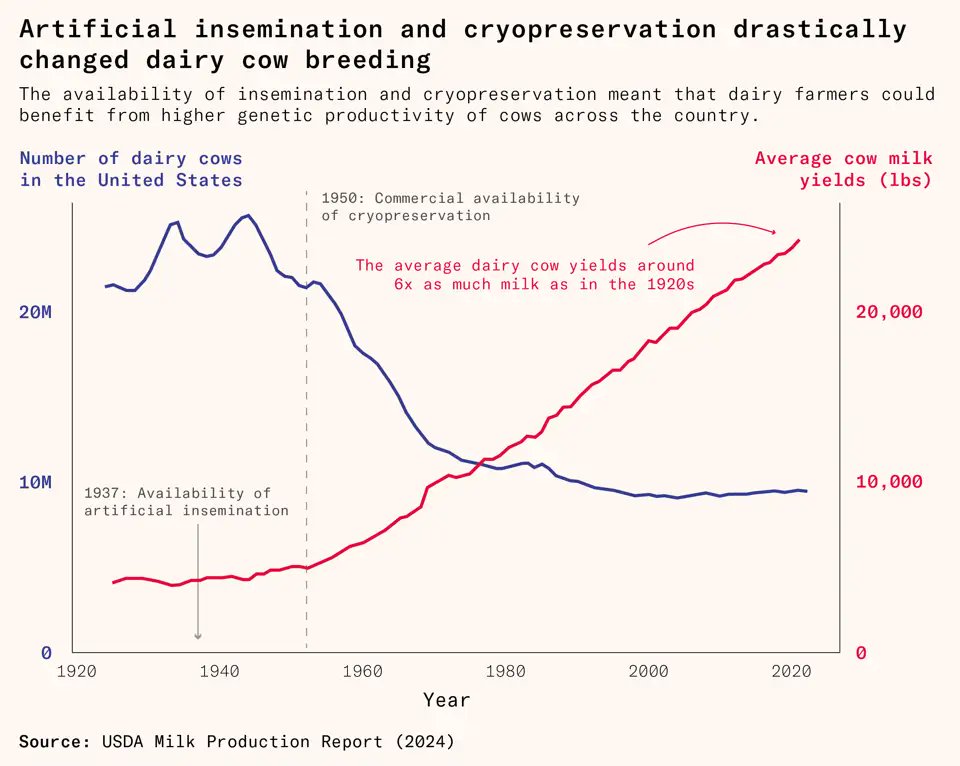
Because everyone buys from the same companies, a handful of bulls sire a huge share of calves. The Holstein breed's effective population size is (genetically) under 60. But this genetic selection process has increased milk yields per cow over the last few decades.
Meet the bluebuck, Africa’s lost blue antelope. For the first time ever, its story is being told. 🎥 Drops July 29 at 12 p.m. ET (UTC-4) on YouTube, with a Colossal scientist live to answer your questions.
India is building metro rail urban mass transit at a scale that is unimaginably staggering
As of June 2026, MoHUA alone has 30 metro projects under various stages of implementation. 886 km at a combined sanctioned cost of ₹3.04 lakh crore.
And even this dramatically understates the national build-out.
The list excludes much of Mumbai/MMR’s massive state govt agencies-led metro programme (which is roughly another 135 km under construction involving 60,000 crore ) as well as Kolkata Metro’s ongoing expansion (about 30 km), largely implemented under the Ministry of Railways rather than MoHUA.
Put the different metro constructional pipelines together and India comfortably has 800+ km of metro rail currently being built , on top of nearly 1,000+ km network already operational.
A gigantic transformation of how Indian cities move is happening simultaneously beneath and above the streets of virtually every major urban region
Source https://t.co/UYBtOyu4Gi
Hear the man himself: Satyanarayan Nuwal, Chairman, Solar Defence & Aerospace Ltd. (SDAL):
“Bhargavastra is a complete system. Internal trials will finish in 2–3 months. The micro-missile has already been tested at Balasore and Pokhran, and the integrated system, including radar, EOTS, and missile has been validated. Our radar has a 10 km range and the EOTS 6 km, exceeding the Army’s current 2.5 km requirement. We have already begun work on a 6 km interceptor and are confident of realizing the PM’s ‘Sudarshan Chakra’ vision by 2030 with a layered 2.5 km, 6 km, and 25 km air defence system.”
it's ironic that the first autonomous AI attack was done by a close weight model defended by an open weight model, where everyone was expecting the opposite
The @DRDO_India has successfully conducted the maiden flight test of Long-Range Surface-to-Air Missile Kusha today from the APJ Abdul Kalam Island off the coast of Odisha.
Kusha missile system is capable of neutralising wide variety of aerial threats including fighter jets, missiles, UAVs and large enemy aircrafts within a wide range and altitude envelope.
Today’s successful test flight of Kusha marks an important milestone in Indian defence R&D. The capability in developing long range surface-to-air missile system is possessed only by a handful of nations. This will also eliminate the import dependency for such systems and signifies a giant leap in air defence capability of the nation. I congratulate DRDO and other stakeholders for this achievement.
If you walk into the Secretariat of Public Education in Mexico City & look up at the massive, world-famous frescoes painted by Diego Rivera, you will see something that should make every Indian’s jaw drop.
Among the painted Mexican revolutionaries, farmers & national heroes sits an Indian man with intense eyes, sitting at a long wooden table, breaking bread with poor peasants.
He is not a diplomat. He is not a movie star. He was a wanted fugitive from Maharashtra whom the British Empire spent decades trying to hunt down & the man who quietly revolutionized global agriculture before the world even knew what the "Green Revolution" was.
His name was Pandurang Sadashiv Khankhoje.
Born in 1884 in Wardha, Maharashtra, Khankhoje grew up on stories of the 1857 uprising. While other kids played games, young Pandurang spent his teens founding secret societies & training in martial arts. Inspired by Lokmanya Tilak, he reached a radical conclusion early in life: To defeat an empire, you need military training & global allies.
In 1906, penniless & under British surveillance, he fled India on a ship. He worked his way through Japan & San Francisco, eventually enrolling at the Mount Tamalpais Military Academy in California while earning a degree in agriculture at Oregon State University.
In Oregon, he co-founded the Ghadar Party, the legendary international movement aimed at overthrowing British rule in India through armed revolt.
During World War I, Khankhoje traveled across Europe & the Middle East, attempting to recruit Indian soldiers in the British Indian Army to turn their guns against their colonizers. But the revolt failed. British intelligence put a massive price on his head. He could not go back to India. He could not stay in the West. He was a man w/o a country.
Exiled & on the run, Khankhoje slipped across the border into Mexico in the 1920s. Mexico was rebuilding after its own bloody revolution & its rural population was dying of starvation & drought.
Khankhoje realized something profound: An empire does not just conquer with guns; it conquers through hunger. If you want a nation to be truly free, you have to feed its people.
Appointed as a prof at the National School of Agriculture in Texcoco, he threw himself into plant genetics. Working under harsh conditions with limited funding, he did something extraordinary:
- Taming the Wild Corn: He crossbred wild grass (teosinte) with domestic maize, creating high-yielding, drought-resistant hybrid corn that produced multiple ears per plant instead of just 1.
- Frost-Proof Wheat: He developed new strains of high-yield wheat capable of surviving extreme Mexican weather & blights.
- Schools for the Poor: He did not lock his research in academic journals. He founded the Escuelas Libres de Agricultura (Free Agricultural Schools), teaching impoverished Mexican farmers hands-on genetics, soil conservation & yield optimization.
His high-yield crops transformed Mexican farming. Decades later, when American scientist Norman Borlaug came to Mexico & developed the high-yield dwarf wheat that kicked off the global Green Revolution, he built directly upon the foundation of plant genetics laid by Pandurang Khankhoje.
In 1947, India finally won its independence. The British were gone.
Now an elderly scientist globally celebrated across Latin America, Pandurang Khankhoje packed his bags & came home to Nagpur, eager to offer his life's work to build the agricultural backbone of a newborn India.
The bureaucracy of newly independent India did not know what to do with him. His radical revolutionary past frightened bureaucrats; his foreign academic achievements were ignored. He was given no major agricultural policy role, no national honors & no platform :((
When he passed away in Nagpur in 1967, his passing barely made a ripple in the local newspapers. His neighbors knew him simply as a quiet, retired old man who used to live abroad.
Today, if you ask an Indian agricultural student who fathered modern crop hybridization, they will quote Western scientists. Almost no 1 in Maharashtra/Delhi knows the name Pandurang Khankhoje.
But 1000s of KMs away in Mexico City, inside the halls of govt, his face remains painted on the wall, immortalized by Diego Rivera as a symbol of unity, knowledge, and freedom.
He was erased from the history books of the country he fought to liberate, but the soil of Mexico still remembers the Indian ghost who taught them how to feed a nation.
ORBIT ACHIEVED. 🚀
Vikram-1 Test Flight-1 has reached orbit. India's first privately developed orbital rocket has completed its final burn and injected its payloads into a ~450 km orbit, making India the third country in the world with private orbital launch capability.
History is made. 🇮🇳
#Vikram1 #JourneyToOrbit #SkyrootAerospace