VoidZero, the team behind Vite, Vitest, Rolldown, Oxc, and Vite+, is joining Cloudflare. Vite stays open source, vendor-agnostic, and built for everyone. https://t.co/DJTpX4Q9Xt
VoidZero is joining Cloudflare.
Our mission stays the same: to make JavaScript developers more productive than ever before. Vite, Vitest, Rolldown, Oxc, and Vite+ remain MIT-licensed. Evan and the VoidZero team will continue leading them.
Cloudflare shares our commitment to open source. Together, we can keep investing in the tooling developers rely on every day, while bringing the Vite ecosystem and Cloudflare’s platform even closer together.
Introduce Transform for producing Compose State.
A new Transforms library is introduced, which leverages a headless Compose runtime to enable the production and management of Compose State independently from the Compose UI layer.
https://t.co/GXFZ4unYhD
retain() in Jetpack Compose is what remember() wished it was 🔥
remember → lost on rotation
rememberSaveable → needs Parcelable
retain() → survives config change, no Parcelable, no Bundle limits 🚀
Think ViewModel, but scoped to a composable.
#JetpackCompose#AndroidDev
Fork your dependencies, trim them to only your use case, never update unless it breaks for your users. I’ve been vocal about this for 10+ years. I’ve always said that updating is way riskier than latent bugs (which can be tracked and CVEs monitored).
If you are updating a dependency, it’s on you to analyze every single commit in the full transitive set of dependencies. If you dont see anything compelling, dont update!
I remember at HashiCorp once in awhile an engineer would try to update a dep or replace a DIY lib with an external one and id always ask “show me the commit we need.” Dont update for the sake of it.
Feeling pretty swell about this mentality with all the supply chain attacks happening.
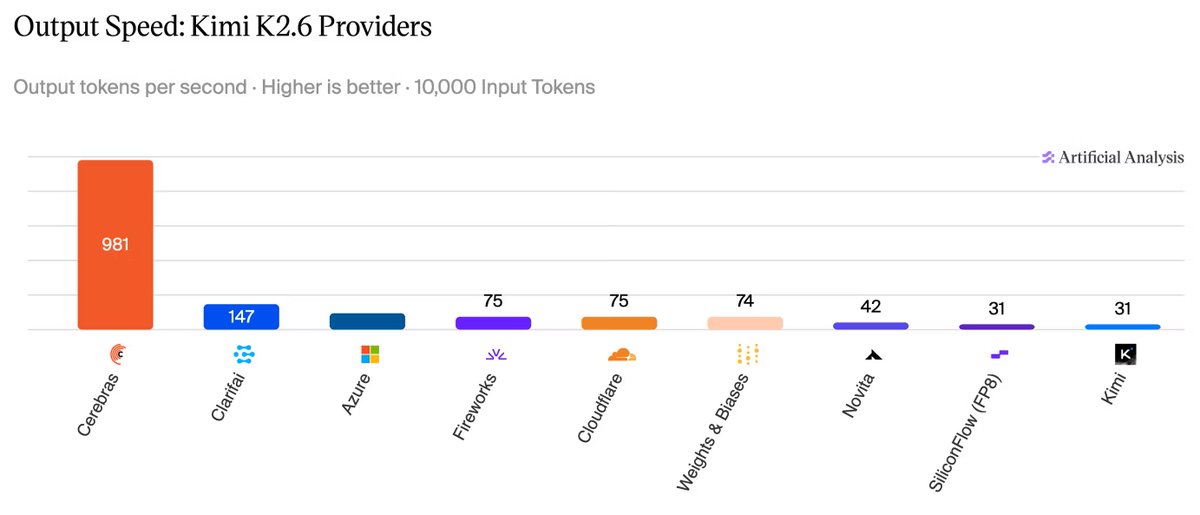
Cerebras is now running Kimi K2.6 – a trillion parameter model – in enterprise trials.
At ~1,000 tokens/s, this is the fastest frontier model performance ever measured by Artificial Analysis @ArtificialAnlys.
Transitioning Gemini CLI users to Antigravity CLI
We are unifying our efforts around a single harness and platform, Google Antigravity with four distinct surfaces:
• Antigravity 2.0
• Antigravity CLI
• Antigravity SDK
• Antigravity IDE
This will allow us to move faster and give you a streamlined experience wherever you do your best work.
Rebuilt in Go for speed, Antigravity CLI is available today and brings robust multi-agent orchestration and asynchronous workflows to your terminal.
Important things to know:
1. If you are using Gemini CLI through your Google one account (Google AI Pro or AI Ultra) or through Gemini Code Assist for individuals (free offering) we will be helping you migrate your workflows over the next 30 days.
2. No action required for Enterprise users. Enterprise plans and API keys will continue to be supported in Gemini CLI.
Read the full details in our blog post → https://t.co/IqvqDt9XLn
I have yet to see a benchmark where it is slower than the Zig implementation. It is basically the same codebase. It doesn’t use async rust and like the Zig implementation, uses few 3rd party libraries. It’s really the same thing just with better tools for us to prevent crashes.