During a spacewalk early in his career, @astro_luca's helmet began to fill with water. As the water started to rise Luca couldn't breathe, communicate or even see, relying on his safety tether to return to the airlock - and safety. He handled the life-threatening crisis with so much calm and clarity that his heart rate stayed stable at a resting rate and colleagues at mission control couldn't even tell he was stressed.
This is a story that is passed around the hallways at ESA as legend. It's a story that tells you more about an astronaut than any CV ever could.
Luca is precise, composed and determined. He is exactly the right person for this role. A test pilot by training, with two missions to space, a commander of the International Space Station – he has seen spaceflight from every angle that matters.
Yesterday I felt so much pride for Luca, as I caught a glimpse of his two daughters from the audience while they watched their father named part of the #ArtemisIII crew, in what must be one of the most emotive moments of his career.
Caro Luca, siamo tutti orgogliosi di te. Buon volo!
https://t.co/f2yCvYe6eM
🚀 Mark your calendars.
On June 17th, Ariane 64 will launch 36 Amazon Leo satellites into orbit.
This will be the first Ariane 6 flight equipped with four P160C boosters, increasing its payload capacity from 32 to 36 satellites on a single launch.
🕒 Launch window:
- 07:53 - 08:22 (Washington, D.C.)
- 08:53 - 09:22 (Kourou Time)
- 11:53 – 12:22 (UTC)
- 13:53 - 14:22 (Paris time)
#LaunchingAmbitions #Ariane6 #VA269
@Amazonleo@ArianeGroup@esa@CNES@EuropeSpacePort
The Japan Aerospace Exploration Agency, @JAXA_en, is an important partner with @ESA on Ramses, providing its TIRI infrared surface imager, lightweight solar array wings and its H3 heavy lift vehicle – detailed by Makasi Fujimoto, Director General of JAXA’s science institute ISAS
The end of a journey, the start of arrival 🛰️🌑☀️
After 8 years of solar electric propulsion, @esa 's @BepiColombo switches off SEP as it enters its Mercury arrival phase!
Next? MTM separation, orbit insertion & a bold new chapter around the innermost planet! 🎉
#bepicolombo
⚡️Hicari-II Results
💎Why do crystals grow faster in space? 🤔
Experiments using the Gradient Heating Furnace on “Kibo” revealed that transient constitutional supercooling in microgravity drives rapid growth in the early stage—unseen on Earth✨
Advancing semiconductor crystal growth!
https://t.co/lfCtIW9U1r
The @astrobotic Griffin-1 lander is nearing the end of final assembly before heading to California for environmental testing next week. The @Astrolab_Space FLIP rover will be integrated onto the lander down at the Cape ahead of launch in late 2026.
📸: @w_robinsonsmith
Today, we unveiled our Griffin-1 lunar lander, recently designated by @NASA as Moon Base II🌙, during a visit by NASA reps, gov officials, and industry partners at our HQ in Pittsburgh. "Today, Griffin stands behind us as proof of what is possible when talented people spend years solving hard problems together," read more: https://t.co/KokSZAGPPE
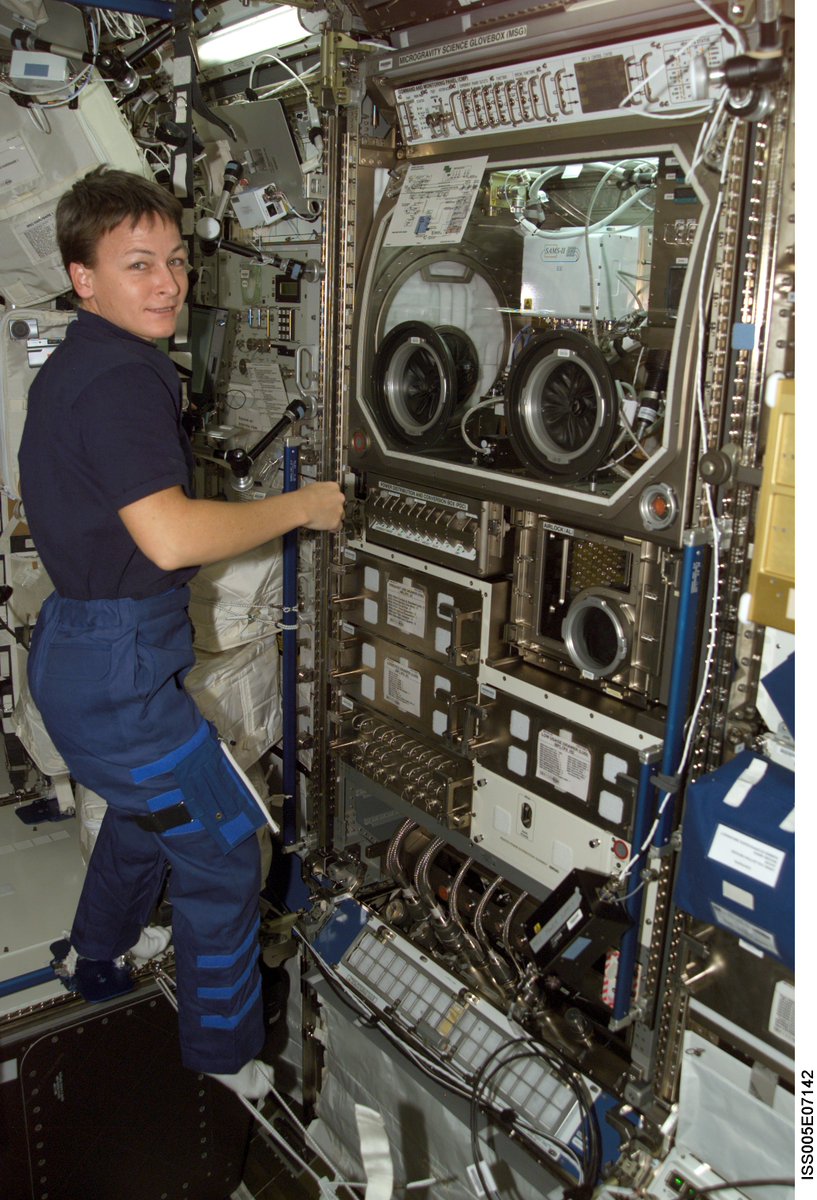
The Microgravity Science Glovebox (MSG) reached 100K hours of operation! Since 2002, this facility has hosted many experiments while keeping astronauts and the space station contamination-free.
Check out photos of MSG’s science throughout the years: https://t.co/npkhsz5hUy
☎️ On June 9, at 7:57 a.m. CT, the Expedition 74 crew called the payload operations team at @NASA_Marshall to celebrate a major milestone. The Microgravity Science Glovebox aboard station has hit 100,000 hours of crew science and autonomous operations!
The Artemis III crew has already made an impact on our lunar rovers.
Artemis III Commander @AstroKomrade and Mission Specialist Frank Rubio participated in human factor testing of our FLEX rover mockup in 2024. They tested every interaction point on the FLEX mockup in full EVA suits: hatches, controls, handholds, ingress and egress. Their feedback shaped our design.
Lanzamiento a las 07:30 UTC del CZ-5 Y11 desde Wenchang con el satélite geoestacionario militar TJS-25 (aparentemente similar a los TJS-11, 20 y 23). El lanzamiento usó la cofia larga de 18,5 metros.
Let me just remind everyone that Apollo 9 did not see the CSM dock to a docking target and then undock, it saw the CSM dock to the LM, have the crew transfer over, and then actually FLY the lunar module in low earth orbit.