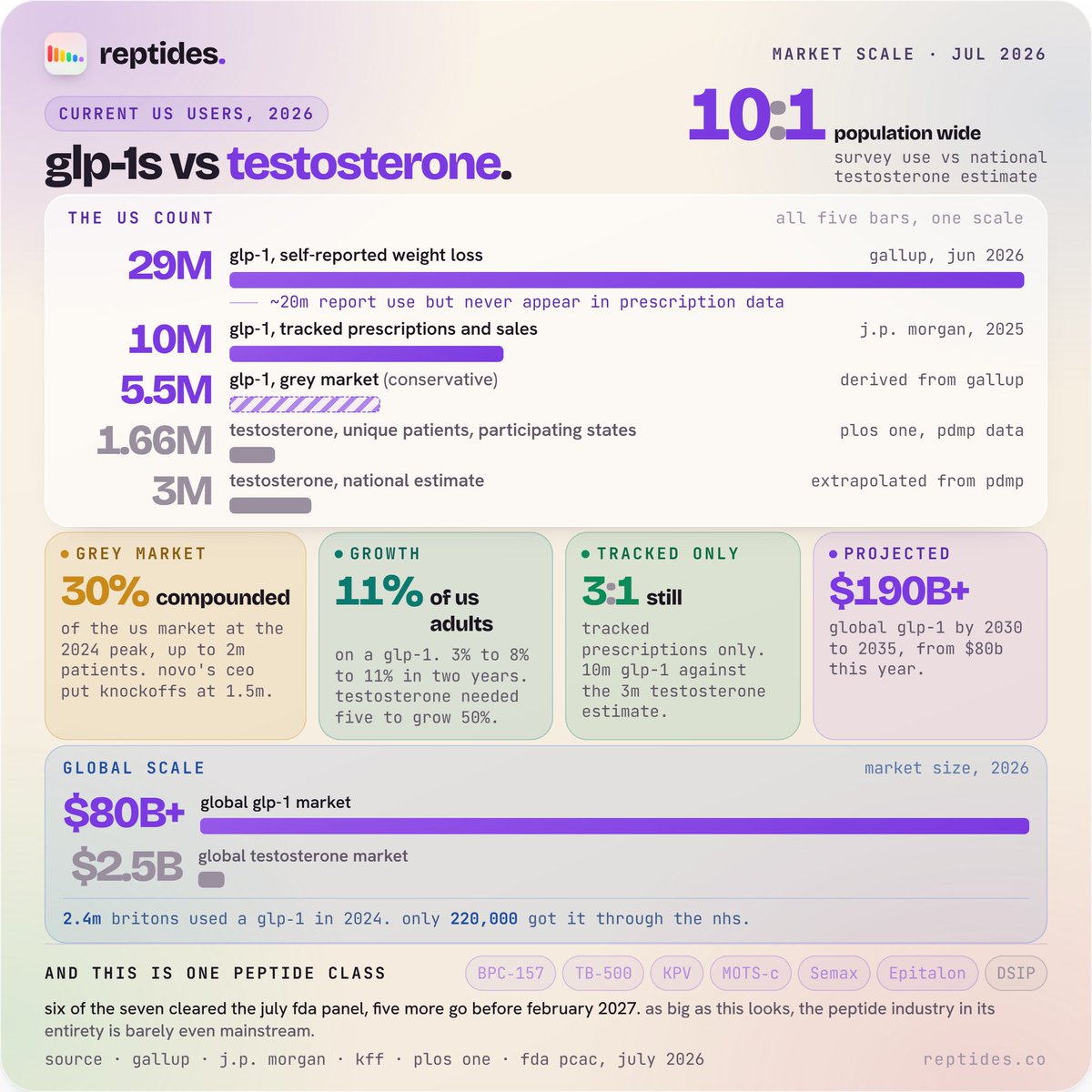
To give you some perspective on how large the peptide market already is... here is some context around current GLP-1 users vs. Testosterone.
Current confirmed GLP-1 US users:
- 11% of US adults are on one for weight loss. Roughly 29 million people (Gallup, June 2026)
- 12% are on one for any indication, weight loss or diabetes or cardiovascular (KFF)
- Prescription and sales data tells a smaller story: about 10 million in 2025, up from 6 million in 2024 and 5 million in 2023 (J.P. Morgan)
Roughly 20 million people report being on a GLP-1 who never show up in prescription data.
Current estimated grey market GLP-1 US users:
- 19% of current users say they are on a compounded or custom-mixed version right now. Another 12% do not know what they are taking (Gallup)
- Novo Nordisk's own CEO said in January that up to 1.5 million Americans are on compounded or knockoff versions of their drugs
- At the 2024 peak, compounded product was roughly 30% of the entire US GLP-1 market and supplied up to 2 million patients (KFF Health News)
Based on this data, a VERY conservative estimate of the number of people on grey market GLP1s is likely 5.5 million.
These figures are lagging behind a boom that is taking place that is not visible publicly right now.
Testosterone, current US users:
- 1.66 million unique patients filled a testosterone prescription in 2022, 0.98% of the population studied (PLoS One, state prescription monitoring data). That study covered participating states only, so the national number is likely 3 to 5 million
- 11 million prescriptions written in 2024, up from 7.3 million in 2019. That is scripts, not people
- Lifetime non-medical steroid use in the US runs 3 to 4 million, and lifetime is not current
If you compare:
- Population wide: roughly 10:1 in favor of GLP1s to Testosterone based on survey data. Still 3 to 1 using only tracked prescriptions
- Men only, which is the fair fight since TRT is almost entirely male: 9% of American men are on a GLP-1, roughly 11 to 12 million, against 1.5 to 4 million on prescribed testosterone. Roughly 4:1
- Growth: GLP-1 use went 3% to 8% to 11% of adults in two years. Testosterone scripts grew 50% in 5 years
If you zoom out globally:
- At least 2% of European and UK adults are on a GLP-1, roughly 9 to 10 million people
- 2.4 million Britons used one in 2024. Only 220,000 got it through the NHS. The other 2.2 million paid privately
- France started reimbursing Wegovy and Mounjaro at 65% on June 15, the first permanent coverage in the EU
- The global GLP-1 market is north of $80 billion this year, projected at $190 to $200 billion by 2030 to 2035
- The global testosterone market is $2.5 billion
And all of this is just one peptide class vs testosterone.
As big as it may seem, the peptide industry in its entirety is barely even mainstream.
The FDA voted on seven more last week. BPC-157, TB-500, KPV, MOTS-c, Semax, Epitalon, DSIP.
Six of the seven cleared the PCAC vote, and another PCAC covering five more is already scheduled before February 2027.
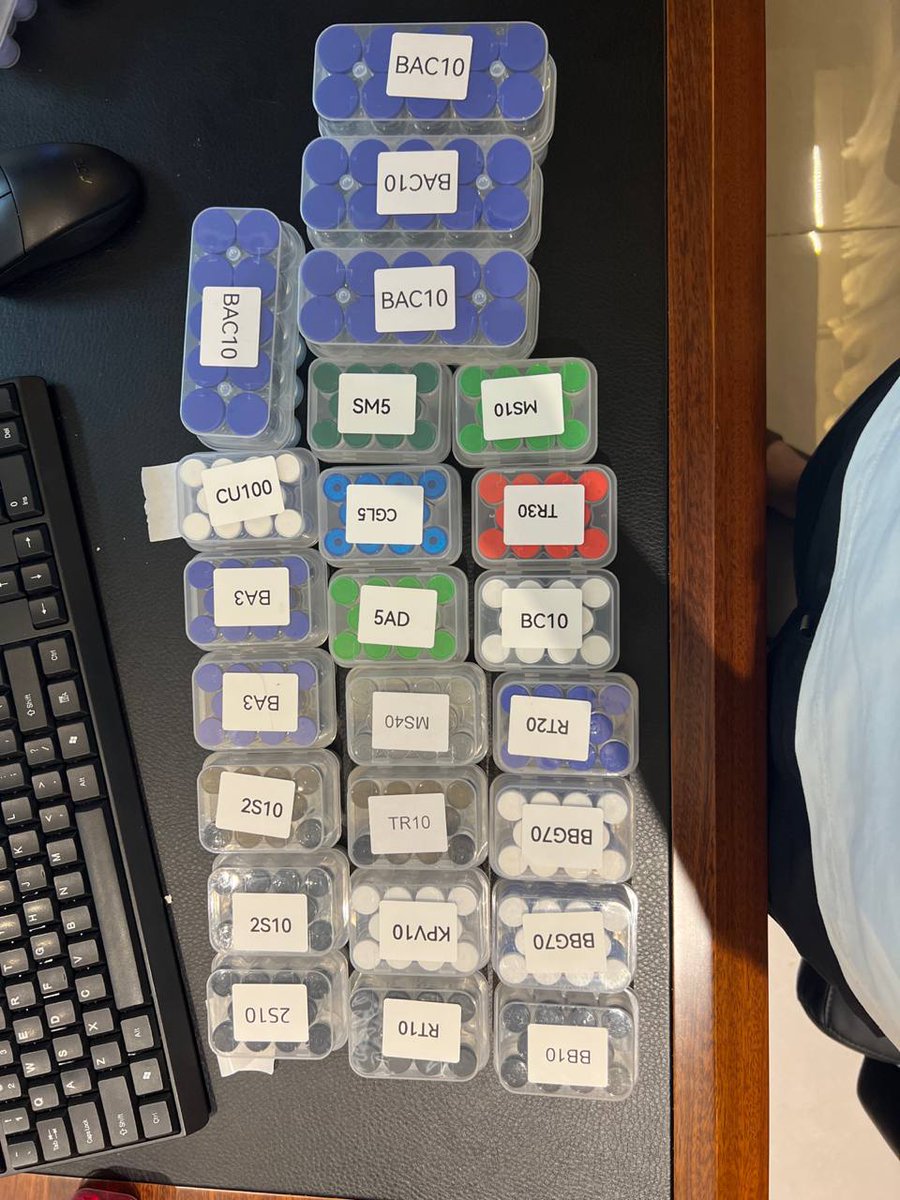
A mistake occurred while preparing the order for the customer.
The customer had requested the RA10, but we accidentally provided the RT10 instead. This kind of error must not happen again. In light of this mistake, we refunded the customer for the RA and gave him the RT10 for free.
@AbudBakri@DrAlexTatem Research laboratories at some of China’s top universities do indeed have many outstanding researchers, who are often recruited by major pharmaceutical companies.
Goods from Brazil took over 40 days to reach the customer. This is related to both the freight forwarding company and the customer's customs clearance capabilities. Therefore, customers in Brazil should not place orders, as the probability of receiving the goods is too small due to the strictness of Brazilian customs.