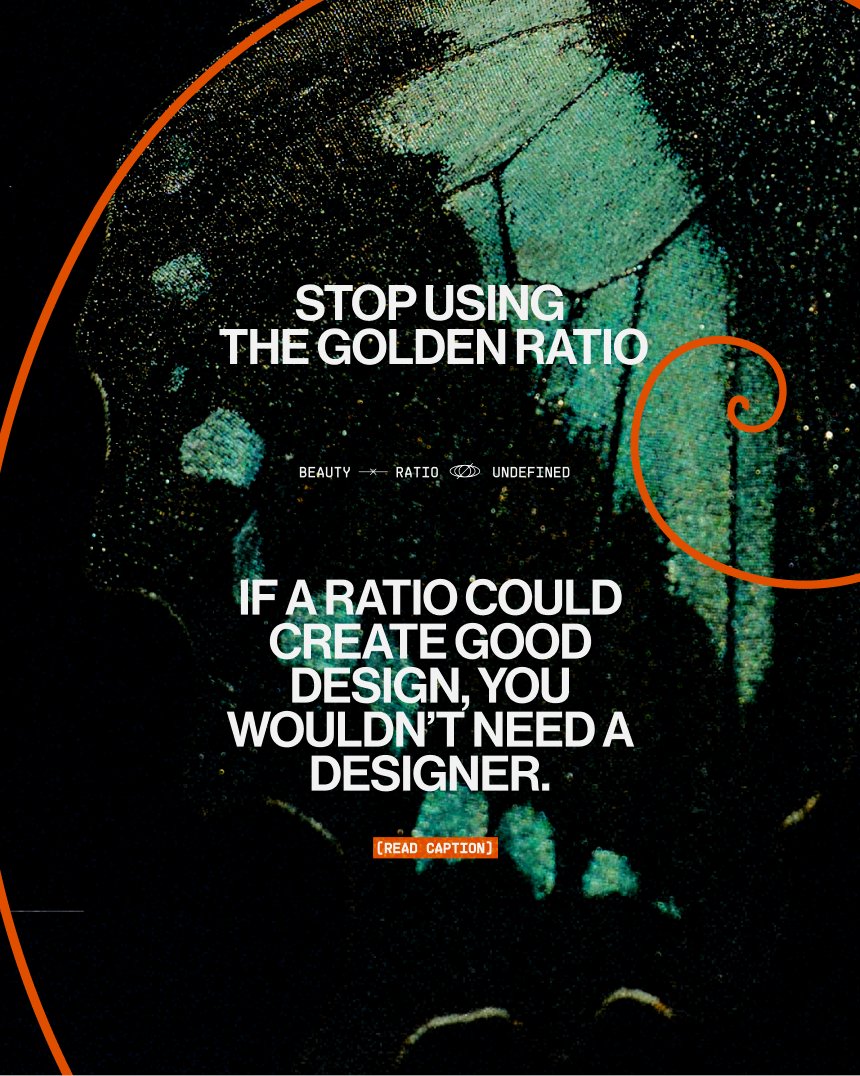
We need to stop designing with formulas.
The golden ratio or any ratio/hack isn’t a shortcut to good design.
Using the “right” ratio doesn’t magically make something beautiful or usable.
I used to design like this too. Even when something felt off, I’d tell myself it should work because the ratio was right. Looking back, I just didn’t trust my own judgment.
There’s no proven formula for beauty. What people find attractive or pleasing changes with culture, context, and experience. If one ratio worked for everyone, everywhere, we wouldn’t still be debating it.
Good design works when there’s intent behind it.
Sometimes the problem isn’t big.
Sometimes it’s simply: this doesn’t look right.
When a design doesn’t feel right, a hack won’t save it. You have to ask why—whether the hierarchy is weak, the balance is off, or the structure isn’t clear.
Or is the cultural context completely different?
Take Japan. A lot of Japanese design is dense, maximal, visually full. By many Western design rules, it shouldn’t work. But it does—because it’s cultural. The intent matches the environment it’s made for.
Even things like symmetry and balance don’t work because of math.
They work because of evolution.
For thousands of years, symmetry meant health and safety. Rotten food looked wrong. Healthy plants looked right. Our brains learned these patterns long before design ratios or systems existed. That’s why certain things feel “right” to us—not because of numbers, but because of survival.
So no, there’s no ratio to beauty.
Use structure when you need structure.
But stop outsourcing taste to formulas.
Trust your eye. Trust your intent.
Understand the culture you’re designing for.
Curious what others think—
do ratios help you, or do they limit your judgment?