@aleabitoreddit@Sofigoodboy I see the recent neocloud selloff as an opportunity.
Tighter financing and permitting constraints may actually strengthen the moat of established players with secured capacity and hyperscaler contracts.
I agree LTAs won’t necessarily protect peak margins.
But for hyperscalers to build substantial DRAM inventories, supply must first catch up with demand. Their current low inventories suggest the opposite.
LTAs are about securing long-term Q growth, not defending peak prices.
Gradual price normalization is fine as long as volume growth supports revenue and FCF.
The real risk begins when supply growth consistently outpaces demand.
I agree that LTAs can be renegotiated and won’t necessarily protect peak margins.
But I think there’s an important assumption missing here.
For hyperscalers to build substantial DRAM inventories, supply needs to catch up with demand first.
If hyperscalers are still operating with minimal inventories, as he mentioned, doesn’t that suggest demand continues to outpace available supply?
More importantly, I don’t think maintaining today’s DRAM prices is the real objective.
I’d rather see prices normalize gradually while structural growth in Q continues to drive revenue and cash flow.
To me, LTAs are more about securing long-term volume visibility than protecting peak pricing.
The real risk begins when supply growth consistently exceeds underlying demand growth.
I'd like to believe LTAs are durable too. But take one example.
Analog chipmaker onsemi said this in 2023.
On January 5, 2023, at JPMorgan's CES forum, CEO Hassane El-Khoury was asked how much LTSAs would still hold once the shortage eased. His answer: “They are a legally binding agreement ’cause they’re a liability for the customer because they’re take or pay.” He also said he would not accept a customer reopening price talks just because it could get the same parts 10% cheaper elsewhere.
On October 30, 2023, on the Q3 earnings call, onsemi cut its SiC shipment forecast for the year from $1 billion to more than $800 million after one automotive OEM reduced demand. An analyst asked how this could happen when the company had been saying its LTSAs were legally binding. The same CEO reaffirmed that they were binding, but said he did not want to enforce the contracts just to push inventory onto a customer whose demand had dropped. If it worked for both sides, terms could be adjusted customer by customer, whether by a quarter, a year, or longer.
In its 10-K filings, onsemi also states that it amended LTSAs with some strategic customers by mutual agreement in 2024, and changed delivery schedules and committed volumes on some LTSAs in 2025 as demand shifted.
Microchip is another case. Customers in its Preferred Supply Program (PSP) originally had to place 12 months of orders and could not cancel or reschedule them unless Microchip raised prices. On its November 2025 earnings call, however, the CEO said the company had accepted some cancellations and pushouts so customers could adjust their backlog. On the same call, the CFO separately addressed the multiyear LTSAs the company had signed. Some of those contracts were still in effect, he said, but customers had been allowed to defer taking delivery of committed volumes by one to two years if they needed to.
Every time I see cases like these, I doubt how much memory makers' LTAs will protect earnings in a downcycle. Right now the most reliable thing is the prepayments and deposits themselves. That cash can go into capacity expansion today.
I can picture hyperscalers with no DRAM inventory continuing to buy at current prices. But once inventory has piled up, will they keep taking every committed unit at the same price? I have a hard time picturing memory makers holding customers to the high contract price all the way through.
The LTA itself may never be broken and may stay in place. But if both sides agree to push this year's volumes into next year or two years out, this year's earnings estimates come down. If price gets renegotiated too, margin estimates have to come down as well.
Again, I agree LTAs are sturdier than they used to be. What I question is whether, after demand turns, memory makers can still earn 80% margins on contracts signed during the upturn and keep collecting hundreds of billions of dollars in profit because of those LTAs.
OpenAI's latest usage figures highlight the accelerating adoption of ChatGPT.
According to OpenAI executive Adam Fry:
• 1.2B weekly active users, up 200M in just two months.
• Search-related queries now equivalent to ~20% of Google's search volume, based on OpenAI's estimates.
• 1.5B images generated weekly.
• 250M weekly active voice users.
Notably, the 20% figure refers to relative query volume, not search market share.
Meanwhile, Google's search revenue continues to grow, suggesting that AI-powered search adoption has yet to translate into a clear decline in Google's core search business.
The broader trend is clear: AI usage is expanding beyond text-based interactions into search, images, and voice.
The next metric worth watching is how quickly this growth translates into revenue relative to inference costs.
The growing political backlash against data centers may create an interesting divergence within AI infrastructure.
Regardless of whether Democrats or Republicans control state governments, stricter permitting, environmental standards, and community acceptance are becoming structural constraints on new data center development.
I see this as a potential tailwind for $BE .
SOFC technology offers lower NOx emissions, less noise, and reduced water requirements compared with conventional gas generation, potentially improving its relative attractiveness under tighter environmental standards.
Stepping back from the market noise, KB Securities' 2027 memory outlook reinforces my conviction in $MU and $SNDK.
What stands out isn't just stronger demand. It's the structural supply constraint.
KB projects 2027 ASP growth of 40% for conventional DRAM, 32% for NAND, and 121% for HBM.
HBM is expected to consume nearly 30% of global DRAM wafer capacity while contributing only 13% of total DRAM bit supply. As HBM production expands, it effectively crowds out conventional DRAM capacity.
Meanwhile, AI inference is driving demand beyond HBM into server DDR5 and enterprise SSDs.
This creates a powerful combination: rising bit demand, constrained supply, higher ASPs, and operating leverage.
Long-term supply agreements add another layer of earnings visibility, potentially making this cycle more durable than previous memory upcycles.
For $MU , the thesis is HBM growth combined with structural DRAM tightness. For $SNDK , it's NAND pricing power, AI storage demand, and improving contracted revenue visibility.
I'm maintaining strict DCA on weakness, with one important condition: supply discipline must hold.
The real test comes in 2028–2029, when new capacity, Chinese competition, and contract renewals could challenge today's pricing power.
Until those fundamentals change, I see volatility as an opportunity to accumulate rather than a reason to abandon the thesis.
I plan to maintain my overweight position in $NBIS relative to $CRWV heading into earnings. I continue to hold both.
I remain constructive on long-term AI infrastructure demand, but my focus has shifted increasingly toward capital efficiency, financing costs, and FCF.
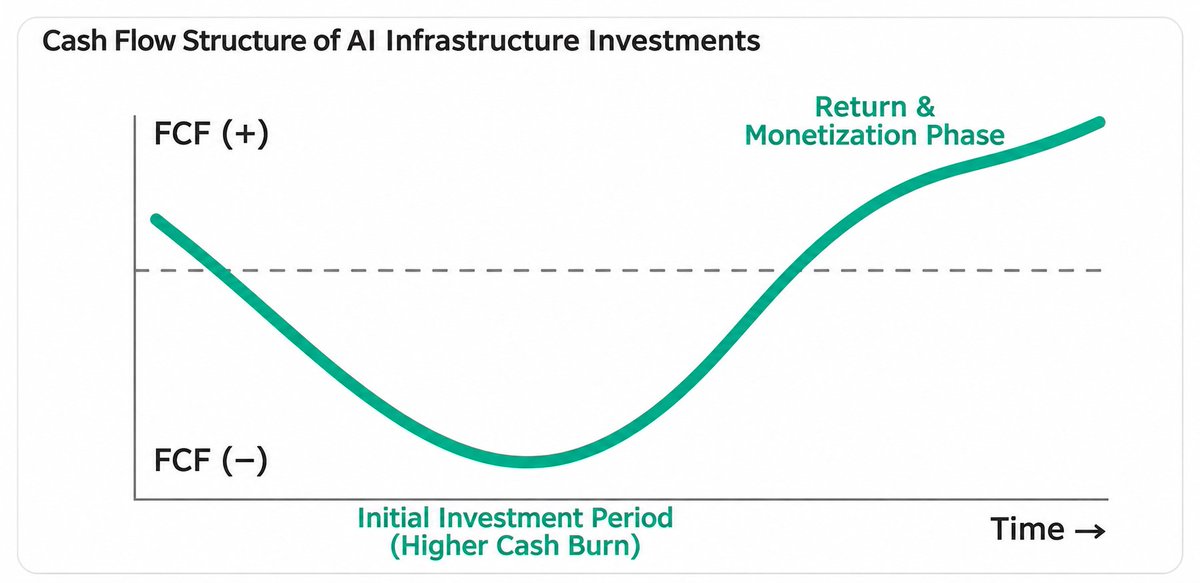
I believe we're still in the downward phase of the AI infrastructure J-curve, with 2027 likely to be the critical financing test before a potential FCF inflection in 2028–2029.
I currently favor $NBIS for its relatively more flexible funding structure, particularly customer prepayments, which could reduce upfront capital requirements and financing costs.
$CRWV offers significant growth potential, but its heavier debt burden, refinancing needs, and potential dilution leave it more exposed to tightening credit conditions.
That doesn't make $NBIS risk-free. Customer prepayments aren't the same as sustainable FCF, and both companies still need substantial capital to support growth.
I see the upcoming earnings as an important checkpoint for funding gaps, borrowing costs, CapEx commitments, and cash conversion.
For now, I prefer to stay overweight $NBIS while maintaining exposure to $CRWV , with disciplined DCA and strict financing guardrails.
I believe we're now entering the downward phase of the AI infrastructure J-curve.
I don't see negative FCF today as evidence that AI investments are failing. I see it as the consequence of CapEx running ahead of monetization.
I expect 2027 to be the most critical period for financing, with a potential FCF inflection in 2028 and a broader recovery emerging in 2029–2030.
But getting there won't be easy.
I see four things that need to happen: stronger utilization and monetization, slower CapEx growth relative to operating cash flow, sustainable financing, and returns on invested capital exceeding the cost of capital.
My biggest concern isn't the long-term demand for AI infrastructure. It's whether companies can finance the valley without excessive leverage, dilution, or disruption to their investment plans.
I also distinguish hyperscalers from neoclouds. Strong existing cash flows give the former more flexibility, while $CRWV and $NBIS remain more sensitive to financing costs and capital availability.
I remain constructive on the long-term AI infrastructure cycle, but I think 2027 will be the real test.
The J-curve may be real, but financing the valley is the real challenge.
I find the latest several semiconductor outlook broadly consistent with my long-term AI infrastructure thesis.
I see the market increasingly questioning capital efficiency, FCF, and financing costs rather than AI demand itself.
What stands out to me is the widening gap between memory CapEx and actual supply growth.
DRAM CapEx is expected to rise 54.5% in 2027, while bit supply grows only 24.4%. HBM will consume 30% of DRAM wafer capacity but contribute just 13% of bit output.
I also see Micron's expanding strategic customer agreements as a potential structural shift. With SCA revenue coverage moving beyond 35% toward 50%, memory earnings could become less cyclical and more predictable.
I remain constructive on $MU and $SNDK through 2027, although I see NAND supply dynamics as somewhat different from DRAM.
I expect 2028–2029 to be the real test, particularly as new capacity, CXMT expansion, and long-term contract renewals begin to influence supply.
I prefer to step back from short-term market volatility and focus on whether the underlying thesis is changing.
For now, I see no reason to abandon my disciplined DCA approach, as long as the key guardrails remain intact.
Long Memory.
DCA $SNDK — Key Takeaways from the Earnings Call: NBM
• 8 NBM customers, with 95% of contracted volume backed by investment-grade counterparties.
• FY27: 50% of bit supply already contracted.
• FY28: 67% of bit supply already contracted.
• Existing customers are requesting additional volumes beyond their original commitments.
• One customer has already signed a second agreement, with further contracts expected.
The most important signal isn't the 67% contracted supply for FY28. It's that customers are coming back for more.
AI-driven NAND demand is increasingly turning into committed, multi-year volumes rather than short-term orders.
Stepping back from the market, I'm increasingly focused on how hyperscalers can improve their OCF/CapEx ratios.
Latest quarterly figures:
$MSFT 147% | $META 94% | $GOOGL 82% | $ORCL 81% | $AMZN 56%
Below 100% doesn't necessarily mean AI demand is weakening. These companies are already generating substantial revenues and operating profits while investing aggressively in future capacity.
What interests me is how they plan to improve capital efficiency.
Microsoft is optimizing infrastructure utilization. Google and Amazon are scaling proprietary AI chips. Meta is targeting over 10x compute cost efficiency for Muse. Oracle expects lower capital intensity and a return to positive FCF.
I believe OCF/CapEx can improve over time through higher utilization, cheaper inference, and stronger monetization — not necessarily lower CapEx.
But there is another side to this.
Greater hyperscaler efficiency, particularly through proprietary ASICs, could pressure NVIDIA's GPU economics and the pricing power of GPU-dependent neoclouds.
Memory and optics, however, remain essential across both GPU and ASIC architectures, although supply discipline still matters.
My long-term view remains unchanged.
AI demand is real. Hyperscaler competition is inevitable. But the economic benefits will not be distributed equally across the infrastructure stack.
China's optical stocks sold off sharply today.
Tianfu -20%, Eoptolink -10%, Innolight -8%.
I see this as a combination of earnings disappointment, and profit-taking rather than a structural decline in AI optics demand.
With hyperscaler CapEx still expanding, Long Optics thesis remains intact.
Demand hasn't changed.
$LITE $VIAV $SMTC $AAOI
Citi's latest $MU investor meeting reinforces Long Memory thesis. But I'm increasingly focused on the supply risks emerging in 2028–29.
A few key takeaways:
• DRAM supply is expected to remain tight through 2027–28.
• Shrinking node efficiency gains make new cleanrooms increasingly necessary.
• Meaningful new capacity additions should accelerate into 2029.
• Micron's 26 strategic customer agreements improve revenue and pricing visibility through 2030 and beyond.
• Both HBM and conventional DRAM profitability remain strong.
My interpretation is simple.
Keep growing Q while protecting P on the downside.
LTAs could reduce earnings cyclicality and potentially support a structural valuation re-rating.
I remain constructive on $MU and $SNDK through 2027, viewing corrections as disciplined DCA opportunities.
According to Samsung, demand for long-term supply agreements is expanding beyond hyperscalers, server OEMs, and SoC vendors into mobile, automotive, and networking.
The target of securing 60–70% of 2030 capacity under LTAs now looks increasingly achievable. Customers want to extend contracts annually, but suppliers simply don't have enough capacity to accommodate everyone.
I see this as a structural shift in memory.
From spot-driven cycles toward greater long-term supply visibility and pricing discipline.
LTAs won't eliminate cyclicality, but they could significantly reduce the volatility that has historically defined this industry.
Long Memory. $MU $SNDK
Quarterly CAPEX missed expectations. But Annual AI spending is still moving higher.
$MSFT: $45.2B vs. $50.7B expected (-10.8%)
$GOOGL: $51.4B vs. $55.8B expected (-7.9%)
What matters to me is the forward guidance.
Google previously raised its 2026 CAPEX outlook from $180–190B to $195–205B, reaffirmed it this quarter, and expects another significant increase in 2027.
Microsoft also expects FY2027 CAPEX to grow YoY, despite near-term deployment delays.
I see a timing issue, not a demand collapse.
I'm viewing the current weakness in $NBIS and $CRWV as a disciplined DCA opportunity, while closely monitoring financing costs, dilution, and execution.
SK hynix’s call adds more detail to the memory thesis.
1. Pricing strength extends beyond HBM.
DRAM ASPs rose 27–29% QoQ, with bit shipments up roughly 10%. Server DDR5 sales volume grew over 40%.
NAND ASPs rose 24–26% despite slightly lower shipments, reflecting a shift toward higher-value products such as enterprise SSDs.
2. HBM4 is moving into meaningful volume.
Management expects HBM4 to exceed HBM3E in both shipments and revenue mix in Q4. HBM4 yields are ahead of plan, prompting higher targets, while HBM3E has also exceeded its planned mature yield.
HBM4E samples were delivered in Q2, with customer evaluation and custom HBM development progressing.
3. Supply is growing, but so is committed demand.
Q4 DRAM bit shipments are guided up 24–26% QoQ, supported by process migration and the M15X ramp. For 2027, DRAM bit growth is guided at 24–26%, versus 17–19% for NAND.
The question is how much of that incremental supply is already spoken for.
4. LTAs are improving visibility.
Fourteen customers have signed LTAs, with contracted volume covering more than 50% of total 2027–28 capacity. Some customers are discussing extensions.
Management describes DRAM and HBM as effectively sold out through 2027 when signed contracts and customer demand discussions are combined.
That distinction matters: contracted volume and demand under discussion are different levels of visibility.
5. HBM de-spec does not automatically mean weaker demand.
Management framed some specification adjustments as a way to secure more available volume. Customer requests reportedly exceed available supply by more than 2x, and potential specification changes are already reflected in supply planning.
Watch total bits, qualified capacity and customer commitments—not specifications in isolation.
6. Inference expands the memory hierarchy.
SSD is already being used for KV-cache offloading. As cache sharing extends across servers and GPUs, management expects SSD’s role to expand further, with HBF being developed to bridge HBM and SSD over time.
This supports a broader demand thesis across HBM, server DRAM and enterprise SSDs.
For $MU and $SNDK , it strengthens the industry backdrop. Each company still has to deliver on execution, margins and customer qualification.
@JSCC2020Lee Exactly. I think that's the real structural shift. Long-term contracts won't eliminate memory cycles, but better demand visibility should allow suppliers to manage CapEx more rationally. That's what keeps me bullish on $MU.
What caught my attention from BofA's $MU meeting is that memory shortages are actually forcing customers to reduce memory content, not because demand is weakening.
I think the bigger story is the shift toward long-term supply agreements extending through 2030. Better demand visibility should allow suppliers to manage CapEx more rationally and potentially avoid the extreme oversupply cycles we've seen in the past.
I'm not saying memory cyclicality is disappearing, but I do believe this cycle is structurally different. It's no longer just about pricing power, but also earnings visibility and sustainable FCF.
My Long Memory conviction remains intact, and I'll continue disciplined DCA during corrections.
$MU $SNDK
Long Memory.
After reviewing the five key factors I’ve been monitoring, I remain cautiously bullish on AI infrastructure.
$CRWV & $NBIS Financing
Hyperscaler FCF
AI Credit Spreads
AI Model Economics
AI IPO Market
Financing structures are evolving, but I still need to see lower borrowing costs and less dilution risk for $NBIS and $CRWV. Hyperscaler CapEx remains strong, although FCF sustainability is becoming increasingly important. AI credit markets show no clear signs of relative deterioration, while progress in model monetization is encouraging. The IPO market could provide another funding channel, but its ability to absorb massive AI valuations remains untested.
My conclusion is that the Capital Bottleneck is gradually improving, but far from resolved.
I continue to prefer $NBIS over $CRWV on a risk-adjusted basis and intend to maintain disciplined DCA as long as these five factors show no material deterioration.
For $MU , $SNDK , $LITE , $SMTC and $VIAV, my long-term conviction remains intact. I believe the structural AI infrastructure cycle still has a long way to go.
I'm more interested in how bottlenecks evolve and eventually translate into earnings than in reacting to short-term market noise.
Demand is real, but financing remains the thesis.