on-chain credit/RWA protocols have a risk that's easy to overlook: you're relying on a borrower to actually pay you back.
if they default, the loss is yours, not the protocol's.
https://t.co/yAc5qSmREr works differently. there's no borrower, no IOU, no one who can decide not to pay you.
if the market doesn't hit your price, you keep your principal in the asset you started with + earn yield
you set your own risk too.
your own price, your own timeframe.
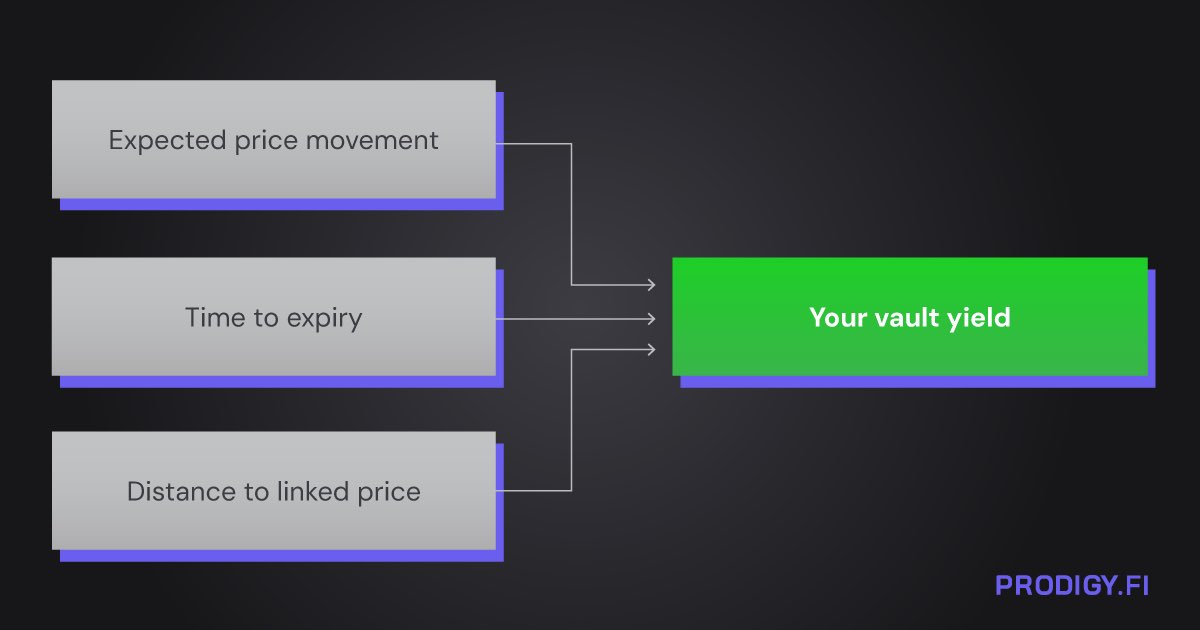
how ProdigyFi V2 sets vault yields:
yield isn't arbitrary. it's calculated from real options market data.
implied movement expectations.
time to expiry.
how far the linked price sits from current market.
all three feed into the same pricing model institutional options desks use.
when fear is elevated (like now) which drives up expected price movement, vault yields go up.
options get more expensive to sell, so the premium you collect is bigger.
when time to expiry is longer, yields compound differently.
this isn't a promotional rate. it's a market-driven rate.
the same data that prices institutional options prices your vault yield.
but don't need to trade options to earn it, great bonus.
https://t.co/7mnXtpsIec
https://t.co/yAc5qSmjOT V2 just dropped.
...with everything you asked for ✨
💫 dynamic pricing. yield that actually moves with the market.
💫 simpler UI. deposit in seconds, no confusion.
💫 no deposit caps. go big or start small.
structured yield, evolved.
live now on @Ethereum and @Base.
https://t.co/7mnXtpsaoE
defi yield is having a moment.
sky-high APYs are trending. everyone's asking the same question: where is the yield actually coming from?
some of it is looping. some is liquidity incentives. some is real borrowing demand.
they can all work, until the conditions that made them work change.
https://t.co/yAc5qSmREr's yield comes from a different place entirely.
a trader needs to hedge or leverage.
they pay a premium upfront.
it's locked on-chain the moment the position opens: one transaction, one defined outcome.
the yield exists because demand for that hedge exists.
not because of a rate environment.
not because of token incentives.
when the market shifts, the source doesn't.
https://t.co/eJqtQ0tpuT
US stocks dumping hard, oil exploding past $110 amid escalating geopolitical tensions.
macro chaos everywhere.
this is exactly when structured yield wins, no guessing direction, just getting paid on volatility. 📊
deploy $20k in our vaults at https://t.co/yAc5qSmjOT
→ pocket ~$230 extra in 4 days (~103% APY) on ETH while they figure it out.
NEW IN. our referral program just got juicier.
we’re democratizing structured yields and now, we’re democratizing the rewards too.
you can now earn up to 30% of protocol fees in rewards. no more counting invites; your tier now scales directly with the volume you refer.
Defi is a central part of the value that Ethereum provides. Financial empowerment is a central part of what it means to have agency and freedom in our current world. Finance is far from the only thing that Ethereum is good for, but it is an important thing. This post discusses how the Ethereum Foundation is approaching defi.
Defi today makes the world's best savings, risk management and wealth-building opportunities permissionlessly available worldwide. We need to build on that.
Ethereum's early defi era was great because it dared to dream and innovate and come up with totally new paradigms (eg. AMMs). Defi tomorrow will bring back that spirit. Don't just "make a better stablecoin", dig a layer deeper, and think about the underlying problem (risk management, hedging one's future expenses), and come up with an even better solution.
But also, as the EF, we are not interested in supporting "onchain finance" or even "defi" indiscriminately. We have a specific vision of what we want to see out of defi: permissionless, open-source, private, security-first global finance that maximizes people's control over their own assets, minimizes centralized chokepoints and trusted third parties, and democratizes risk management and wealth building (the two key goals of finance according to modern portfolio theory) as well as payments. We want protocols that pass the walkaway test: that keep working even if the original team suddenly disappears without warning (or even: becomes hostile / compromised without warning).
Bringing this vision to reality will inevitably take a lot of work. Defi is a complex toolchain, including various onchain components, user-side offchain components (ie. wallet, local agent...), other offchain components, etc.
The things that we care about include areas like:
* Improving security of defi through "traditional" means, eg. audits, standards, wallet-side safeguards
* Improving security of defi through "new" means, eg. AI-assisted formal verification, user-side agents as safeguards
* Oracle security and decentralization (there's A LOT of skeletons in the closet here, we as an ecosystem really need to point a big eye of sauron at it for a while)
* Privacy. Both privacy-preserving payments, and privacy of more complex use cases (eg. what does it mean to have a maximally privacy-preserving CDP? there are clearly benefits in reducing liquidation-sniping risk, but it requires hard tech to get there)
* Open source, and improving the licensing / forkability situation in defi
Ethereum is a permissionless protocol, and nothing stops people from deploying insecure protocols, protocols that enshrine ultimately unneeded centralized trust in the name of convenience, or dopamine-maximizing gambleslop. However, we *are* interested in working with anyone aligned to make permissionless, open-source, intermediary-minimizing and security and user-agency-maximizing defi ecosystem as strong as possible, so that it can be not just individuals and institutions' first choice in Ethereum, but also a globally compelling way to manage funds for anyone who needs its properties.