To reflect on the wisdom of the polymath and poet Omar Khayyam:
"To wisely live your life, you don't need to know much. Just remember two main rules: You'd better starve than eat whatever, and better be alone than with whoever."
China built the world’s manufacturing floor with vocational schools, not universities. 35 million students are enrolled in technical training right now. Their graduates get hired before they finish school.
We built grammar schools instead.
A bricklayer who understands laterite, a carpenter who can carve and turn wood, a potter who knows clay, a weaver who works cane and bamboo, a mason who reads soil; these are not lesser educated people. These are the people who physically build a country.
Our universities produce architects who cannot read a construction site. Engineers who have never mixed a material. Graduates fluent in theory and lost on the ground.
Vocational training should not come after university. It should come before it. Let every student learn to build something, make something, fix something before they are allowed to theorize about it.
The hand that knows what it is doing will always outbuild the mind that only read about it.
Good morning Africa.
Researchers in China are exploring bamboo as a potential alternative to petroleum-based plastics. The plant is gaining interest because it grows rapidly, needs relatively little fertilizer or water, and absorbs carbon dioxide as it develops. Bamboo fibres are also naturally strong, making them useful for reinforcing bio-based materials.
In laboratory tests, bamboo-fibre composites have shown strength levels similar to some conventional plastics, especially for uses like packaging and lightweight products. Certain bamboo-derived biopolymers also biodegrade more easily than standard plastics under industrial composting conditions.
Still, major hurdles remain before bamboo plastics can be widely adopted. Scientists are evaluating durability, resistance to heat and moisture, manufacturing costs, and real-world performance. While bamboo is unlikely to replace all plastics on its own, ongoing research suggests it could play a meaningful role in developing more sustainable materials.
France has taken a bold step by making planned obsolescence a criminal offense — meaning companies can now be punished for intentionally designing products to wear out early.
If manufacturers deliberately create electronics or appliances that fail sooner than they should- whether through weak hardware, software updates that slow devices, or other built-in limitations, they can face serious consequences. Penalties include up to two years in prison and fines of €300,000, or as much as 5% of a company’s annual revenue in major cases.
The law grew out of France’s consumer-protection efforts and was strengthened after investigations into phone slowdowns revealed how software could be used to push people into buying replacements.
But this isn’t just about punishment. It’s part of France’s wider “right to repair” movement, which aims to reduce electronic waste, stop hidden forced upgrades, and encourage companies to make products that last longer and can be repaired more easily.
By cracking down on disposable-by-design goods, France is sending a strong signal to manufacturers worldwide: build products to last. The goal is a more sustainable system where items are repaired instead of replaced helping both consumers and the planet.
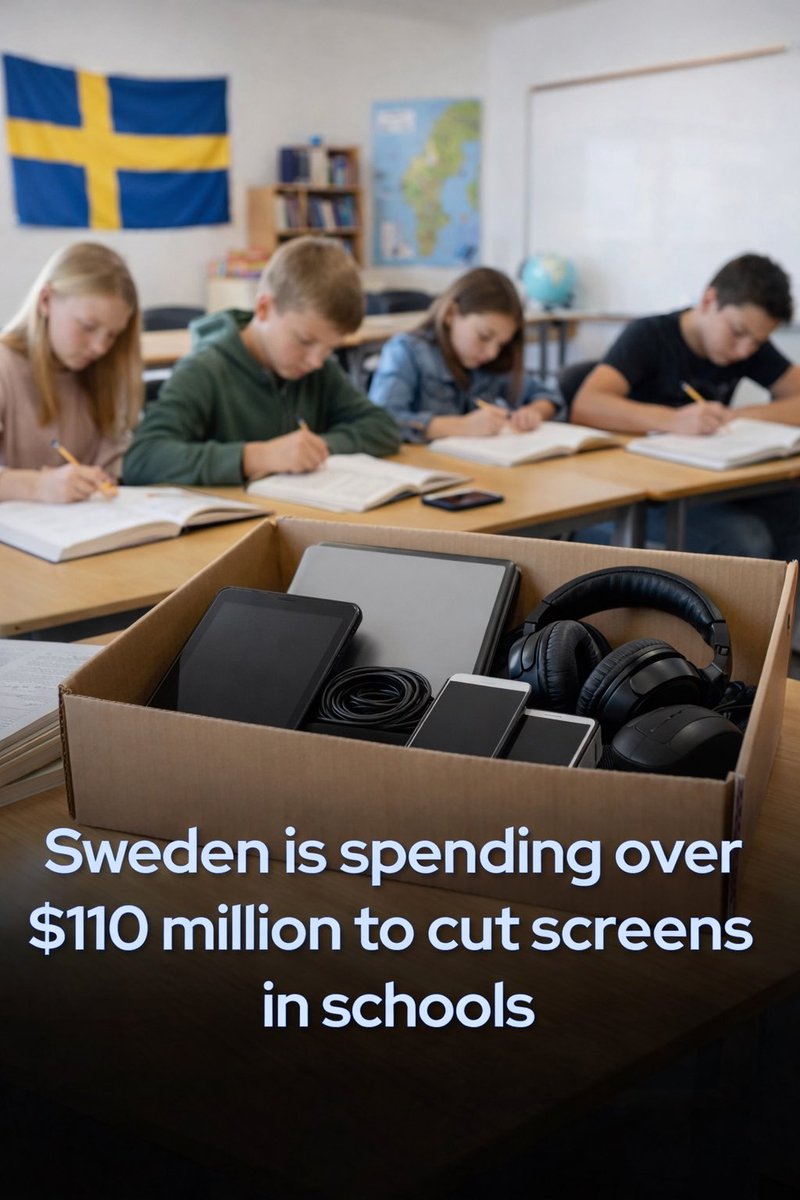
Sweden is investing more than $110 million to bring printed textbooks back into classrooms.
After years of pushing digital learning, the Swedish government is reducing screen use in schools and renewing its focus on physical books. Over the past decade, many schools replaced textbooks with laptops and tablets, moving lessons, homework, grading, and parent communication almost entirely online.
During this period, student performance declined. Results from international assessments such as the OECD’s Programme for International Student Assessment showed drops in reading, math, and science, prompting officials to reconsider the role of screens in learning.
Research indicates that reading on digital displays can demand more mental effort than reading on paper, especially for younger students. Screens also introduce more distractions, and studies have linked heavy digital use to reduced comprehension and memory retention.
In response, Sweden allocated €60 million in 2023 to restore printed textbooks, with another €44 million planned through 2025. The aim is to ensure every student has a physical textbook for each subject.
Officials stress that technology isn’t being removed from schools, but repositioned as a support tool rather than the default. Printed books are now prioritized for core learning, particularly reading.
While Sweden remains highly tech-advanced, this policy shift reflects a growing global debate: whether more technology automatically leads to better education.
Read somewhere: In politics, the quickest way to wealth isn't stealing—it's praising the leader louder than everyone else. Sycophancy pays well. Flattery is the only industry in with no recession—leaders always need their egos fueled. A good 'Your Excellency is immortal!' today buys a government contract tomorrow. One epic praise can turn a pauper into a rich powerful palace insider overnight. Other rewards include land, titles, immunity from audits, ambassadorial, and ministerial appointments.
TOP 10 AFRICAN COUNTRIES WITH HIGHEST UNEMPLOYED GRADUATE SCIENTISTS/ENGINEERS
(Small wonder someone said, "We're going nowhere, where witchdoctors have more work than top honour scientists").
•South Africa - Graduate unemployment at 11.8% in 2023, with 30.3% for young graduates (20–29). Scientists face challenges due to economic constraints and skills mismatches.
•Nigeria - Over 50% graduate unemployment. Natural sciences and mathematics graduates struggle due to limited research and industrial opportunities.
•Namibia - High graduate unemployment in 2021, impacting scientists due to underdeveloped research sectors.
•Kenya - Five-year average job search time. Scientists face challenges due to limited funding for research and development.
•Ghana - Five-year job search average. Science graduates encounter barriers due to low demand for specialised scientific roles.
•Tunisia - High STEM graduate share (nearly 40%), with scientists unemployed due to focus on computer-related fields over natural sciences.
•Algeria - 29% of graduates in STEM, with scientists facing unemployment due to limited research infrastructure.
•Morocco - STEM graduates (29%) face unemployment, with science fields less in demand than engineering.
•Egypt - High graduate output, with scientists unemployed due to limited research and academic opportunities.
•Uganda - Youth unemployment at 62–83%, with science graduates affected by skills mismatches and a lack of research jobs.
-Phys.org (2025), Econ3x3 (2025), ResearchGate (2024), Statista (2025), South African Journal of Labour Relations (2015), Taylor & Francis (2019), World Bank Data (2025), and Emerald Insight (2023).
@ntvuganda@jorampaulssonko Where can one find data used for this report.
We need to compare karamoja, bukedi and other regions.
Busoga usually gets this bad non factual PR
@ApolloBuregyeya Good one.
Have u looked at composition(quality) of our limestone in moroto verse the cement requirements
Did u look at hw much of limestone is being imported from Kenya by these industries and what reasons they give to do so.
Hw accurate is info gathered from miners in moroto
EXPOSED:
This film reveals how global companies impose industrial seeds and chemicals, trapping farmers in reliance and stripping away their ancestral wisdom and seed sovereignty.
#SeedIsLife | #OurSeedOurFuture
Throughout American [and Western] history, biblical texts have often been cited to justify and sustain racial injustices, including slavery, segregation, apartheid, and opposition to civil rights movements.
https://t.co/hlafuEyy1U