Codex + GPT-Live有种黑魔法感觉,one ring to rule them all. 这体验太爽了,通过一个对话的语音可以操控所有codex对话,是所有设备的所有对话,包括在远程设备上新建对话以及computer use等。启动时遇到了连接问题,codex自己修好了Mac端,但iOS还卡。
ChatGPT Voice is now in the desktop app.
Control your computer and direct multiple agents running in ChatGPT Work or Codex, using just your voice.
It's powered by GPT-Live, so it can speak, listen, and coordinate work in the app at the same time.
Rolling out globally today on macOS and Windows to Plus, Pro, Business, Edu, and Enterprise plans.
Some observations on Kimi:
1. It's a very good model! I don't think its performance can be explained away by distillation or anything like that. In agentic coding sessions, it seems pretty much on par with the best public models of Q1 2026. In my fairly limited use, it also seemed very token hungry. It's not obvious to me that this model is actually that cheap to run.
2. I am personally surprised the Chinese state continues to allow the open sourcing of models this good, given potential risks. To be clear, I *myself* might be fine with models presenting this level of marginal risk being open weight, but I am surprised that China is fine with it. I suspect the reason they are is 75% explained by strategic blindness/lack of AGI-pilledness (the CCP is very Yann Lecun-y in its views of AI). The other 25% or so is their lack of compute for customer inference (making China's open-weight strategy an unintended byproduct of US export controls) and the normal Chinese strategy of aggressive exports. For the companies, as opposed to the government, the decision to open source is partially ideological and partially because they are behind, and they know that very few people would pay for sub-frontier models from China.
3. Open-weight models are inherently decelerationist, and I'm continually surprised to see the so-called "accelerationists" so excited about open-weight models. I suspect the reason they are is that they know open-weight models are effectively ungovernable, and they simply like the overall cloak of ungovernability open-weight models create over the whole of AI. It's not a bad strategy; it reminds me of James Scott's recounting of the hill people in "the art of not being governed." Still, in the end, open-weight models deter further AI capex.
4. One probable outcome of an open-weight-model-dominant world is full AI communism, which is precisely what China proposes: rather than a market product, AI is a "public good" which will ultimately be provided by the state as a kind of "digital public infrastructure." This future strikes me as a dystopian hellscape, but I've never met an open-weight models advocate who doesn't ultimately concede this is where things end. You'd be surprised how many 'accelerationists' lobbied me, while I was in government, to support an eleven or twelve-figure federally funded data center so that startups could train models at a subsidy and then give them away for free. There was no other way for AI to progress, they said. Perhaps this is the logical end state of things. Nonetheless, I find myself surprised to see supposed accelerationists excited about such an outcome. I think many of them just don't know what they're doing. Many accelerationists do not view the creation and serving of frontier models as a legitimate business.
5. I would guess that the Trump Administration will at some point realize that their best strategy here would be to create large amounts of regulatory risk around the use of open-weight Chinese models. You don't need to "ban open source" (one of the dumber motifs of AI policy discussion). You just need to direct every agency to issue soft law that creates FUD. "A Federal Reserve Advisory Bulletin found that there may be backdoors in Chinese AI models." It needn't be that well justified. You just create enough regulatory risk that every regulated enterprise backs off. You probably don't want to create so much regulatory risk that you scare off the hyperscalers from serving Chinese models; this will just drive startups to sketchier providers. There's a happy middle ground here. I'd assume they will do some version of this.
6. It's probably true that open-weight models of this capability make the world a bit more dangerous, but not so much more that you'll really notice. At some point the models will be capable enough that you will notice. "A nonliving, invisible, dangerous, and infinitely self-replicating agent escaped from a Chinese lab," you say? Color me shocked.
oh @CapApp points program is only going to give out the full airdrop to YT holders because "we have to make YT holders whole"?
https://t.co/OCgODbVkWg
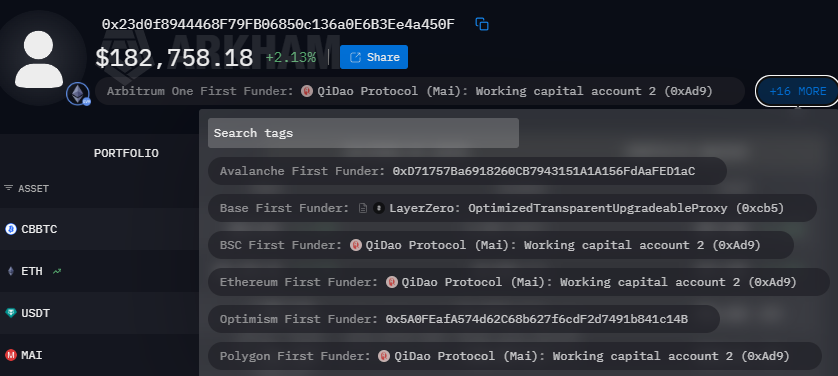
let's see who is their largest YT buyer.. ah its 0x23d0f8944468F79FB06850c136a0E6B3Ee4a450F! 19m YTs bought over 21-28 dec
which turns out to be "@QiDaoProtocol Working capital account 2" aka founder @Benjamin918_
this is pathetic, you have got to cover your tracks much more thoroughly. i am happy to offer you a lesson for $4.2m cUSD
i typically am only slightly suspicious of projects buying their YTs but basically pocketing the whole airdrop is actually a first
@apyx_fi watch and learn since you have such a massive supply of YTs
ICO committers really just put $ in the @CapApp team's hands (@Benjamin918_ and @defidave, surprised at the latter who i thought was upright, guess not)
Voice agents are getting more capable.
Here’s what’s new:
• GPT-Realtime-2 for voice agents that reason and take action
• GPT-Realtime-Translate enabling translation from 70 input languages into 13 output languages
• GPT-Realtime-Whisper, making transcription even faster
Codex is getting easier to automate and customize around your code.
🪝 Hooks customize the Codex loop with scripts that run at key points in a task:
• Run validators before or after work
• Scan prompts for secrets
• Log conversations to internal systems
• Create memories or customize behavior by repo or directory
⚙️ Programmatic access tokens provide scoped credentials for Business and Enterprise teams:
• Create tokens from ChatGPT workspace settings
• Use them in CI, release workflows, and internal automations
• Set expirations or revoke access when needed
• Keep usage tied back to the workspace