An open letter to Baroness Cass ref the case of this child, whose situation needs to investigated by social services. This indeed is not a political matter but one of child protection.
https://t.co/XOTCtPq8tZ
Dear Baroness Cass,
I am writing in response to the case you described of the eleven year old boy socially transitioned by his parents at two and a half, now living stealth, afraid to attend school as either sex, and increasingly withdrawn and physically deconditioned as a result. I wanted to set out why I think this case illustrates something more specific than the question you posed about whether politicians or doctors should decide what happens to children like him.
The case is, on its own terms, a clear demonstration of premature identity foreclosure. A child of two and a half has no capacity for the kind of abstract, exploratory self reflection that genuine identity formation requires, on any developmental account from Piaget through Marcia. What happened to this child at that age was necessarily a decision made on his behalf and then sustained around him, not a discovery he himself reached. Bronfenbrenner's ecological model describes exactly the mechanism by which that early decision then becomes self perpetuating: once a social transition is established in the home, it is carried into school, peer relationships, and eventually clinical contact, each system reinforcing what the previous one had already settled, with no point at which the original premise is revisited. By the time this child reaches adolescence, an identity adopted before he could speak in full sentences has become something he now actively conceals and fears having questioned, which is a strange and telling outcome for an identity supposedly discovered rather than constructed.
The detail you raise of weakened bones from inactivity rather than from medical intervention is, I think, the most important part of the case, because it shows the harm operating through an entirely social pathway. A child too afraid of being outed to attend school is a child whose ordinary developmental environment, peer contact, physical activity, the everyday testing of self against the world that Erikson and Marcia both treat as necessary to identity formation, has been closed off by the position he has been placed in. This is not a side effect of any drug. It is the direct consequence of a foreclosed identity that has left him with nowhere safe to be a child.
I would push back on framing the central question as one of medical versus political authority over decisions like puberty blockers. The decision that produced the harm you describe was not a medical one at all. It was a parental and social decision taken years before any clinical pathway became relevant, and the clinical system he now exists within is managing the consequences of that earlier decision rather than the cause of his distress.
Given that he is now isolated, school avoidant, and showing physical signs of neglect of his basic developmental needs, I think it is also worth asking plainly whether this is a case that ought to have come to the attention of children's social services on ordinary safeguarding grounds, independent of any question about gender identity at all. I would suggest the more pressing question your case actually raises is what support and recourse exists for a child in his position now, given how early and how thoroughly the foreclosure already occurred, and what should change about how social transition in early childhood is approached so that fewer children arrive at eleven in a position this difficult to unwind.
Yours sincerely,
Before this Pride Month ends, let us tell you about the fusion of ideology and public administration that the EU has become. It would be well advised to return to the principles of democratic accountability, institutional neutrality and the rule of law.
https://t.co/G637RpLDCS
I've never watched back my debate with Helen Webberley because I found it so enraging and upsetting. I think she's worse than a liar: to me she seems like someone who has lost all sense of respect for truth or reality. But watching this was quite fun.
A recently deceased founding member of Belfast Pride has been revealed as a trans-identified male who had several previous criminal convictions, including procuring a child for sex.
Tina McCombe – who was previously known as Thomas Alistair “Alison” McCombe – was hailed as a hero after his death in local media, while some articles referred to him as a woman.
Several local individuals commented on a Facebook thread with recollections of McCombe “waving his penis” at girls in public.
“I have not so fond memories of Tina, born as Alistair McCombe and lived in Donaghadee,” one comment read.
“Myself and many schoolchildren were traumatized walking to primary school back in the late 70’s, early 80’s, as he waved his penis at us from his window and front door.”
#Pride
https://t.co/2vvOWyQYw0
@SeeRedWoman1 speech #OneYearLaterBelfast
"In five days’ time, it will be exactly one year since the Supreme Court ruling.And what did it say?
Something so simple it should never have needed saying. That women-only spaces are for women.
Years of fighting. Thousands of pounds. Extraordinary courage. For what was, in the end, just stating the obvious. Finally, in law.
And yet here we are. In Belfast. One year on, Still waiting for it to mean something in actual, everyday life.
Let’s talk about the women who got us here.
Marion, Trina, Susan, and Magdalen Berns. The women behind For Women Scotland. They saw what was happening and refused to go along with it.Magdalen didn’t live to see the ruling. She kept going through illness, kept speaking, kept telling the truth. She died in 2019, aged 36.
Her words still stand:It’s not hate to defend your rights. And it’s not hate to speak the truth.
I found her at a point when I thought I was alone. She cut through everything. No performance. Just clarity.
I was blacklisted by feminist groups here in Belfast for mentioning her. I know what it costs to even say her name.
And I’m saying it anyway.
Marion, Trina and Susan carried that fight all the way to the Supreme Court. Mocked, dismissed, told they were on the wrong side of history.
They weren’t
And they’re not the only ones.
J. K. Rowling faced a cultural pile-on most people wouldn’t withstand. Told her career was over. Attacked from every direction. - She didn’t back down.
Maya Forstater lost her job for stating a basic fact. Took it to tribunal. Lost. Appealed. And won. That judgment changed the landscape. Every case since stands on ground she helped secure. Because of her our reality is worthy of respect in a democratic society.
Sandie Peggie, an A&E nurse, objected to a male colleague in the women’s changing room. She was suspended, investigated for months, and took NHS Fife to tribunal. She succeeded in her claim and is still appealing the parts that didn’t go her way with the most incredible counsel.
Two years of her life. She’s Still fighting.
And the Darlington nurses. Eight of them. They raised concerns, were ignored, told to broaden their mindset. They formed a union, took a case, and were successful at tribunal.
And then the arts.
Because this is personal.
Róisín Murphy. I’ve loved her music for years. And when she spoke, privately, about puberty blockers, it felt like the industry turned on her almost overnight.
Reviews rewritten. Her Album sidelined. Pressure to apologise. She didn’t.
And that matters.
Rosie Kay. Pushed out of the company she built. So she built something else.
Denise Fahmy. Fifteen years at Arts Council England. Faced a hostile internal climate, resigned, took a case, and won.
And there are others - claudia, sibyl and . Women who can’t be named. Watching. Waiting. Weighing the cost. - We are here for them too.
I worked in the arts here in Northern Ireland.
Inclusion was my job. Literally.
And when I spoke, in my own time, about why single-sex services matter, that inclusion stopped at me.The pressure built quietly at first, and then all at once, until leaving didn’t feel like a choice anymore.
And I left. Not because I was wrong. Because I became a problem.
And there are women here who know that feeling exactly.
The email you don’t send.
The meeting where you stay silent.
The quiet calculation that the cost is just too high.
Women are still making that calculation. Today.
So yes. The ruling matters. It confirmed that sex means biological sex. That single-sex spaces are lawful. That women’s rights to privacy, dignity and safety are real.
That’s not abstract.
It’s the woman in a refuge who needs to know who she’s sharing with.
It’s the survivor walking into a rape crisis centre who needs clarity, not ambiguity.
I can tell you that trust isn’t a detail in that work, it’s the entire foundation.
So the law is clear. The need is clear. And still, nothing moves.
#OneYearLater
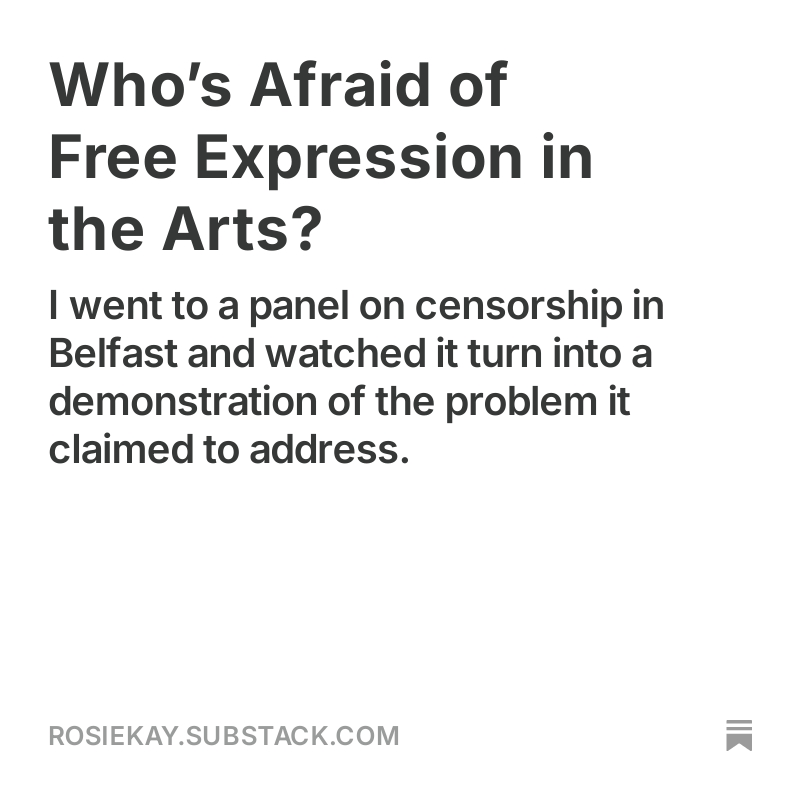
"For much of the evening, the discussion was intelligent and familiar. The arts is under pressure. Institutions have become risk-averse. The language of harm and safety is narrowing what can be said and shown. But then Sara Morrison challenged Ruth McCarthy from the audience, and the room stopped talking about censorship in the abstract."
New Substack!
Who’s Afraid of Free Expression in the Arts?
I went to a panel on censorship in Belfast and watched it turn into a demonstration of the problem it claimed to address.
@SeeRedWoman1@ImagineBelfast
@SeeRedWoman1@AudreySuffolk@RosieKayK2CO Interesting. I applied to put on a Free Speech Union event as part of the festival. An acclaimed performance on the theme of self-censorship. It was declined.
1/4
Hansard, 12 November, 2025
Rebecca Paul, (Reigate) (Con)
"I would like to ask the Prime Minister for his help. It has been over six months since the Supreme Court ruling on the meaning of sex. Yet public institutions are still knowingly and intentionally breaching the law.