I’m grateful to the @MindScienceFdn for funding my sleep project at the @InstitutCerveau 🥳🙏
Check out the videos of the 3 winners 🎥 and VOTE for your favorite project 🤩
The project with the most votes will receive a $10,000 Audience Choice Award!
https://t.co/wl5mW8xVuq
@omerxsharon Absolutely no clue, any and all ideas are welcome. Considering that it took decades to figure out what all the other oscillations might be for, I’m not expecting answers any time soon but would love to be proven wrong 😅
@omerxsharon So far it looks like less than 1/3 of children and 1/5 of adults. But in REM it was more common so maybe it’s just a matter of measuring for long enough to pick up on them 🤷♀️
The Dreamscape Project: Mapping the phenomenological and neurophysiological features of subjective experience during sleep https://t.co/FHGUE9lgTf This is our accepted proposal for ARCDP2024. Looking for a PhD candidate who are interested in Aim 1 and 3! @thandrillon
And here it is, the final installment of my PhD thesis! The curious conditions under which alpha oscillations predict better performance and only the largest theta events predict behavioral lapses 🤔
https://t.co/n2ZfaVTtI5
@Brainclinics@mr_corcorana And there were plenty of trials; 30% of trials were lapses (omission errors) during sleep deprivation, which was about 90 per person. Participants hated it, but I got plenty of data 😅
The most obvious EEG markers of drowsiness don't actually predict moment-to-moment changes in vigilance during sleep deprivation. What to make of these theta bursts... 4 years of PhD and I still have no clue 🤔
https://t.co/NjYb45zkT1
@Brainclinics@mr_corcorana I looked mostly at omission errors; commission errors were negligible in this task. I only looked at reaction times in the context of slow vs fast trials (<0.5 s), but not more fine grained than that.
Ever wondered what pupil size can tell us about our sleep?
In our new work we show that pupil size dynamics correspond to macrostructure and microstructural events in human sleep, and also influences our response to auditory stimulation (video).
https://t.co/XSvAz2yLwS
New paper properly out!
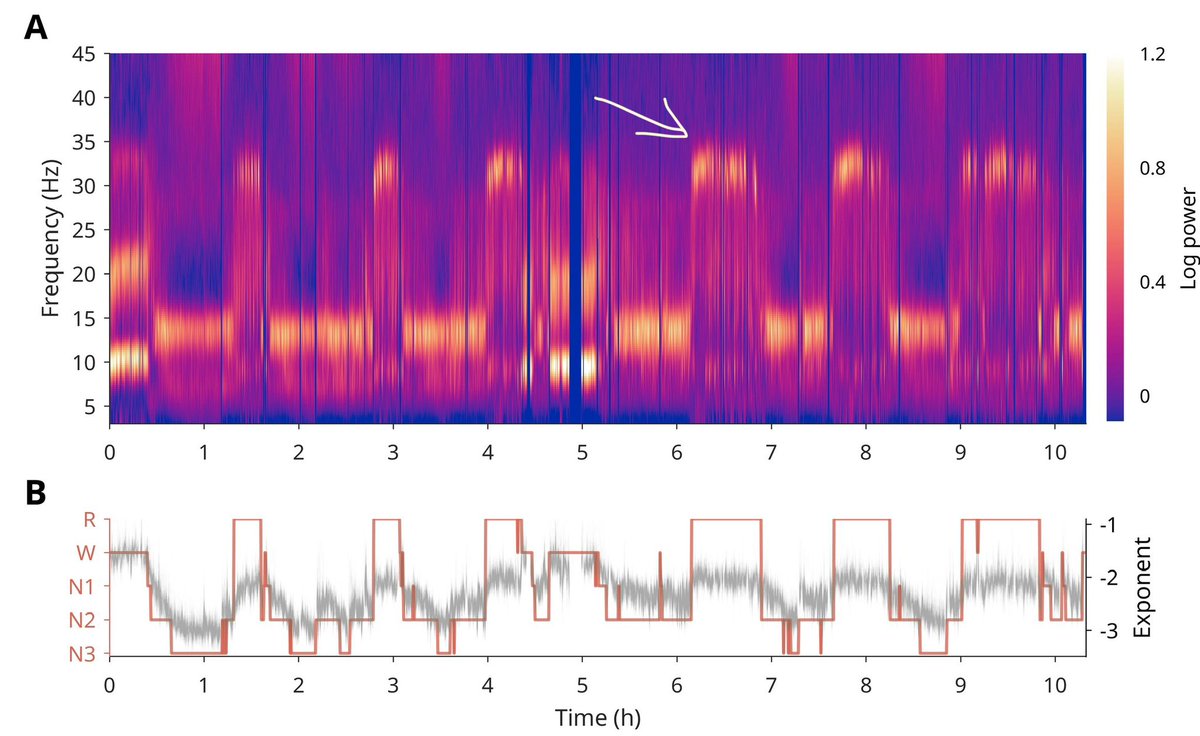
Oscillation amplitudes increase with time awake, reflecting process S 🌊
but the *amount* of oscillations changes independently…so don’t trust spectral power ever again! 👻
https://t.co/ykc1xKcY0f