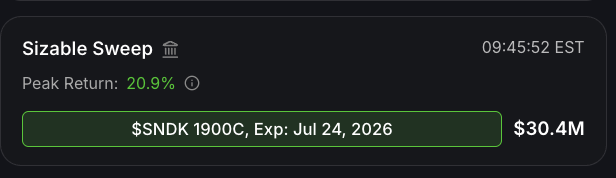
JUST IN: $META secures long term supply deal with $SNDK as it scales its AI infrastructure
Meta is reportedly moving its in-house AI accelerator, code-named Iris, into production in September, according to an internal memo reviewed by Reuters. The chip is part of Meta’s MTIA roadmap and is designed to supplement, not fully replace, the large GPU fleets Meta continues to buy from Nvidia and AMD.
The broader strategic point is that Meta is trying to reduce dependency on external accelerator supply while scaling AI infrastructure aggressively. Reuters says Meta plans to deploy 7GW of compute infrastructure in 2026 and targets 14GW in 2027, implying a significant step-up in data center capacity and supporting infrastructure.
To support that buildout, Meta has secured multi-year supply agreements across key bottleneck inputs, including Samsung for memory, Sandisk for flash storage, and Sumitomo Electric for fiber-optic equipment. The Sandisk agreement is notable because it frames flash storage as a strategic AI infrastructure input rather than a generic commodity component.
Net/net, the news is directionally positive for AI infrastructure suppliers tied to memory, storage, optical, and custom silicon supply chains. It also reinforces the view that hyperscaler capex is broadening beyond GPUs into the full bill of materials required to scale AI compute.
Samsung Electronics prelim Q2 operating profit surged 19x YoY to ~$58.4B, above $55.3B consensus, on AI memory demand.
However, prelim Q2 revenue came in slightly shy at ~$111.8B, vs $113.1B consensus, though still up 129% YoY.
As vehicles become more intelligent and data-intensive, the role of memory and storage continues to grow — and so does the importance of long-term partnership.
Micron is proud to strengthen our relationship with another great American company: @Ford.
The Strategic Customer Agreement @MicronTech announced today is supported by our ongoing investments to expand capacity and localize manufacturing in the U.S., including advanced DRAM production in Virginia.
It is a privilege to work alongside @jimfarley98 and the Ford team to build what's next together.
Read more: https://t.co/nahngcvoxW
Guess we finally found why $META signed massive agreements with Neoclouds like $NBIS back in March...
And why Gemini got super nerfed.
$GOOGL reportedly restricted Meta's capacity in March 2026 because of compute restraints.
Google's CEO said from last earnings computing power restrictions prevented Google Cloud from taking on more customer needs and made the department's backlog nearly double the previous quarter.
This is probably positive for the AI DC capex buildout since hyperscalers capacity is way below what is needed, and especially so if they can't rely on one another.
@JapanDeepValue1 I don’t think it was vibes. It was the launch of their next generation nand flash technology in collaboration with $SNDK
https://t.co/FjNifwuZ37