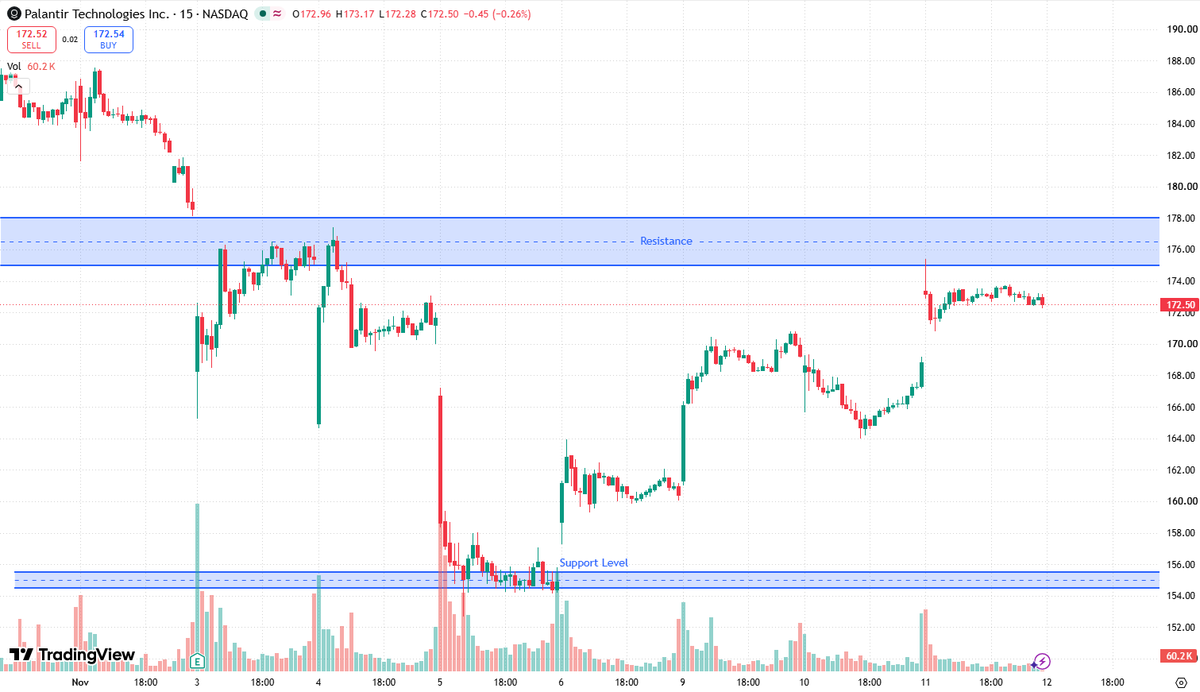
$PLTR just dropped one of the most insane quarters in software history—revenue up 96% YoY to $2.31B.
Yet the stock is down ~20% from its October highs of $212.
Retail is confused. Wall Street is divided.
After 12 years of trading, here’s what’s actually happening beneath the surface on $PLTR 🧵👇
@dmoses34@VD718@Seawolfcap Got it, that makes a lot more sense looking at it through the lens of being the primary liquidity source for the ecosystem. Appreciate the clarification, will give it a listen
While the market is panicking over short-term volatility and debt headlines, $CRWV (CoreWeave) is quietly executing the fastest AI supercluster rollout on the planet.
Looking at the site-by-site breakdown from their latest filings, the physical execution on the ground is unmatched:
1. Denton, Texas (262 MW IT Capacity)
100% delivered and fully energized ahead of schedule.
Locked into a 12-year, $4.6B infrastructure agreement powering massive frontier AI workloads.
2. Polaris Forge 1 — Ellendale, North Dakota (400 MW IT Capacity)
250 MW is already live and generating revenue.
The remaining 150 MW is deep in construction, ramping toward a $11B long-term contract.
3. Helios — Dickens County, Texas (526 MW IT Capacity)
First 133 MW phase is officially online.
393 MW of high-density liquid-cooled capacity is actively scaling through 2027–2028 under a $19.7B agreement.
4. Kenilworth (NEST 11), New Jersey (Self-Built Flagship)
$1.8B transformation of a former pharma campus into a flagship AI hub.
On track for early 2027 launch, backed by $250M in state AI tax credits.
5. Global Footprint (4.6 GW+ Contracted Power)
Over 1.7 GW is already active across 50+ data centers in North America and Europe (including Copenhagen's DEN01), with 1.3 GW+ secured internationally.
Already running NVIDIA Vera Rubin NVL72 clusters in production.
Most players are still fighting for power interconnects and waiting on next-gen GPUs. $CRWV is converting a $132.5B backlog into live, revenue-generating megawatts every single month.
You can't fake live GPU clusters on the ground. Execution speaks louder than stock noise.
@BP_Investments_ Honestly doubt we see sub-$40 unless the whole market pukes. Hard to pass up $CRWV around $50 after a 10% flush when the backlog keeps growing
@insiderwave Honestly don't even need inside info to buy $AVGO on big red days like last week. Funny enough it's pulling back ~6% today too, basically giving everyone a second shot at that dip.
@AnthonySandford@unusual_whales $AVGO down 5%+ on zero company news is wild. Pure index/basket selling while everyone hides in $WMT and $KO. Good spot to slowly add tbh.
Classic sympathy sell-off driven by sector basket algos. $CRWV getting dragged down on peer volatility makes zero fundamental sense—its contracted hyperscaler backlog and revenue visibility are completely insulated. Market dislocations like this are pure gift opportunities for $CRWV bulls.
@NighthawkTradez Strongest secular trend in the market right now. Among the three, $CRWV sits at the top of the food chain with unmatched scale, contracted hyperscaler backlog, and proven execution. When AI compute demand surges, $CRWV leads the pack.
Let’s separate Twitter rumors from audited financials. Calling $CRWV part of a fake "money loop" ignores the reality of its customer base—hyperscalers like Microsoft and frontier AI labs signing multi-billion dollar, legally binding take-or-pay contracts. Wall Street institutions like Blackstone and Magnetar didn't underwrite billions in asset-backed debt without tearing apart every single invoice and GPU cluster
$CRWV has already reached escape velocity and no longer relies on Nvidia’s balance sheet to grow. With tens of billions in contracted backlog, proven access to institutional debt markets, and sticky enterprise demand, a neocloud shakeout actually widens $CRWV’s moat. Smaller GPU-rental shops will get wiped out, leaving $CRWV as the primary independent winner
Everyone is debating whether $NBIS is truly asset light after its 2027 delivery slip, while overlooking the massive capital puzzle right next door at $CRWV.
Yes, CoreWeave just posted $3.66B in Q3 revenue with a massive $132.5B backlog.
But look beneath the surface: how does an infra-heavy model bridge the gap when annual capex runs into the tens of billions, triggering massive depreciation and heavy debt servicing before 2028?
Retail sees the backlog. Wall Street is watching the funding and balance sheet risk. After 12 years of trading, this divergence is where the real setup lives. 🧵👇
@CVecchioFX@tastyliveshow Wild how tight spreads remain despite the equity vol.
Feels like until $XCCC actually starts pricing in some stress, dip buyers are going to keep treating this as just noise
After surging 24% yesterday, $CRWV's pre-market drop is a collision of NBIS's earnings and NVDA's crisis.
$NBIS beat Q3 revenue, yet delayed its $7B ARR target to February with deliveries slipping into 2027. Combined with yesterday's news, AI compute leasing is facing three structural shifts:
1️⃣ The bottleneck shifted from "chips" to "power." Grid delays slow down deployment, while annual GPU depreciation keeps ticking—eating away the prime rental window of debt-funded GPUs.
2️⃣ The implicit backstop is fading. Neoclouds took on massive high-yield debt relying on Jensen Huang's allocation and capital backing. Any leadership turmoil at the top will spike borrowing costs and end the era of reckless leverage.
3️⃣ Forced supply chain diversification. Single-vendor risk is now fully exposed. To reassure creditors and customers, players like CRWV will move much faster to onboard AMD and custom ASICs.
In the second half of AI compute, it’s no longer about who can raise the most debt, but whose cash flow can outlast delivery delays.
In this shakeout, which player holds up best, and which non-Nvidia chipmaker benefits most? Drop your take below 👇
Even if Jensen Huang is ousted, how can Nvidia ensure every future generation still delivers breakthrough innovation instead of becoming the next OpenAI?
Once its existing tech pipeline is released, future products could gradually lose their competitive edge
$NVDA
The market is overly focused on NVIDIA’s short-term price action, overlooking the real risk: a governance discount. While the first scandal triggered external export probes, the second involves a direct report (VP of Healthcare Kimberly Powell), crossing institutional compliance red lines.
Without decisive board action—like splitting the CEO/Chairman roles—long-only and sovereign funds face forced ESG de-risking. $NVDA’s threat isn't an earnings miss, but multiple compression. Even strong earnings won't command the same valuation premium.
Internal turmoil also shifts supply chain leverage. As compliance reviews slow Nvidia's execution, hyperscalers like Microsoft, Google, and Meta gain a board-level excuse to diversify 2027 AI CapEx into custom silicon. This compliance hedging boosts order visibility for $AVGO and $AMD.
Finally, healthcare AI faces a secondary shock. If Powell is suspended, Nvidia’s pharma compute push hits a six-month vacuum—opening the door for Google Cloud to capture pharma deals and pressuring NVDA-backed plays like $RXRX
Personal technical observations only
Curious where the street lands on this: Does the board force a governance overhaul to protect the multiple, or do they ride it out and let institutional ESG outflows cap $NVDA's upside?
Drop your take
@mistressdivy Classic case of price action trumping headlines—$CRWV ripping +24% right through turbine cancellation news tells you everything about where institutional demand is sitting.
Watching how it holds above $60 into the close.