@paoloardoino Where do you see this heading @paoloardoino ?
Do you see a future where humanoid robots will be armoured with a decentralised form intelligence in @qvac
& given the people’s wallet for stable financial communication via @tetherwallet ?
AI big tech subsidizes compute to increase user count building expensive infrastructure / capex subject to fast decay (3/5 years).
- Token price mismatch.
- Profitability timeline mismatch.
- Cost of capital maturity mismatch.
- Open-source AI taking growing chunks of revenues.
What could go wrong.
Removing Capital Gains Tax from Bitcoin is the single most important thing we can do for Bitcoin adoption.
It will allow Bitcoin to be used as money and incentivise people to save in Bitcoin over assets such as Real Estate.
I will keep repeating this.
The US Gov just banned Mythos 5 & Fable 5 for being ‘too powerful’ less than a week post launch.
Meanwhile, Quantum Computers capable of breaking Bitcoin’s immutable, decentralized ledger will be allowed to roam free.
Probably nothing. 🌝
[ Block 953563 ]
A German robotics company just raised $1.4 billion to build humanoid robots that hold their own crypto wallets.
Tether led it. Nvidia, Amazon and Bosch came in too. Each robot gets a self-custodial wallet and earns micropayments per task.
No bank accounts. Just private keys.
🎯 @PrestonPysh
Prediction :
$USDT ($149B) flips $ETH ($220B) in USD Market Cap this cycle.
As we get closer to the 1,000,000th block, the entire ‘Crypto’ market distills into two real life use cases :
1) Store personal wealth across generations & grow the ₿alance Sheet.
2) Instantly move capital across space without intermediaries.
The 1) , 2) set up cements the ‘there is no second best’ narrative in stone.
[Block 895678]
With all of the exploits in DeFi, Zcash, and all of the other insanely complex crypto systems we are reminded again that Bitcoin’s simplicity is its biggest feature.
🎯 @PrestonPysh
Prediction :
$USDT ($149B) flips $ETH ($220B) in USD Market Cap this cycle.
As we get closer to the 1,000,000th block, the entire ‘Crypto’ market distills into two real life use cases :
1) Store personal wealth across generations & grow the ₿alance Sheet.
2) Instantly move capital across space without intermediaries.
The 1) , 2) set up cements the ‘there is no second best’ narrative in stone.
[Block 895678]
In a world of infinite fakes, physics is the only proof left.
The AI-vs-Bitcoin fight used to be about one thing: electricity. Who gets the power — the data center or the mining rig. Now it's about two, and the second front is playing out this week: who gets the capital.
Look at what's lining up. SpaceX opens its roadshow at a ~$2T valuation, raising up to $75B. OpenAI (~$852B) and Anthropic (just repriced to $965B after a $65B round) are both moving toward listings this fall. Combined, that's ~$3.6 trillion of new equity — the GDP of France — asking the market for capital in a single year. Goldman sees 2026 IPO proceeds near $160B, four times last year.
Money is infinite — that's the whole reason Bitcoin exists. The bid isn't. At any given moment the risk capital willing to chase a story is finite, and right now that story is AI. Bitcoin is down ~22% on the week and more than 45% off its high, bleeding 3.2B from spot ETFs, while the AI pipeline swells.
But that's the trap in the framing. Capital rotation is the cyclical question. It reverses. The structural question is the one that compounds: when everything digital can be faked for free, what's left that can't?
The numbers on the "infinite supply" side are staggering. Europol projects up to 90% of online content will be synthetically generated in 2026. Deepfakes shared across social platforms went from ~500,000 in 2023 to an estimated 8 million in 2025 — roughly 900% growth a year. Voice cloning crossed what researchers now call the "indistinguishable threshold" in late 2025. Deepfake-enabled fraud losses hit ~$1B last year, up 669%.
AI is doing to trust what central banks did to money: driving the marginal cost of producing a convincing unit to zero. A fake face, a fake voice, a fake document, a fake "proof" — supply is now effectively infinite. And infinite supply means zero value. We've seen this movie. It's called inflation.
Now hold that against Bitcoin.
You cannot fake a Bitcoin. Not because a regulator says so — because thermodynamics says so. Every block is secured by ~800 exahashes per second of real computation, drawing ~175 TWh a year, more electricity than most countries use. That energy isn't waste. It's the receipt. Bitcoin is the one digital object whose scarcity is enforced by physics rather than by a promise: 21 million, final, un-forgeable, no matter how good the models get.
That's the whole thesis in one line: AI is an infinite-supply machine. Bitcoin is its thermodynamic opposite. The better AI gets at manufacturing fakes, the more valuable the one thing it provably cannot manufacture becomes.
The asymmetry:
• If AI stays niche → Bitcoin's scarcity story is unchanged. You lose nothing.
• If AI eats the internet → every form of digital trust gets debased, and the only natively scarce, physically verified digital asset becomes the reference point for what's real. You win enormously.
Heads you're fine. Tails you own the anchor.
People keep filing AI and Bitcoin under "tech." They're not the same category. One is a printing press for reality — the most powerful counterfeiting tool ever built. The other is the first form of money whose supply no human, model, or state can alter. The printing press makes the anchor more necessary, not less.
And here's the irony in what we're seeing this week: the ~$3.6T chasing AI is being valued on promises — projections, narratives, claims about a future that hasn't shipped. Every operator should be asking what they actually own when the story turns. Most "assets" are claims: entries in someone's database, honest only as long as the database is. AI is about to make every database suspect.
Bitcoin is the exception. It isn't a claim. It's proof. Settled in energy, checked by every node, impossible to print.
The Pharaoh's view: the AI era won't kill Bitcoin's energy use — it'll vindicate it. When fakes are infinite, the thing that costs real-world physics to produce is the only thing left worth trusting. Proof-of-work was never about mining coins. It was about manufacturing certainty in a world that's running out of it.
And yes — an AI helped write this. Fitting, isn't it? The infinite-supply machine can counterfeit my prose, my cadence, maybe even my conviction. It still can't print a single satoshi.
Larry Fink just outlined the best opportunity of the next decade:
"The U.S. is short on power, compute, and chips - I believe a new asset class will be buying futures of compute."
Those who get in on the AI compute gold rush will print money.
What if the next element to the S-Curve of growth we are seeing in compute capacity, which involves all elements of the semiconductor supply chain, grows even FASTER and with GREATER magnitude because we have another S-Curve forming right in front of us…which are humanoids.
We have several millions of GPUs online, the world wants hundreds of millions of them…
If the world also wants hundreds of millions of robots, if not billions of robots…especially due to our global population crisis…
Where does this next decade go?
Such an exciting time to be an investor.
Food for thought.
Will the CLARITY Act wake investors up to the real carry trade?
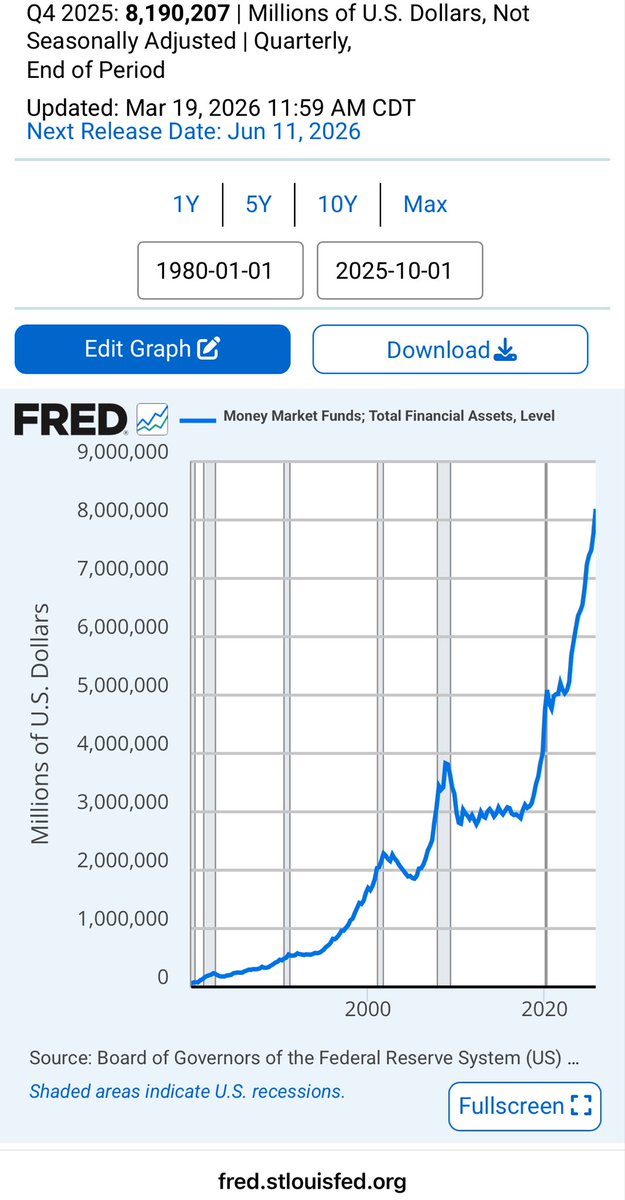
More than 7.75 trillion dollars now sits in US money market funds, while roughly 3 trillion in reserve balances is parked at the Federal Reserve earning about 3.65%. That is over $10 trillion still chained to the logic of the old monetary order, accepting what looks like “safe” yield even as the purchasing power of the underlying currency is steadily eroded.
Since the gold window closed in 1971, broad money has exploded growing at close to 8% p/a; the fiat unit of account is designed to grow, yet savers are asked to pretend that a nominal rate a few points above zero is “risk‑free.” Sensible is not the same thing as efficient. Nor is “risk‑free” the same thing as preserving real wealth.
The thesis of the incumbent system is simple. Safety lives in bank deposits, Treasury bills, central bank reserves and government‑only money funds. Investors, chastened by crises, park cash in money markets for liquidity and low volatility. Banks, scarred by regulation, leave reserves at the Fed for a predictable overnight rate and a quiet life with supervisors.
The classical carry trade built on this foundation was straightforward: borrow cheaply at the policy rate and reach a little for yield in duration or credit, clipping a modest spread. Now add the risk free rate in the digital world.
The antithesis is already visible in the digital world. Instruments linked to Bitcoin‑centred balance sheets and digitally native structures are building a different yield curve. Strategy’s STRC, a perpetual preferred backed by a Bitcoin‑levered corporate, has recently offered an annualised 11.5%, paid monthly, with distributions structured as return of capital rather than ordinary income.
It is not a Treasury bill, and there is balance‑sheet risk. But it shows that the market can engineer “cash‑like” exposure with double‑digit, tax‑efficient payouts, anchored in hard digital collateral rather than in the spread between overnight funding and a five‑year note. Bitcoin itself sits at the philosophical core: its supply is capped at 21 million coins, while fiat continues to expand.
The synthesis is a new definition of “risk‑free” and a new destination for the global carry trade. Public debate still obsesses over the dialectic of stablecoins versus bank deposits. The Digital Asset Market Clarity Act of 2025 would create a federal framework for digital asset markets and formalise regulatory boundaries.
More important is what such a law would symbolise: a tacit admission that a parallel monetary system is being built on top of the US dollar and Treasury market, but with yields discovered in competitive digital markets rather than by the constricted economics of legacy banks. Fully collateralised, dollar‑denominated, Treasury‑backed structures on public rails can in principle offer both the credit quality of the US sovereign and higher, more transparent yields than the old deposit‑money market complex.
This does not make every high‑yield token or Bitcoin‑linked security safe. It does mean that “risk‑free” in the old world has become a marketing phrase for nominal returns that often fail to protect purchasing power. Banks leaving reserves at 3.65 % are leaving money on the table. Investors accepting mid‑single‑digit money‑market yields in a structurally inflationary fiat regime are doing much the same.
The real question is whether the CLARITY Act will be remembered as the moment investors finally woke up to a generational shift: the point at which they realised that the true baseline for low‑volatility, dollar‑denominated returns had begun to migrate out of the old banking system and into a new, digital, USD Treasury‑backed monetary architecture.
Yes Bretton Woods 2.0 is upon us, the only question now is when will investors wake up to the opportunities in front of them.


![sov_sam_'s tweet photo. The US Gov just banned Mythos 5 & Fable 5 for being ‘too powerful’ less than a week post launch.
Meanwhile, Quantum Computers capable of breaking Bitcoin’s immutable, decentralized ledger will be allowed to roam free.
Probably nothing. 🌝
[ Block 953563 ] https://t.co/lAbrYHoRdv](https://pbs.twimg.com/media/HKuzzRoXoAEW2Ms.jpg)


![sov_sam_'s tweet photo. 🎯 @PrestonPysh
Prediction :
$USDT ($149B) flips $ETH ($220B) in USD Market Cap this cycle.
As we get closer to the 1,000,000th block, the entire ‘Crypto’ market distills into two real life use cases :
1) Store personal wealth across generations & grow the ₿alance Sheet.
2) Instantly move capital across space without intermediaries.
The 1) , 2) set up cements the ‘there is no second best’ narrative in stone.
[Block 895678]](https://pbs.twimg.com/media/GqW_jt1WwAAG7ad.jpg)