Over the past months, Sovra, @class_lambda and @alignedlayer have been working together on Propia, a public protocol for verifiable digital credentials.
Propia starts from a simple premise: trust established by one institution should be reusable by others, without requiring shared databases or dependence on a private intermediary.
This has become increasingly relevant as AI agents begin to participate in everyday operations. They submit requests, exchange information, authorize transactions and interact with other agents. These interactions need a reliable way to establish who an agent represents, what it is authorized to do and whether the claims it presents remain valid.
Rebuilding that verification process within every organization is costly and creates isolated systems. A shared protocol allows credentials to be issued once and independently verified wherever they are needed, including by machines acting on someone’s behalf.
For institutions, this means fewer repeated checks, fewer custom integrations and lower operating costs. As more institutions participate, more credentials can be reused and the protocol becomes more useful for everyone.
We believe this infrastructure should be open and collectively governed. Today, we are publishing the whitepaper as a public proposal and inviting others to discuss it, improve it and build on it.
Argentina’s provinces are now coordinating one open protocol for verifiable credentials, and Sovra is the technical lead of the effort.
#FederAI launched its Digital Identity working group, bringing provincial modernization teams to one table with a shared goal: a credential issued by one province, recognized in every other, while each jurisdiction keeps its own systems and its own autonomy.
The technical foundation is Propia, the open identity protocol we built with @class_lambda and @alignedlayer on international standards.
What the group is working on now:
· shared technical governance for the protocol
· who can issue, and how a credential gets revoked
· the first interprovincial use case: interjurisdictional licenses
Federal interoperability starts here.
every time a verifier calls the issuer, the issuer learns where you’ve been.
with Propia, credentials are checked against public registries. the issuer never learns where you used them.
Propia, built in collaboration with @sovraio and @class_lambda.
No more chasing files. No more “we’ll get back to you.”
Just a live, verifiable trail from request to permit.
And at the end it can land as a verifiable credential in your wallet.
How it’s built, step by step:
https://t.co/VqlVFTmvJ1
Bureaucracy’s black box is dead.
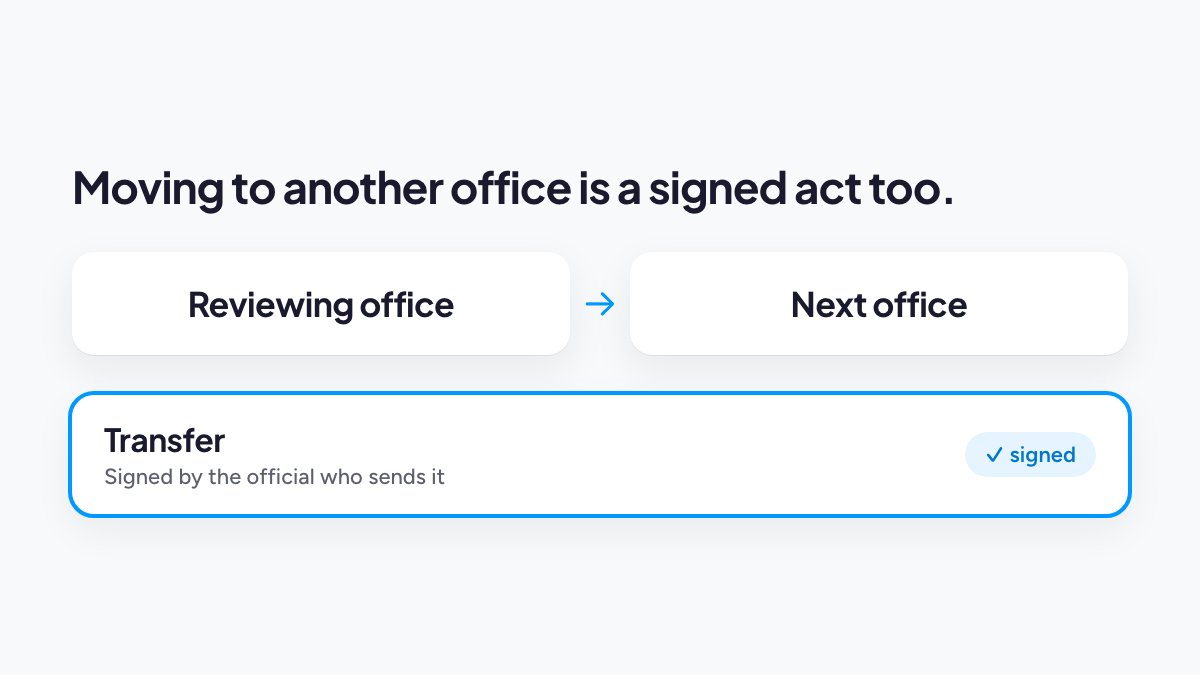
In an electronic case file, every step, including the transfer between offices, is a signed act that becomes the next folio.
The applicant sees each one as a status, in real time.
👇
Four months to sign one agreement between two governments, multiplied by every province and municipality.
@fernandezdiego at #RedGob2026 on recognizing another jurisdiction's verifiable credentials with a resolution of your own 👇
in Nuevo León, millions of citizens carry official documents as verifiable credentials on @sovraio infrastructure.
up to 80% less time on procedures and up to 30% fewer requirements.
the credentials run on Propia and settle on Ethereum.
Years of fishing by hand had worn away the fingerprints of cacao farmers in the Peruvian Amazon, so the identity check kept failing.
@ReniecPeru's Héctor Saravia took Peru's digital ID upriver and switched to facial biometrics.
¡ #Sovra es sponsor del Convergencia Data Center Forum!
Operadores de #DataCenters y #Cloud, inversores, proveedores de infraestructura, tecnología y energía, gobiernos y quienes deciden sobre nueva capacidad y construcción se pueden sumar acá: https://t.co/4qoBsdlrSs
Verifiable credentials are everywhere lately, and most of the conversation is about the signature.
A valid signature tells you the content hasn't changed since it was issued.
To fully trust a credential, a verifier needs two more answers: whose key signed it, and whether it is still valid.
With SovraChain, both answers live on a public chain.
Every verifier reads the same record, the check keeps working when the issuer's server is offline, and personal data stays on the person's phone, in SovraWallet.
how a national-scale identity system settles on @ethereum@sovraio runs sovrachain on ethrex, while aligned deploys the rollup and turns its many proofs into one.
as a result, every proof ends up secured by ethereum, and costs stay low as it scales.
When you send someone a document to prove something, how much information are you actually giving them?
Usually, more than they need.
A verifiable credential can work differently. You can share the specific information needed, while the recipient can verify that it came from the right issuer and hasn't been altered.
At Sovra, institutions use SovraID to issue credentials, people keep them in SovraWallet, and verifiers can check them independently.
Prove what matters without handing over everything else.
"We loved the idea that we would be blind and deaf every time a digital ID is presented."
That's Héctor Saravia of @ReniecPeru in the latest Sovra Podcast.
→ Director of Certification and Digital Services at RENIEC
→ Led Peru's national ID onto the Peru Pass wallet as a verifiable credential
→ Built on MOSIP's open-source Inji, with support from @CentreforDPI
Peru's registry issues the credential once. After that the wallet presents it, the verifier checks signature and status on its own, and nobody calls the issuer, so a digital ID keeps the privacy a plastic card always had.
Worth your time if you care about verifiable credentials, open-source DPI, or wallet design that keeps the issuer out of the loop.
how many times have you proven who you are this year?
how many were the same proof?
time to own what you've proven.
propia, the public trust layer for verifiable digital credentials, is live across government deployments in Latin America, settled on @ethereum.
built with @sovraio and @class_lambda.
The SEC just said it's interested in ZK-based credentials, and @rj_aligned says @alignedlayer is already shipping them.
He says Aligned went live on verifiable credentials with a partner and published a blueprint telling governments how to build their own, on rollups and Ethereum.
The problem it solves: KYC as a data honeypot in a world where AI breaks the old processes.