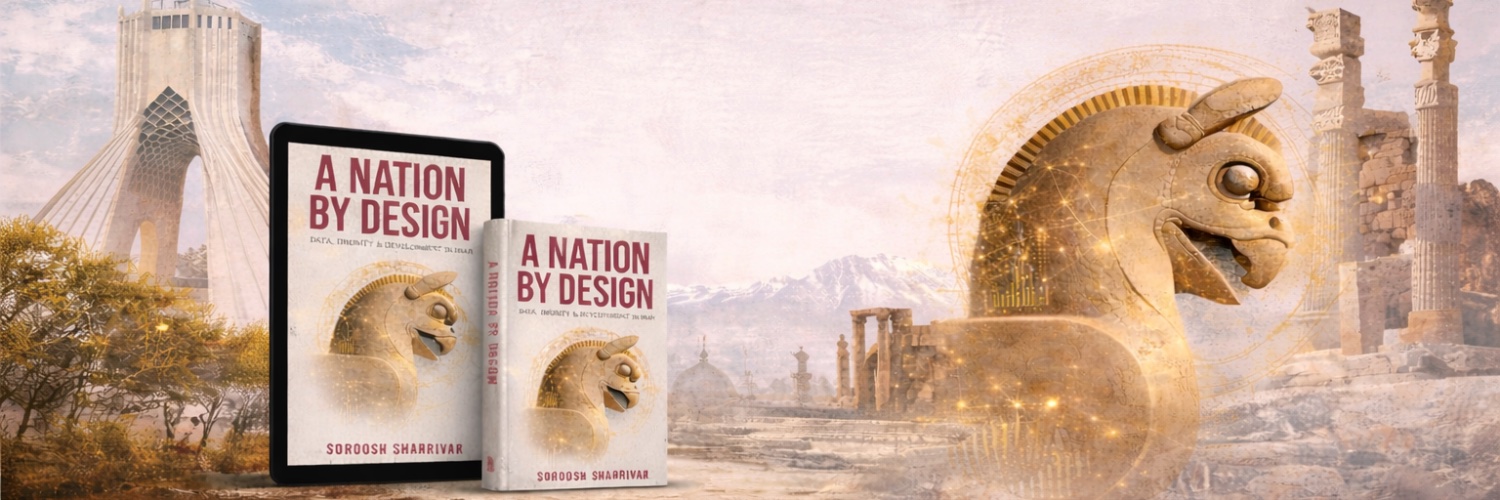
3,000 years of history, identity, and depth.
One doctrine to make sense of it all.
Out now, The Iranian Doctrine.
https://t.co/x7JWwExoSi
#Iran#MiddleEast#History#Civilisation#Books
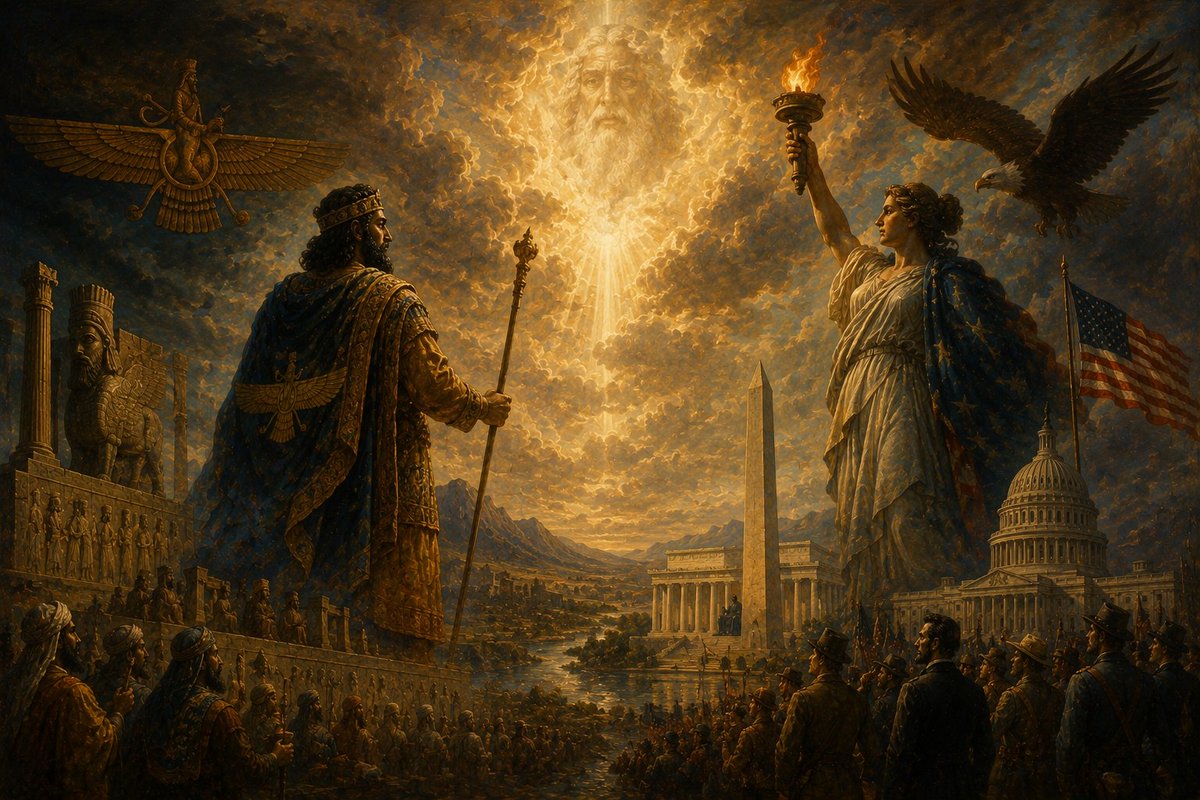
In God We Trusted: The motto that Iran and America share.
Scroll through a list of national mottos and you notice something. France: liberté, égalité, fraternité. India: truth alone triumphs. Canada: from sea to sea. Brazil: order and progress. Greece: freedom or death. Spain: further beyond. Most nations, when asked to distill themselves into a handful of words, reach for geography, ideology, or aspiration. They invoke land, people, or the arc they are bending toward.
Then there are two.
Two nations reach beyond themselves and invoke God.
United States of America: “In God We Trust”
Iran: “God is the Greatest”
I am Iranian. I have spent a significant portion of my life navigating the peculiar dissonance of belonging, in some cultural sense, to both of these civilisations simultaneously and I will admit that when I first noticed this, it stopped me cold. I had even heard it once from a man I was having a cigarette with in Tehran many years ago: that these two nations have a great deal more in common than the eye lets on. That, I will save for another day. Back to the God in the motto; it is and was the answer to a problem both empires faced at their founding and never fully resolved. Understanding that problem explains almost everything else about how they rose, how they governed, and how they will fall.
The problem is blood.
An ethnic empire does not need God. It has ancestry, family trees, shared DNA and pedigree. The logic of blood is self-sufficient: we rule because we are the people, and the people are us. Han China could appeal to Han identity. The Ottoman Empire, at its most Turkish, could appeal to Turkish lineage. Even at their most pluralist, ethnic empires always had a core people whose claim to dominance was written into genealogy.
The Achaemenid Iranians had no such luxury. Cyrus the Great conquered Babylon in 539 BCE and found himself ruling Persians, Medes, Babylonians, Egyptians, Lydians, Jews, Greeks, Scythians, and dozens of peoples whose languages he could not speak and whose gods he had never heard of. There was no single blood to appeal to. The empire was too large, too diverse, too internally contradictory to justify itself by tribe. It needed something above tribe.
America faced the identical problem, two and a half millennia later, for almost identical reasons. It was, from its first generation, a nation assembled from peoples who had arrived from elsewhere. English, Dutch, African, French, German, Irish, all with different languages, different religious traditions, and different histories of arrival. E pluribus unum. The plurality was the point, and the plurality was the problem. You cannot build a national identity on blood when your nation was built by people whose only common ancestor is the fact of having gotten here.
Both empires solved this problem the same way. They reached above the human entirely.
In Cyrus the Great’s case, he did not conquer Babylon. He was chosen by Marduk, the Babylonian god, to liberate it from Nabonidus, who had offended him. He did not defeat the Jews. Yahweh sent him to restore them to Jerusalem. He is, remarkably, the only non-Jewish figure in the Hebrew Bible to be called mashiach; the anointed one, the messiah. In his own royal inscriptions, and in those of Darius after him, almost every declaration begins identically: By the grace of Ahura Mazda. The phrase appears so consistently it becomes almost syntactic, a grammatical requirement before any sentence about power.
This was not piety as we understand it. It was the unifying principle upon which an empire rested. Without divine legitimacy, the Iranian king was merely the latest warlord with a larger army than his rivals. With it, he became the earthly steward of Asha, the Zoroastrian ideal of truth, order, and right arrangement. The empire was not conceived as an instrument of conquest but as a guardian of cosmic order. To oppose it meant to side with druj, the lie, the disorder, the darkness that threatened to unravel the proper balance of the world.
America followed the same grammar. “In God We Trust” was not part of the founding documents. Jefferson and Madison were too philosophically careful for that. The phrase first appeared on coins during the Civil War, when the nation was tearing itself apart and needed an authority higher than the Constitution itself. The Constitution had become the very thing being contested.
It later became the official national motto in 1956, at the height of Cold War anxiety, when there was an ideological threat. A self-consciously godless communism confronted a democracy that increasingly defined itself through an appeal to God.
Both moments are revealing for the same reason. The phrase emerges in times of crisis instead of times of calamity. God is what a civilisation reaches for when blood is not enough, when institutions are under strain, and when argument has exhausted its persuasive power.
Once you ground your empire in divine mandate, certain things follow almost inevitably, as downstream consequences of that single upstream decision.
The first is the liberation myth. When you are doing God’s work, you cannot be a conqueror. You can only be a liberator. The Cyrus Cylinder is, at its core, a liberation narrative. Cyrus freed Babylon. He restored the exiled. He returned the stolen gods to their temples. The conquest is written entirely as rescue. America has told the same story about every military engagement in its history, without exception. They did not invade, they liberated. They did not occupy, they rebuilt. The theological grounding makes conquest psychologically impossible to acknowledge, even privately. This is not cynicism or propaganda. It is the sincere blindness that comes from genuinely believing you are the instrument of something larger than yourself.
The second consequence is the moral binary in foreign policy. Zoroastrianism may be the first great dualist religion: the universe as an absolute struggle between light and darkness, truth and lie, with no neutral ground and no permanent accommodation possible. This theology, that grew out of the temple, shaped how Achaemenid kings understood their enemies. They went beyond looking at them as political adversaries with legitimate interests. Rather the Achaemenids saw them as agents of chaos who had to be defeated for the sake of cosmic order. American foreign policy has operated on a structurally identical template. The Cold War was not framed as a competition between two great powers with different economic systems. It was framed as a struggle between the free world and tyranny, between God and godlessness, between light and an axis of evil. Behind both empires lies the same instinct: to see history as a contest between what is right and what is wrong, rather than between competing interests and imperfect actors. Once that lens takes hold, accommodation becomes difficult. Compromise begins to look like complicity. After all, you do not negotiate with druj.
The third consequence is the most uncanny: the empire becomes invisible to itself. If you are doing God’s work, you are not an imperialist. You are a servant, burdened by responsibility you did not ask for. Ordinary Persians in the Achaemenid heartland did not experience themselves as the ruling class of a vast extractive empire. They experienced themselves as the chosen stewards of cosmic order, maintaining the peace that would collapse without them. Most Americans do not experience themselves as imperial citizens either. They experience themselves as a free people, occasionally exhausted by global obligation, trying their reluctant best. Beyond being useful propaganda for the elite, this theological grounding produces a genuine mass psychology of innocence that persists even as the evidence accumulates. The greatest privilege of an empire is not power. It is the ability to mistake its own interests for the interests of the world.
There is also one final consequence I keep returning to, and it is the one I find hardest to resolve.
Civilisations build for eternity when they start feeling mortal. Persepolis was constructed by Darius and Xerxes at precisely the moment when the Achaemenid Empire was transitioning from expansion to administration, from hunger to maintenance, from making history to managing it. The columns, the audience halls, and the relief carvings of tribute-bearing peoples from every corner of the known world were built to project permanence onto a system that was already beginning to harden.
Washington, D.C.’s monumental core emerged during a similar phase. Much of it was cemented in the late nineteenth and early twentieth centuries, when America was entering its imperial adolescence and still intoxicated by its own momentum. The Lincoln Memorial. The Jefferson Memorial. The Mall. All were built to look eternal.
They were built to look eternal. History, as it tends to do, arrived shortly afterward to remind everyone that nothing is.
The monuments will outlast the power. They always do. That is, perhaps, exactly what they were built for.
I do not know what to make of the fact that both of these empires, the one I am descended from and the one I grew up under the shadow of, inscribed God into their official identities and then proceeded to behave in ways that sat uneasily with the ideals they claimed to serve.
Maybe that is the point.
Maybe “In God We Trust” and “Allahu Akbar” are not merely declarations of faith. Maybe they are admissions of need. Confessions that an empire is too vast, too diverse, and too internally contradictory to hold together through any purely human logic, and therefore requires something beyond the human to legitimise it.
If that is true, then the motto is more than just a boast. It is a prayer.
And prayers, as anyone who has read the inscriptions at Persepolis knows, do not always receive the answer that was hoped for. The columns still stand. The empire does not.
Between the permanence of the stone and the impermanence of the power it was built to celebrate lies a lesson that neither Iran nor America escaped. Both invoked God not as an object of worship, but as a source of legitimacy, purpose, and meaning. Both sought to anchor something temporal in something eternal.
Yet history is merciless toward such ambitions. The monuments endure. The slogans survive. The prayers remain carved into stone and stamped onto coins. But the societies that utter them are forever changing, forever falling short of the ideals they invoke.
Perhaps that is what these two civilisations ultimately share: the audacity to speak in the name of God, and the profoundly human inability to fully live up to what that requires.
The Push Present. On what America delivered to the world, and the gift it sent home from the hospital.
There is a custom called the push present. I only came across it recently. A man gives his wife a piece of jewelry to mark the labor she has just survived, or will survive. A diamond for the tearing, a bracelet for the blood.
The gift is supposed to commemorate a birth. Yet what it really commemorates is a change. Something beautiful for something brutal. A shiny object placed between memory and pain. Look at the stone, not the stitches. A receipt for suffering redeemable in carats.
I have come to think this is the best metaphor we have for what happened to public life during the past decade.
Something was born in the middle of the 2010s, a new mode of public life, a new metabolism of attention and rage, and it was born the way most things are born, in mess and screaming. And the country that delivered it did what the custom demands. It wrapped a present. It handed the rest of us a gift to mark the occasion, and the gift was the very pain it was meant to distract from.
We should be precise about who “it” is, because the comfortable version of this story has a villain who is too small. The comfortable version says that a demagogue came down an escalator, and a few bad networks amplified him for ratings, and that was that. This lets almost everyone off the hook. It lets the prestige press off, because they were merely covering him. It lets the independent sphere off, you know, the podcasters, the substackers, the streamers, the men with microphones and grievances, because they were only responding. It lets the left off, because it was only resisting. It lets the right off, because it was only fighting back. Everyone in the room insists they were the reaction and never the cause, which is how you know the whole room is the cause.
What actually happened was a tectonic shift, and it happened across the entire spectrum at once. Somewhere in those years the American information economy completed its conversion from a business that sold news to a business that sold arousal. And not the erotic kind, but the physiological kind, the spiked pulse and the clenched jaw. The unit of value stopped being the informed citizen and became the aroused citizen. And activation, it turns out, has a chemistry. It runs best on contempt. It scales best on the certainty that the people across the aisle are not wrong but wicked, not mistaken but a threat to your children. Every outlet learned this, the august and the upstart alike, because the platforms that carried them all paid out in the same currency, and the currency was fury.
This is the part the mainstream press has never honestly reckoned with, because its self-image forbids it. The legacy institutions told themselves they were the adults in the information octagon. They were the fact-checkers, the firewall, the calm against the chaos. But the firewall ran on the same fuel as the fire. The front pages discovered that the resistance sold as well as the provocation. That a permanent emergency was good for subscriptions. That is how you keep them ‘subscribed.’ They did not lie, well mostly they didn’t. They just learned which true things to put in eighteen-point type and which to bury, and the selection was made by the same algorithm that governed everyone, the one that asks only one question. Will this be shared in anger?
Call it the Orange Press, the Yellow Press 2.0. A century ago the originals invented the same trick, the screaming headline that moved the paper by moving the panic, and we named that jaundiced thing for its colour. This was the upgrade, and it is fitting that the man who spearheaded it answered to a nickname borrowed from a defoliant, Agent Orange, a toxin that does not stay where it is dropped but drifts, downwind, into everything that was supposed to be safe from the war.
And the independent ecosystem, the one that defined itself precisely against the mainstream, turned out to be the same machine with the badges filed off. It sold authenticity, but authenticity engineered for the feed is just outrage with better lighting and a more intimate voice. The promise was that the gatekeepers lied to you, and here is the real thing. The product was that here is a new gatekeeper, and selling you a different fury and calling it freedom. Left independent media and right independent media despise each other and are, in a way, twins, both monetizing the conviction that the other half of the country is the enemy, both dependent on the very polarization they diagnose.
Here is where I have to land a blow against my own thesis, because a case that names no objection stops being an argument and becomes a tantrum.
The honest objection is this one. Extremism did not begin in 2016, and America did not invent fanaticism. The twentieth century needs no lessons from a cable network. Every nation that caught the fever had its own kindling, its own histories, humiliations, and demagogues waiting for a match. To say America gave the world its extremism is to flatter America with an authorship it does not deserve and to rob other peoples of their own grim agency. Russian information operations. Chinese algorithms. European tabloids. They all existed and the fire was already laid in a hundred countries. This is true, and I will not pretend it away.
But a gift is not the same as an origin. I am not claiming America lit every fire. I am claiming America perfected, packaged, and exported the catalyst, along with the delivery system and the grammar. What crossed every border in those years was not the grievance, which was local, but the style. The post that is engineered to enrage. The influencer who is really a militia recruiter in a podcast chair. The conversion of every disagreement into an existential war. The discovery that a democracy’s own openness can be turned into a weapon against it. That technology of feeling is the American export. The kindling was already there. America shipped, free of charge and at planetary scale, a better way to strike the match.
This is the cruelty buried in the word gift. Because a true gift binds the giver and the given. It says, I thought of you. And this one did. The American attention economy did not export its methods by accident, as exhaust. It exported them as product, through platforms designed in California and monetized by engagement, through formats copied in Manila and São Paulo and Warsaw because they worked, because they had been tested to destruction on the most lucrative political market on earth. The American public were the focus group. The world received the finished good.
And so the new era was delivered, screaming, in the American winter of that first campaign, and to mark the occasion the country reached into its pocket and produced a present for the rest of us. Not the thing itself. The thing itself America kept, and is keeping still, and is being eaten by. What it sent abroad was the bright wrapped version, the bracelet for the blood. A method, a mood, a permission. Here. Something to remember the birth by.
The custom assumes the present settles the account. It does not. The jewelry sits in a drawer and the wound becomes a body, and the body has to be lived in for the rest of a life. We are all living in it now, every country that learned, from the best teacher in the world, how to hate its other half with the speed and the reach and the unblinking confidence of an American.
The custom marks a birth, so it is worth remembering that the thing born that winter is no longer an infant. It is almost ten now. It speaks every language. It has its mother’s appetite and its father’s certainty, and it is being raised, lovingly, in a hundred countries at once, by parents who all swear it takes after the other side of the family. We are not done unwrapping. The gift was only the first thing it ever gave us.
Iran, the Strait of Hormuz and the Geometry of Weakness
There is a detail in the architecture of the medieval European castle that has outlived its purpose and become a parable. The stone staircases that wound up through the keeps were built narrow, and they were built to climb clockwise. This was intentional masonry. A defender retreating upward kept his sword arm free to the open side of the spiral. The attacker climbing toward him found his own sword arm pinned against the central column, his shield turned uselessly into the wall. The geometry decided the fight before the swords met. A stronger man, better armed and better trained, could be beaten by a weaker one who had simply chosen the ground. The lesson the architects understood is the lesson that every weaker power eventually learns. When you cannot win the contest of strength, you change the shape of the room.
Iran has spent four decades learning that lesson, and the Strait of Hormuz is the room it chose.
To understand why, one must first set aside the language in which the strait is usually discussed in Washington. It is the language of blackmail, of a regime “holding the world hostage,” of fanaticism reaching for the global jugular. That language flatters the West’s sense of itself as the reasonable party and explains nothing. Iran’s conduct in the Persian Gulf is not the behavior of a state that has lost its mind. It is the behavior of a state that has counted its disadvantages with great care and found, in a single channel of water twenty-one nautical miles wide at its narrowest, the one place where those disadvantages cease to matter.
Consider the asymmetry through an honest prism. Against the naval power of the United States, Iran cannot win an open contest and has never imagined it could. It has no carriers, no blue-water fleet, no answer to American air superiority in the open waters. In the symmetrical war, the war of tonnage and platforms, Iran is the armoured attacker climbing the stair, and every advantage of the larger power can be brought fully to bear.
But the strait is not the open Persian Gulf. It is the spiral staircase in the castle.
Its shipping lanes are roughly two miles wide in each direction. A supertanker in transit can neither manoeuvre nor hide nor turn. Along its northern shore Iran holds the high ground in the most literal sense. The islands of Qeshm, Larak, Abu Musa, and the Tunbs sit astride the channel like the newel post of the stair. From them, the weapons that suit a narrow place do their work. Sea mines. Shore-based anti-ship missiles. Swarms of small fast-attack craft that are individually trivial and collectively very difficult to suppress.
None of these can defeat the United States Navy in the Arabian Sea. All of them can make the narrow water lethal. That is the entire point.
Iran does not need to match American strength. It needs only to deny American strength a place to stand.
For most of the past forty years this was a deterrent held in reserve, and its value lay precisely in its remaining unused. The threat to close Hormuz was worth more than the closure itself, in the same way that the staircase’s true value was that the attacker, knowing the cost, often declined to climb. Roughly a fifth of the world’s seaborne oil passes through the strait. The mere credible possibility that Iran could interrupt that flow was a permanent seat at a table from which Iran would otherwise have been excluded. It was leverage that cost nothing to hold and would cost a great deal to spend.
What changed in 2026 is that the card was finally played, and played not by Iranian intent but by the Iranian imperative of survival. The Israeli and American strikes that began in late February, the killing of Supreme Leader, Ali Khamenei, and the campaign aimed openly at the survival of the Islamic Republic itself removed the conditions under which restraint made sense. A state that believes it is being dismantled has no reason to preserve its deterrent for a future it may not have.
And so in March, Iran did what for forty years it had only threatened. It declared the strait closed. The mines went into the water. The shipping stopped.
The geometry that had been theory became fact.
Here the parable turns, and an honest account must follow it where it goes.
The defender at the top of the stair is also trapped.
He has chosen ground that favours him in a fight, but it is still a siege, and a siege is not won by the besieged. Hormuz is Iran’s chokepoint, but it is also Iran’s own artery. The oil revenue on which the Islamic Republic survives flows out through the same water it has closed. The strangler’s grip closes on its own throat as surely as on the world’s.
And a deterrent, once spent, is no longer a deterrent.
The American counter-campaign that followed, the air operations from March and the blockade of Iranian ports from April, answered closure with closure and demonstrated that the same narrow water can be turned against the power that holds its northern shore. The room that protects the defender also confines him. Iran has discovered that the spiral stair, descended, leads not to safety but into the open gulf where its weaknesses are again fully exposed.
This is the deeper truth the castle metaphor conceals beneath its tidiness, and it is the truth most relevant to whatever comes next.
Asymmetric advantage is real, but it is conditional, not absolute. It works as a threat and it gradually decays as an act.
It can impose extraordinary costs on a stronger adversary while imposing comparable costs on the one who wields it. The weaker power that builds its whole strategy around a single chokepoint has not solved the problem of its weakness. It has only relocated that problem to a piece of ground where, for a time, the math runs in its favor.
When the threat is finally executed, the math begins, slowly and then quickly, to run the other way.
The question that will determine the next phase is therefore not whether Iran can close Hormuz. It has shown that it can. The question is whether a state can survive having done so. Whether the besieged can outlast the besieger. Whether the cost imposed on the world’s energy supply translates into political pressure that works in Tehran’s favor faster than the blockade and the air campaign work against it.
That is now a contest of endurance, not of geometry, and geometry offers no guidance on how it ends.
The architects of the old keeps understood the narrow stair perfectly. What they could not build into the stone was the answer to the harder question. What becomes of the defender after the attacker, bloodied, decides simply to wait at the bottom and starve him out?
Iran is now living inside that question.
The narrow water that was once its greatest strength has become the measure of how alone it stands.
And yet aloneness should not be mistaken for fragility. A people does not survive three thousand years, outlasting every empire that ever set out to end it, by being easy to break. Before the besieger settles in to starve him out, he would do well to open the older histories.
Let him read of Ariobarzanes at the Battle of the Persian Gate, who with a few hundred men held the narrow pass against Alexander himself for a month, teaching the same lesson of the chokepoint that would later be written in the waters of Hormuz after first being carved into stone two thousand years earlier.
Let him read of Hassan-i Sabbah, who from the rock of Alamut taught the great powers of his age to fear a blade they never saw coming.
And then let him read of Rome.
Of Surena at Carrhae, who broke Crassus not with numbers but with patience, with the feigned retreat, the arrow loosed backward from the saddle, and a train of camels that kept the arrows falling long after the legions had staked everything on the quivers running dry.
Of Shapur, who took the Emperor Valerian alive and kept him, making him the only Roman emperor ever captured by a foreign ruler.
Of Julian, who marched east certain of victory and learned, among the scorched fields the Iranians left him, that a people which refuses the battle you offer and waits for the one it wants is the hardest of all to kill.
This is a nation that does not yield. When it is threatened, it does what is necessary.
Ask Rome.
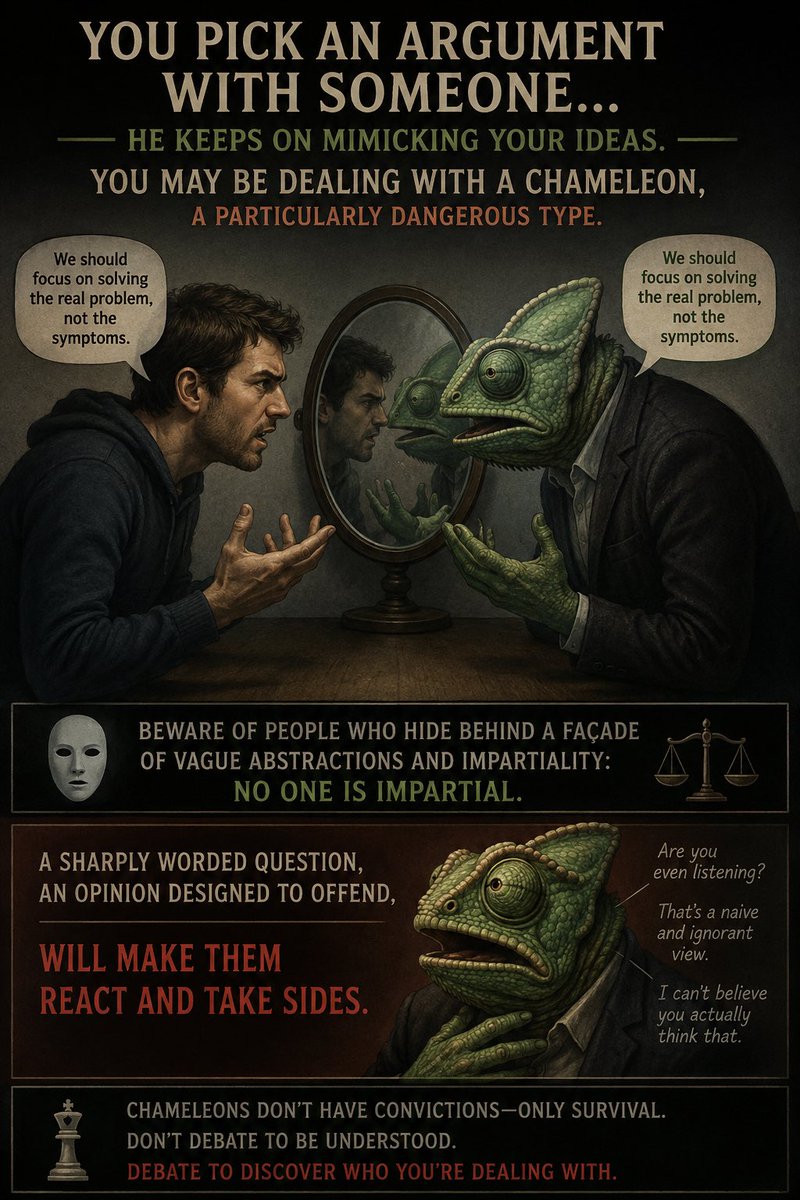
You pick an argument with someone and he keeps on mimicking your ideas, you may be dealing with a chameleon, a particularly dangerous type. Beware of people who hide behind a façade of vague abstractions and impartiality: no one is impartial. A sharply worded question, an opinion designed to offend, will make them react and take sides — Robert Greene, War
Steel is more elastic than rubber.
I didn’t know this. No teacher ever mentioned it. Physics, having discovered it long ago, seems to have kept the fact strangely quiet.
Press rubber and it yields with theatrical generosity. Press steel and it scarcely moves. Yet the one that barely gives is the more elastic of the two.
Who would have thought?
To me, elasticity and rubber belonged together the way Coke belongs with soda, Kleenex with tissues, or Tide with detergent. The words seemed almost interchangeable. Yet physics insists otherwise.
And if you sit with that fact for a moment, a second strangeness arrives behind it. Nearly every trial in life seems to ask the same question; how much can you take? The material world suggests, very calmly, that this was never the question at all.
Elasticity, it turns out, has nothing to do with how far something bends. It has everything to do with how completely it comes back.
That was the part I had wrong.
Rubber can stretch, twist, compress, and contort itself in ways steel never could. Yet none of that is what elasticity measures. The question is not how dramatically a material gives way. The question is how faithfully it returns to what it was before.
By that measure, rubber is surprisingly mediocre. Steel is the star of the show. The material that barely seemed to move is the one that comes back most perfectly to itself.
And that flips something upside down about the way we think of people.
We tend to admire the person who is endlessly accommodating. The one who gives way. The one who absorbs pressure and reshapes themselves around everyone else’s needs. We call that flexibility. We call it maturity. Sometimes we even call it strength.
But in the material world, a thing that is easily reshaped is often a thing with less structure holding it together. Rubber yields because its internal bonds allow it to. Its willingness to change shape is not a virtue. It is simply the consequence of how it is built.
The more I thought about that, the more uncomfortable it became.
Maybe the strongest thing is not the thing that gives the most. Maybe it is the thing that knows how to return.
And there is another layer to this that makes the comparison even stranger.
When rubber is bent and then released, it does not travel back along the same path. Some of the energy disappears along the way. Physicists call this hysteresis. Engineers can see it on a graph. The curve going out and the curve coming back do not match.
That gap is energy lost as heat. In other words, the experience leaves a trace.
Steel behaves differently. Within its elastic range, it retraces its steps almost perfectly. Out and back along the same line. The energy returns. Nothing is left behind. No warmth. No residue. No receipt for the journey.
Which means the material that seemed to feel everything is quietly carrying the cost forward. The material that seemed unaffected is the one that kept nothing at all.
We mistake the heat of dissipation for the depth of feeling. It is only the sound of energy not coming back.
The more I sat with that idea, the stranger it became. We often admire the people who visibly carry the weight of things. The person who absorbs every difficulty, every disappointment, every demand placed upon them appears deeper than the one who remains unchanged. There is something instinctively noble about visible wear. We look at the scars left behind by experience and assume they are evidence of wisdom.
But the physics suggests another possibility. What appears to be depth may sometimes be the record of energy that never returned. The rubber looks responsive because it deforms so readily. It seems to participate more fully in the encounter. Yet it is precisely this participation that leaves it paying a cost on the way back. The energy lost as heat is not evidence of greater resilience. It is evidence that the return was incomplete.
There is another surprise hidden inside the comparison. The qualities we tend to treat as opposites turn out to be closely related. We often imagine that firmness and resilience exist in tension with one another. To hold your ground is one virtue. To recover quickly is another. Life appears to demand a balance between the two.
Yet the material world points in a different direction. The same internal structure that allows steel to resist deformation is also what allows it to recover from it so completely. The ability to keep one’s shape and the ability to regain one’s shape are not separate achievements. They emerge from the same underlying order. What looks like a trade-off from the outside is, at a deeper level, a single property expressing itself in two different ways.
This is what made the idea difficult to forget. We spend so much of our lives trying to become more adaptable, more accommodating, more capable of absorbing pressure. Yet perhaps the more important question is whether we possess the structure required to return. Adaptation without return is simply a slower form of deformation.
Seen this way, the engineer’s concept of fatigue begins to feel less like a property of materials and more like a description of certain lives. Fatigue does not arrive because of one overwhelming force. It arrives because countless small forces leave behind tiny remnants of themselves. Each individual loss is almost invisible. No single bend matters very much. Yet the losses accumulate. Eventually the structure gives way, not because it encountered an impossible burden, but because it never fully recovered from the ordinary burdens it had already survived.
That, I suspect, is how many people lose themselves. Not through catastrophe, but through accumulation. A little compromise here. A little accommodation there. A shape adopted temporarily and then never entirely abandoned. The process is so gradual that it can easily be mistaken for growth. Only later does one realise that adaptation and erosion are not always the same thing.
The uncomfortable implication is that the capacity for return cannot be improvised at the moment it becomes necessary. Steel does not acquire its structure while it is under load. The grain was established beforehand. The forge came before the test. Whatever allows the material to recover so faithfully already existed before the force arrived.
The same may be true of people. The habits, principles, disciplines, friendships, and forms of self-knowledge that make a complete return possible are usually built long before they are needed. They are formed during ordinary periods of life when nothing appears to be demanding them. We often think of those quiet days as empty. Perhaps they are not empty at all. Perhaps they are when the lattice is being built.
The lesson, then, is not to become harder, nor to feel less, nor even to bend less. Rubber bends more than steel and is the lesser for it. The goal is to be structured in such a way that the path back remains available. To encounter pressure without carrying its imprint forever. To experience force without surrendering shape.
Perhaps this is what we meant all along when we admired a mind of steel. Not a mind that never bends, and not a mind that feels nothing. A mind built so well that whatever pressure passes through it leaves no permanent shape behind. A mind whose return is as complete as its departure. A mind elastic enough to remain itself.
Lenin's Pocket Watch https://t.co/ObwMhPzyMu
There is a story that gets told about Lenin, and like most stories, more depth and mystique add to it as the years pass by.
The story goes something like this.
Lenin is addressing a crowd of workers. He speaks, as he always does, about equality. About wealth as a kind of theft. About the indecency of a world sorted into those who own and those who are owned. And then someone in the crowd, unwilling to let the contradiction pass, calls it out. Look at you. The good suit. The pocket watch catching the light. You stand here cursing wealth while you’re draped in a fancy suit and a shiny gold watch.
The reply, as the story goes, was: Yes. I do have a fancy suit and a golden pocket watch. I don’t want to end up like you. I want all of you to end up like me.
Whether Lenin ever said it hardly matters. It’s true that statesmen, leaders, and the ilk of Lenin throughout history are quick-witted. And in that specific moment, he took an accusation and handed it back in one thought-provoking answer.
The heckler couldn’t have known better. He assumed what most already think when the word ‘equality’ gets thrown around. To many, equality means subtraction. That to make a world fair, you must take from the comfortable until everyone shares the same scarcity. There is no room for golden pocket watches, so it is best to smash it, tear the expensive fabric of designer suits, and level the room to its lowest floor for all to live equally ever after. It is the oldest objection to every egalitarian dream, and it contains a quiet cruelty. It imagines justice as the universal distribution of less.
The answer refuses that arithmetic. The suit is not the enemy. Comfort is not the enemy. Dignity, ease, a watch in your pocket and time you are free to spend, these are not the evil bourgeois sins to be confiscated. They are the standard. The complaint was never that some people live well. The complaint was that so few are allowed to.
This is the difference between resentment and aspiration. One says, bring him down to me. The other says, bring me up to him and everyone with me. The first is satisfied by ruin. The second is satisfied by nothing less than shared abundance.
You can quarrel with the man, with the century he set in motion, with the gulf between the line and what followed it. History gives you ample grounds. But strip the anecdote of its author and the idea stands on its own, clean and uncomfortable—
The goal was never to make everyone poor.
It was to make no one have to be.
For too long we have allowed cartographers in distant capitals carve our continent into convenient halves and quarters. West Asia. South Asia. Southeast Asia. Central Asia. Each prefix a small surrender, a quiet admission that we are not whole enough to whole enough to hold a name. The West is simply “the West.” Europe is simply “Europe.” But Asia, the largest and oldest landmass of human civilisation, is granted no such dignity. We are always a region of a region, a sub-continent of a continent, a fragment of something that the speaker apparently considers too vast to bother with as a single idea.
This was not just nomenclature in geography. We slept through those classes. This is a choice of grammar, and grammar shapes politics.
Let us settle this. There never was a need for alignment with the West, and there is even less of one now. The premise of alignment assumes a centre somewhere else, a sun around which the rest of us must order our orbits. That premise has expired. It expired in the supply chains that now run from Shenzhen to Jebel Ali without passing through Rotterdam or Long Beach. It expired in the energy contracts denominated in currencies that do not begin with a dollar sign. It expired in the diplomatic patience of states that were told for three decades that liberalisation was destiny, only to watch their preachers retreat behind tariff walls and industrial policy at the first sign of competition.
For roughly 30 years after the Cold War, many countries were told to liberalise their economy, reduce tariffs, privatise industries, open markets and embrace global free trade. Capitalism is good. More importantly the American interpretation of capitalism is good. And countries that resisted were often portrayed as backward, protectionist, or economically irrational. Fast forward to today, when countries like China have become extremely competitive, especially in manufacturing, technology, batteries, solar panels, steel, EVs, and semiconductors, many Western countries themselves began doing the opposite. They started imposing tariffs, subsidising domestic industries, restricting trade, blocking foreign acquisitions and pursuing industrial policy. What gives?
The answer is in the reversal itself. So let us do what they will not, and give an honest accounting of what we already are.
China is Asia’s industrial powerhouse, the workshop and increasingly the laboratory of the continent. It builds at a scale and pace that the twentieth century reserved for hyperbole. The Arab states sit on the energy that powers not only this industry but most of the world’s, and they are now using that capital to become more than a tap; they are becoming financiers, builders and convenors. India is the agricultural and demographic anchor, a civilisation that feeds itself and increasingly the regions adjacent to it, with a service economy that has quietly become indispensable to global enterprise. Vietnam has emerged as the elegant manufacturing complement, absorbing the diversification that geopolitics demands and proving that the East Asian development model was never a one-country miracle. The CIS states bring the depth of the Eurasian heartland: minerals, grain, fertiliser, and transit corridors that turn a map into a network. Iran sits where it has always sat, the bridge that connects all of it, whether the current administrations in Washington or Brussels approve of the bridge or not.
This is not a list of countries hoping to matter. This is a description of a continent that already does.
The intellectual tragedy of the past generation has been our willingness to accept frameworks that diminish this reality. “Global South” is a useful slogan for solidarity but a poor description of standing; it defines us by what we are not, by our distance from a northern reference point that no longer behaves as a coherent bloc anyway. BRICS is a more serious project, but it remains an acronym, a coalition of conveniences across three continents, not a civilisational claim. Both are vehicles. Neither is a destination.
The destination is Asia. The continent. As a single noun, declared without prefix.
This does not require uniformity. Asia has never been uniform and never will be. Its strength is precisely that an Iranian poet, a Cantonese trader, an Emirati financier, a Tamil engineer, a Kazakh agronomist and a Vietnamese manufacturer can each be entirely themselves and still participate in something larger than themselves. Europe spent centuries trying to manufacture this kind of coherence through wars and treaties. Asia inherits it through geography, trade, faith and the simple endurance of older civilisations that never stopped speaking to one another, even when their colonial overseers preferred them silent.
What this moment asks of us is not new institutions, though those will come. It asks for a change of vocabulary, and behind the vocabulary, a change of self-image. To stop introducing ourselves with hyphens. To stop seeking validation from capitals that have not earned the right to grant it. To stop framing our economies in relation to a centre that is no longer central. To stop, in short, behaving like a region.
We are a continent. The continent. The largest market, the largest population, the deepest history, the broadest set of capabilities ever assembled within a single landmass.
The West will adapt to this or it will not. That is the West’s question to answer, not ours. Our question is simpler and more demanding: are we prepared to speak of ourselves the way the world will eventually have to speak of us?
Asia. Full stop.
"The most passionate advocates of the new science go so far as to say that twentieth-century science will be remembered for just three things: relativity, quantum mechanics, and chaos." - James Gleick, Chaos
A nation without philosophy becomes a marketplace.
When people stop asking what is good, just, beautiful, or worth preserving, the only thing left to measure life by is profit.
https://t.co/Za1vzmEgeg
Truth doesn't care about my opinion or yours.
You have your camp. I have mine. Time will tell us apart.
What's hidden surfaces. What's distorted straightens. The years are patient that way.
You chose where to stand, and the choice will outlive the moment.
If you believe in reincarnation, it will follow you there.
If you believe in generational trauma, it will reach your kin.
If you believe in neither, history is patient enough to wait.
And that silence within, what does it already know?
Whose voice speaks when no one is watching?
There was a time when being heard required earning the right to speak. A printing press cost money. A column inch had to be approved by an editor who had himself been approved by another editor, and somewhere up that chain sat a person whose job was, at least nominally, to ask whether what was being said was true. The system was imperfect, often snobbish, and frequently wrong, but it acted as a kind of friction. Ideas had to push through something before they reached the rest of us.
That friction is gone. Exposure has been democratised, and like most democratisations it has been a glorious disaster. Anyone with a phone and a ring light can now address more people in an afternoon than Cicero managed in his lifetime. The miracle is that this was supposed to give voice to the unheard. The poet in the village could recite his verses. The scientist locked out of the journals could share his theories with the world. The dissident under the boot would finally be heard. Instead it gave a microphone to the man who with unflinching confidence believes he deserves one.
Enter the idiot genius. He is not stupid in the conventional sense. He is something more dangerous. He has just enough intelligence to construct a sentence that sounds like wisdom, just enough charisma to make you nod before you’ve finished processing it, and an almost theological absence of self-doubt. He has read the first chapter of every book and the last chapter of none. He has a take on monetary policy, mitochondrial function, foreign policy, ethics and he will deliver all four before lunch. The hesitations that slow down thoughtful people have been algorithmically punished out of him. Confidence rewards the feed. Doubt buries you.
And so the loudest gets the largest stage. Not the most rigorous or curious. No. Not the one who has actually sat with a problem long enough to know its shape. But the loudest. Thanks to the platforms, they have turned this into a closed loop. Attention buys reach, reach buys credibility, credibility buys more attention, and somewhere down the chain of mistaken inference, an audience of millions decides that volume is a proxy for truth. The genuinely intelligent person, meanwhile, is at home rewriting his second paragraph for the fourth time, trying to make sure he hasn’t overstated something. There is no change he will win in this playing field.
What’s strange is that we all suspect this and participate anyway. We follow them. We share them. We argue with them in the comments, which only makes them larger. The whole apparatus runs on our complicity, and the idiot genius knows this better than anyone. It is, in fact, the one thing he genuinely understands.
What’s strange is that we all suspect this and participate anyway. We follow them. We share them. We argue with them in the comments, which only makes them larger. The whole apparatus runs on our complicity, and the idiot genius understands this better than anyone. He is, after all, “a numbers guy,” so engagement, retention, watch-time, these are things he can recite from memory. The dashboard is the one text he has actually read closely. Everything else he improvises, while washing wisdom, truth, and sincerity in botched ink.
So next time one of them tells you, with the certainty of a man who has never been corrected by anyone he respects, that he has finally figured it all out, you might offer the only reply the moment really deserves:
I’d agree with you, but then we would both be wrong.
https://t.co/uvxWFZ5baX