@Marketplace interviews Morgan and Neil Stephenson.
Using a beach umbrella, Morgan shows the easy part of the sunshade concept: making millions of square kilometers of ‘umbrella’ in space. Then the discussion turns to the hard stuff - governance.
https://t.co/fjbGuoR875
🔟 Open-source space sunshade model released:
@SpaceSRM publishes irradiance model for orbital sunshade fleets to support CESM climate simulations and transparency in space-based SRM research.
10/
Deep dive on sunshades and climate cooling with Ross and @danmiller999 --
- What's really the deal with the moral hazard argument?
- Why is the trolly problem so misleading?
- How are sunshades and stratospheric aerosols complimentary?
https://t.co/SHyVF3B0Fa
I went to the first-ever Planetary Sunshade Workshop, and I went in wondering if this is a 2040s thing or a 22nd-century thing.
The engineering is early, but the economics look different than they did a few years ago. Space industrialization is building the infrastructure a sunshade would need. If you're already mining lunar aluminum for commercial purposes, the sunshade stops being a standalone trillion-dollar climate project and becomes a climate application running on that infrastructure.
I wrote up what I learned. Article linked below 👇
New name, new logo, and an update to our theory of change:
1) sunlight reflection will be necessary
2) there are 2 planetary scale reflection methods: SAI and sunshades
3) these are complimentary
4) space industry is putting sunshades in reach
5) public benefit research now
Lurking below the surface in the equatorial Pacific is possibly the most impressive blob of above average ocean temperatures we've ever recorded since we've had the ability to measure this stuff. When that enormous concentration of bath water reaches the surface over the coming weeks and months, it's going to release devastating consequences around the globe throughout the second half of the year. Get ready for severe droughts in parts of South America, Africa, and Australia, devastating monsoons in southern China, and a roaring southern jet all winter long in North America. When you combine this with the fertilizer crisis bubbling as a byproduct of current global events, there's going to be crop failure on a level most of us have never seen during the closing months of 2026. Hard to see how we avoid widespread deadly famines across multiple stretches of the planet at this point.
Join us for EarthSpace 2026 on Earth Day:
Jeff Overbeek, Technical Director @SpaceSRM on planetary sunshade climate work
Frank White, Author of "The Overview Effect”
Dr. Gülin Dede, Copernicus/ESA leader and analog astronaut
April 22 • 12 PM ET
Register for the webinar today: https://t.co/zqHlhwxjZo
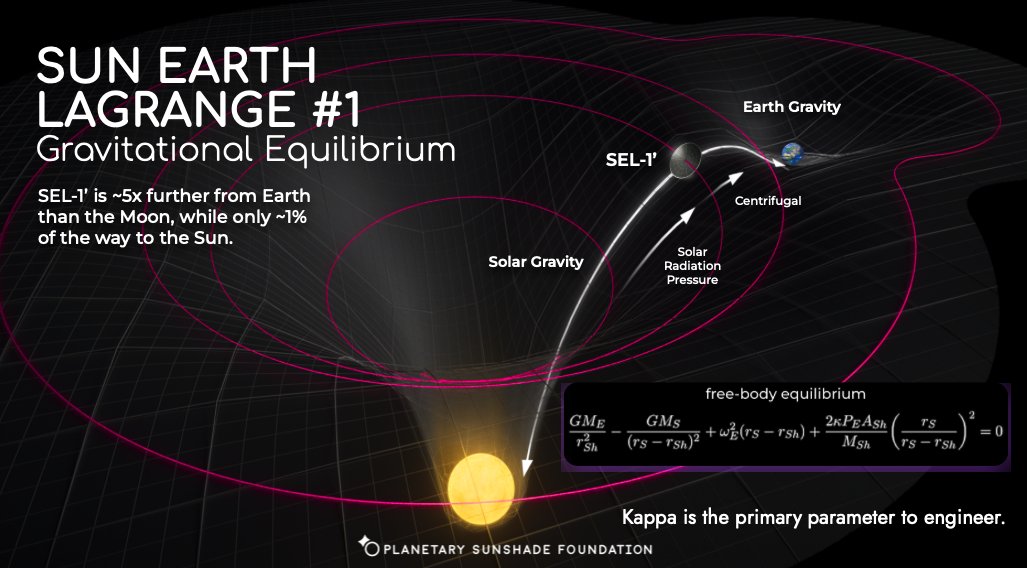
@paulgambill@jasonp One more thing Claude missed, which is important: The Solar-radiation-pressure-adjusted equilibrium point is about 50% further away from earth than the SEL1 point. This matters because further away requires more surface area for the same shading.
@paulgambill So the engineering challenge is to find a material that’s stable under the heat and radiation of space, while being minimally reflective, while also being abundant and manufacturable. A big part of what we’re working on!
@paulgambill In fact, maximizing lightness is counterproductive. The ‘balance point’ where solar radiation pressure and gravity balance gets further away if it’s too light, requiring more surface area (and mass) than if the sail was at the optimum distance for a given kappa. As shown here:
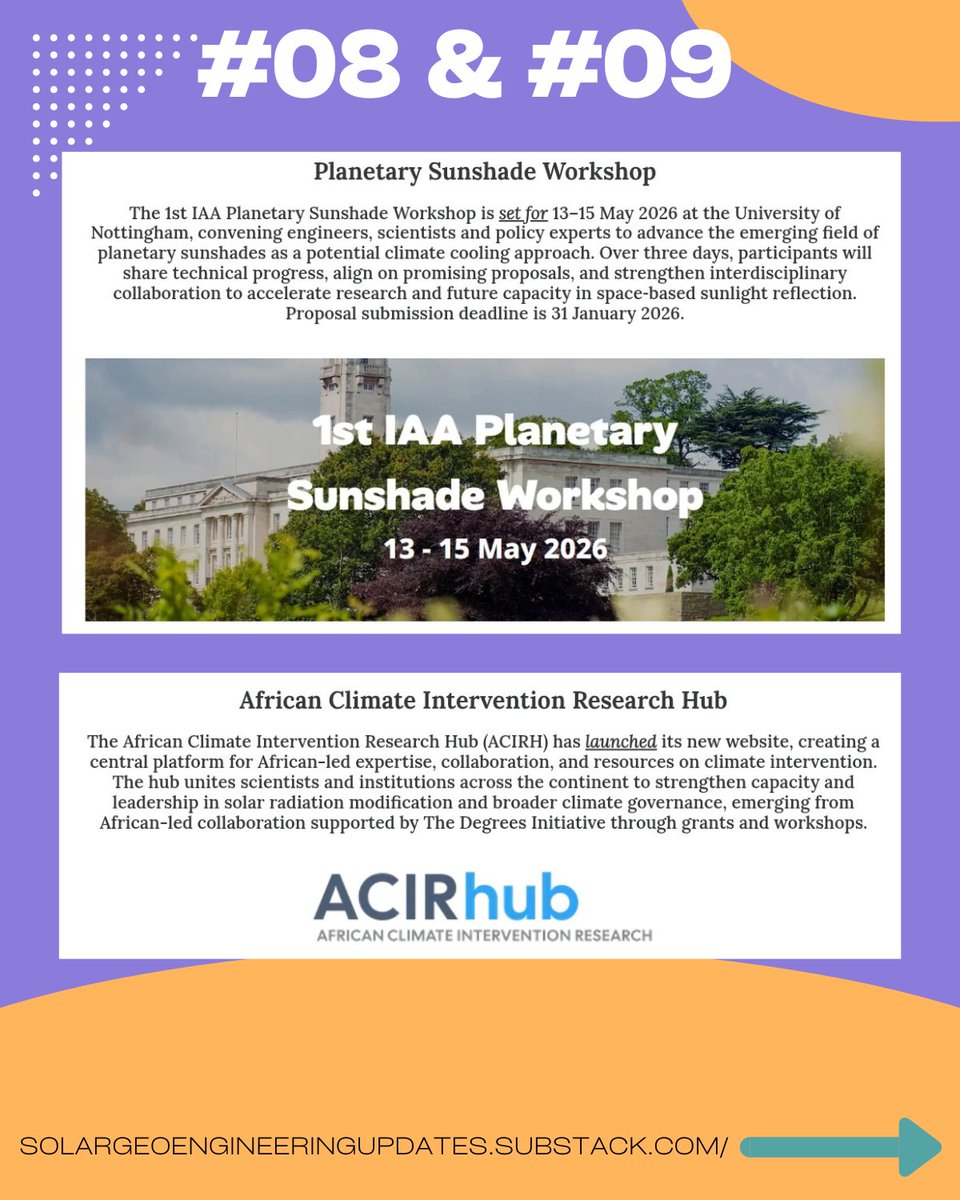
8️⃣ 1st IAA Planetary Sunshade Workshop set for May 2026, aiming to advance space-based climate cooling research and collaboration.
9️⃣ African Climate Intervention Research Hub (ACIRH) launches its website, centralizing African-led SRM expertise, collaboration, and resources.
6/
@Sol4tr33s@satofishi Great questions.
GHGs would depend on whether any of the material could be lunar.
1% sunlight reduction equals about 1 degree C global average temp, so 1% less photosynthesis in ideal conditions. But heatwaves and droughts are far from ideal conditions. So a balance.
@satofishi That’s if the data centers are at Sun earth L1, and it just SSO.
CO2 has other negative impacts which should still drive cleaning up the atmosphere. But in the meantime…
@dranthonygustin@satofishi Reflecting 1% sunlight corresponds to about 1 degree C global average temperature. Climate scientists aren’t sure if this is a good idea but there’s a lot of research happening to try and answer that question.
It might not be a stupid idea after all.
🚨 UPCOMING EVENT 🚨
1st IAA Planetary Sunshade Workshop by @SpaceSRM
🗓️13 - 15 May 2026
📍 University of Nottingham, UK
🚨Proposal Submission Deadline: 31 January 2026
🔗https://t.co/FgrtTzWSfy