I think the biggest reason was that Voldemort underestimated how much damage Slughorn's memory could do to him. He knew Slughorn was ashamed of their conversation and had spent years trying to conceal it. He probably assumed that shame would keep him quiet.
But there's another interesting angle: Voldemort may not have realised that Slughorn's memory was the missing piece Dumbledore needed.
Slughorn knew about the concept of Horcruxes, but he didn't necessarily know whether Voldemort had actually created one, let alone how many. He had no idea that Voldemort had gone further and split his soul into multiple fragments. It was Dumbledore who connected the dots.
I also think Voldemort's arrogance played a significant role. He considered himself far superior to his former teachers and probably didn't regard Slughorn as someone capable of threatening him. Slughorn was a frightened, self-preserving man, not an obvious resistance fighter.
However, I find the decision particularly interesting because Voldemort was extremely protective of his secrets. He murdered people for considerably less. Yet he allowed someone who knew about his interest in Horcruxes to remain alive for decades.
Perhaps he believed Slughorn's guilt was a more effective form of protection than killing him.
The irony is that Slughorn's greatest shame eventually became one of the most important contributions to Voldemort's downfall. Without that memory, Dumbledore might have taken considerably longer to understand the secret behind Voldemort's immortality.
Why Did Lily Smile When James Hung Snape Upside Down? Was Lily Really the Sweet, Innocent Girl We Have Always Assumed Her to Be?
There’s a particular moment in Harry Potter and the Order of the Phoenix that I find quite interesting and, honestly, rather uncomfortable when examining Lily and Snape’s friendship.
During Snape’s Worst Memory, when James uses Levicorpus to hang Snape upside down in front of everyone, we get this description of Lily’s reaction:
“Lily, whose furious expression had twitched for an instant as though she was going to smile.”
Now, I don’t believe J.K. Rowling included that particular detail accidentally. The wording is deliberate. Lily’s expression briefly twitched as though she was about to smile, suggesting that, for a split second, she found something amusing about the situation despite her obvious anger.
To her credit, Lily immediately suppresses that reaction and remains visibly furious with James. She also intervenes and attempts to defend Snape. However, that brief reaction raises an interesting question about the nature of their friendship.
This is someone she supposedly cares deeply about, someone she has known since childhood and has repeatedly defended. Yet, when she witnesses him being publicly humiliated, her immediate reaction isn’t entirely one of horror or concern. For an instant, she appears amused.
I find that particularly revealing because genuine affection doesn’t necessarily mean you agree with everything someone does, but watching someone you care about being humiliated should hardly be an amusing experience.
Does this mean Lily was secretly cruel or that she never genuinely cared about Snape? Not necessarily. She was a teenager, and a momentary reaction doesn’t define her entire character. But it does make me question whether their friendship was as uncomplicated and unconditional as we’ve been led to believe.
Perhaps Lily cared about Snape but was also increasingly embarrassed by his associations, his behaviour and the person he was becoming. Perhaps their friendship had already begun to deteriorate long before the infamous Mudblood incident.
What do you make of Lily’s reaction? Was it simply an involuntary moment of amusement, or does it reveal something less flattering about her feelings towards Snape?
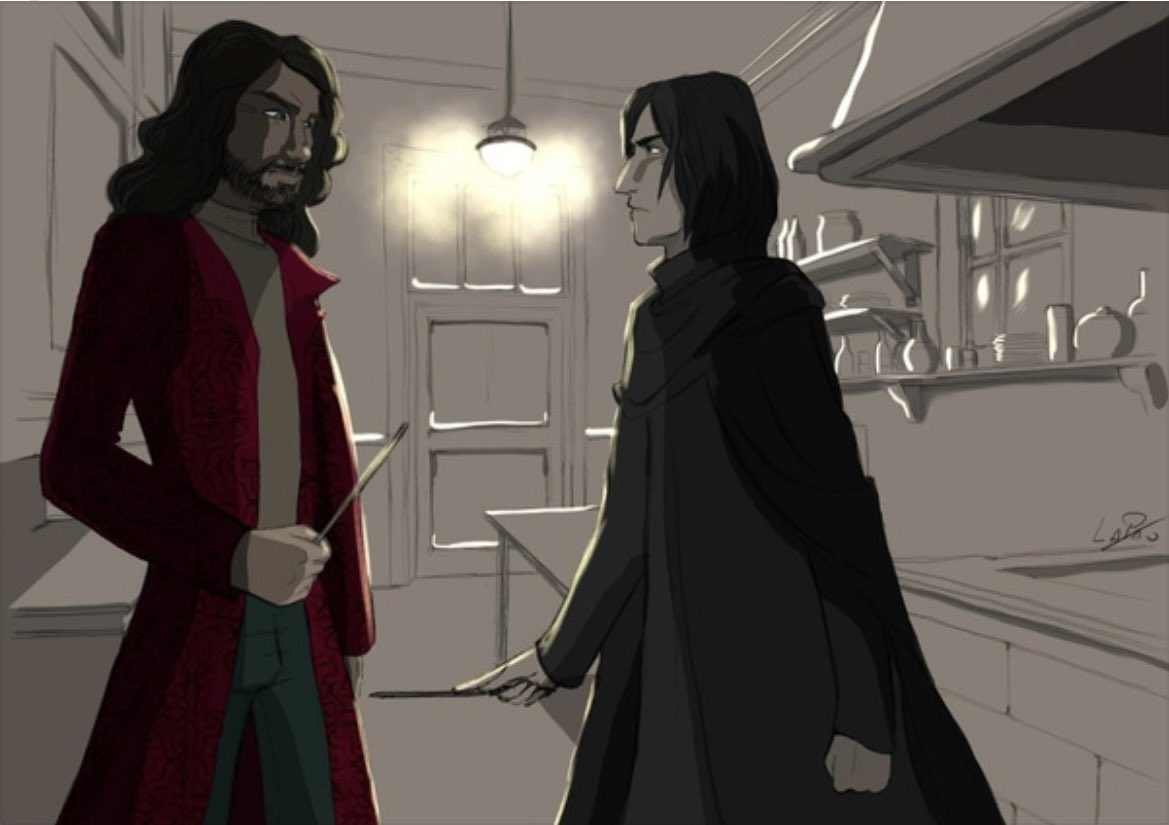
In Harry Potter (book 5.), if Sirius and Severus had duelled at the 12 Grimmauld Place's kitchen and Harry and the others hadn't stopped them, who do you think would have won?
How Do Witches and Wizards Actually Meet Muggles and End Up Marrying Them?
There’s something about the wizarding world that has always puzzled me: how exactly do witches and wizards meet Muggles and develop romantic relationships with them?
I’m not talking about the mechanics of marrying someone from the non-magical world. I’m curious about how these relationships even begin in the first place.
From what we’re shown in the books, witches and wizards seem to live in an almost entirely separate society. They don’t appear to participate in the Muggle job market, use public transport regularly, watch television, or engage with ordinary Muggle entertainment. Most of their social interactions seem confined to other magical people.
So where exactly are they meeting Muggles? How do they interact with them frequently enough to form friendships, fall in love and eventually get married?
This isn’t an insignificant question, either. In Harry Potter and the Chamber of Secrets, Ron explains that pure-blood families would have died out if witches and wizards hadn’t married Muggles. That suggests these relationships are considerably more common than we might initially assume.
But where are these people finding each other?
They’re not meeting at work, they’re not bumping into each other on the Tube, and they’re certainly not exchanging dating profiles on a wizarding version of Tinder. Where, for instance, did Seamus Finnigan’s mother meet his Muggle father?
One possible explanation is that witches and wizards who grow up in places like Godric’s Hollow, or other villages with both magical and non-magical residents, might have more regular contact with Muggles. They could attend local events, form childhood friendships and become involved in their communities.
Another possibility is that young witches and wizards return home during the summer holidays from Hogwarts and socialise with Muggle teenagers their own age. Perhaps some of those childhood friendships eventually develop into romantic relationships.
But is that really enough to explain the frequency of intermarriage in the wizarding population?
I’d genuinely love to know how the wizarding and Muggle worlds interact socially, because the books establish that these relationships are important to the survival of the magical population without ever really showing us how they happen.
Importance of number 7 in Harry Potter series:
•7 books
•7 years of school
•7 horcruxes
•7 Weasley children
•7 players in Quidditch
•7 floors of Hogwarts
•7 is Harry's quidditch number
•7 secret passages to Hogsmeade
•7 th floor of Hogwarts bears Gryffindor's common room
•7 lights were put out by Dumbledore in Privet Drive
•7 locks on Moody's trunk
•7 snakes on door of Chamber of Secrets
•7th month of the year holds birthday of both, Harry and Neville
•Lily and James began dating in 7th year
•The Seven Potters
How did Dumbledore discover that Voldemort's use of Harry's blood would create a life anchor?
When Harry revealed that Voldemort used his blood, a fleeting "gleam of triumph" crossed Dumbledore's eyes. In that split second, the headmaster realized the Dark Lord's catastrophic mistake.
This insight didn't require years of research; it struck Dumbledore instantly in his office at the end of Harry Potter and the Goblet of Fire, as Harry recounted the sinister resurrection ritual in the Little Hangleton graveyard.
Voldemort's motivation was practical. By taking Harry's blood, he bypassed Lily Potter's sacrificial protection, allowing him to physically touch Harry without experiencing excruciating pain. From Voldemort's perspective, this removed the only barrier standing between him and killing the boy.
However, Voldemort possessed a fatal blind spot regarding ancient, emotion-based magic. Dumbledore, the series' foremost expert on the magic of love and sacrifice, immediately saw the unintended consequence of the dark wizard's ritual. Lily's protective enchantment lived in her blood, which ran in Harry's veins. By forcefully taking that blood into his own reconstructed body, Voldemort unwittingly tethered Harry to life. As long as Voldemort remained alive, Lily's protection survived inside him.
Voldemort had turned himself into a horcrux for Harry. If Voldemort attempted to strike Harry down, the Killing Curse would destroy the piece of Voldemort's soul residing in Harry, but it could not kill Harry himself because his mother's sacrifice was still anchored to the living world through Voldemort's physical form.
Dumbledore kept this realization a closely guarded secret for years. He orchestrated the events of Deathly Hallows around this single vulnerability, knowing that Harry had to let Voldemort "kill" him voluntarily. Dumbledore's entire endgame relied on that momentary gleam of triumph, a flash of insight born from understanding the very magic Voldemort dismissed as weakness.