The same satellite tech can track a convoy through dense cloud cover at night, flag a sinkhole weeks before it opens, catch a village built on a collapsing slope, and even map the inside of a pyramid from orbit.
It's called Synthetic Aperture Radar (SAR), and a lot of the data is free.
In this video I cover the physics, the commercial arms race, and the defense constellation that will track every moving vehicle on Earth by the 2030s.
0:00 - A convoy no camera can see
0:56 - What is Synthetic Aperture Radar?
2:02 - InSAR: sub-millimeter change detection
3:07 - They scanned inside a pyramid from space
4:20 - These cities are sinking faster than sea levels rise
5:00 - North American bridges are the worst on Earth
6:09 - An AI caught a village built on a landslide
7:50 - The commercial SAR arms race
9:01 - GMTI: tracking convoys in the dark
11:26 - NISAR: the billion-dollar SAR satellite
12:45 - The other side of this all
Full video on YT on Bilawal Sidhu channel. Enjoy.
Visualizing the Strait of Hormuz shutdown using AIS tracking data.
Wild to see the precipitous drop off in transits from 100's of vessels per day to a handful.
The craziest part is zooming in to track a single Indian LPG tanker and watching it intentionally go dark -- turning off its AIS to sneak through the chokepoint, before popping right back on the radar on the other side.
OSINT is too much fun. Pulling this together to a bigger 4D god's eye view of the gulf region.
Between Gemini 3.1 and Claude 4.6 it's honestly wild what you can build. This feels like Google Earth and Palantir had a baby.
Made this with all the geospatial bells and whistles -- real time plane & satellite tracking, real traffic cams in Austin, and even got a traffic system working. Panoptic detection on everything.
Skinned the whole thing to look like a classified intelligence system. EO, FLIR, CRT. Got a bunch more stuff on the roadmap. This is fun.
The tech we use to capture sports is a decade ahead of how we actually watch it. We can reproduce entire games in 3D, track every player down to their pose and heartbeat - but barely any of that makes it to your living room.
0:00 Immersion Gap
0:48 Computer Vision & Hawk-Eye
1:42 Player Tracking & Wearables
2:08 AI Analytics & Real-Time Stats
3:07 VR Sports Viewing & Why It Fails
4:16 Radiance Fields & Gaussian Splatting
5:10 Viewpoint Pro: Virtual Replays
5:59 Arcturus: 4D Gaussian Splatting
7:31 Muybridge: Virtual Camera Systems
9:53 F1 Vision Pro Experience
11:26 XR Sports Alliance
11:47 COSM: The $600 Ticket
13:04 The Future of Sports Broadcasting
I break down the companies and tech turning sports into a next-gen immersive experience - from Sony's Hawk-Eye camera systems and NFL tracking chips to AI analytics powered by Google Cloud and AWS.
We look at why VR headset viewing keeps failing, and how 4D Gaussian Splatting from Arcturus and multi-plane image-based volumetric capture from Muybridge are creating viewing angles that were previously impossible.
Plus the F1 Vision Pro experience, the XR Sports Alliance, and why COSM's in-person model is winning where headsets can't.
The data foundation is clearly there. The real question is how it gets to you.
Hope you enjoyed this; follow @bilawalsidhu for more deep dives mapping the frontier of creation & computing.
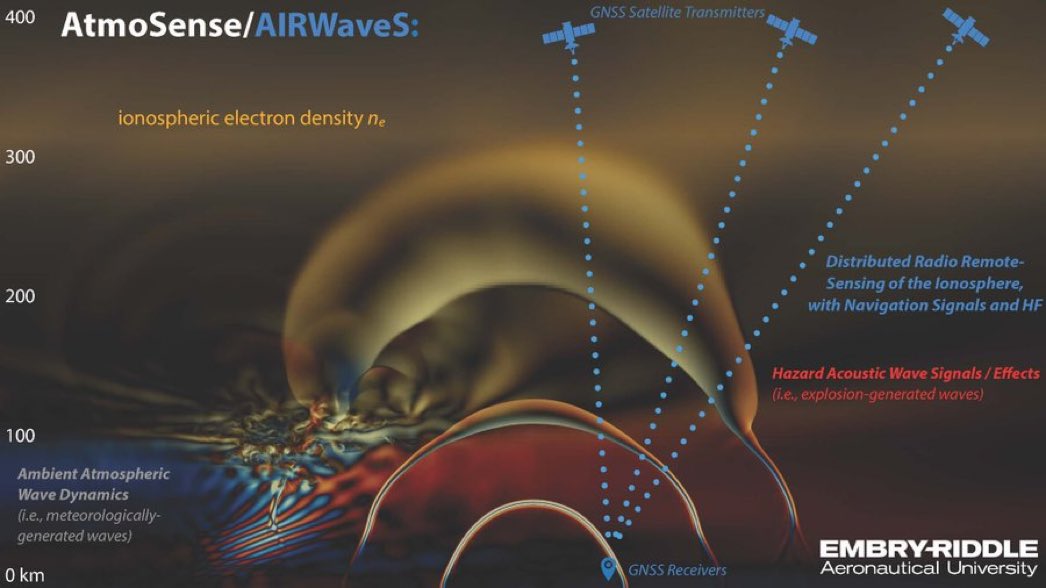
DARPA turned the Earth’s atmosphere into a planetary-scale sensor with Project AtmoSense.
By modeling atmospheric waves across 6 orders of magnitude in 3D, they cracked an "impossible" physics problem.
During tests in New Mexico, the system was sensitive enough to detect SpaceX launches over 1,000 miles away.
Every underground explosion, earthquake, or rocket launch leaves a detectable signature in the sky.
As these meter-scale disturbances propagate globally, within 10 minutes, a data center in Virginia knows exactly what went down.
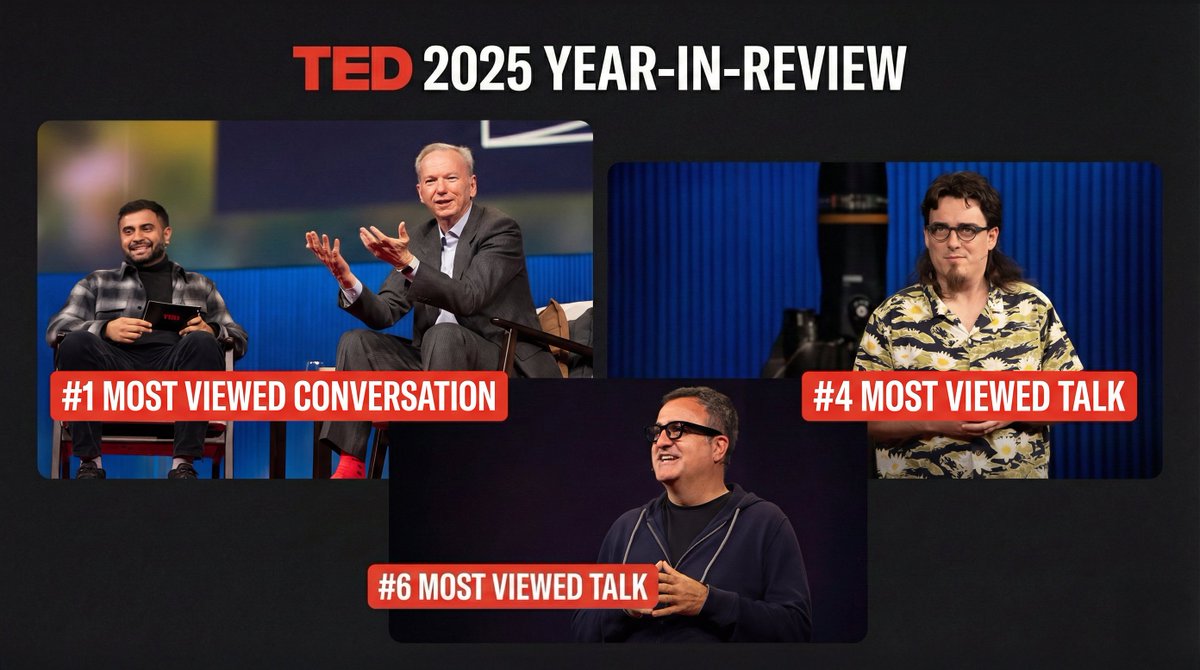
TED has dropped the 2025 year in review.
Three speakers I curated landed in the top 6 most viewed of the year:
→ My chat with @ericschmidt - #1 conversation
→ @PalmerLuckey - #4 most viewed talk
→ @izadi_shahram - #6 most viewed talk
Now curating TED 2026 - Chris Anderson's last conference as Head of TED.
Who's the one tech leader that absolutely needs to be on the stage next year?
Ad: Pretty cool to vibe code games using YouTube Playables Builder.
One of my top VFX/360 videos is now a retro shooter game - stock up on burgers for your intergalactic overlords while dodging a horde of farmers who really want their cows back.
Photoshop is now inside ChatGPT. Just prompt what you want and get slider-level control to dial in the perfect look. Intelligently select content and apply effects — without opening Photoshop. You're the conductor. Photoshop is the orchestra.
For me, this one's personal — I've been using @Photoshop since I was 11 making VFX in my bedroom. Grateful to be partnering with @Adobe to share what's next for it. We're kicking off a Promptathon with Adobe apps and @ChatGPT — try it now and show me what you create. #AdobePartner
What was a complex hacky pipeline in 2023 to take indoor 3d scans and reskin them to different types of decor is now just a few clicks in 2025. World labs marble has collapsed a lot of the complexity involved in generating and editing 3d worlds:
Pretty big step towards a real life Jarvis - a multimodal ai assistant w/ a personality to boot. They're intentionally blurring the lines between a tool and a companion. This is what Siri should've been by now. Cool to see it actually happening:
No wonder Snap's stock dropped 7% yesterday. OpenAI did something with Sora 2 nobody else could by nailing three things at once:
1. Consumer first interface (like Meta Vibes attempted)
2. Production grade output (like Google Veo 3 has)
3. Social collaboration built in (made to create WITH friends, not just for them)
The result? Your social graph manifested as videos doing impossible things. Inter-dimensional cable TV in the best way.
Plus flipping the script on Hollywood - training on everything by default unless studios opt-out individual IPs. Aggressive as hell.
This is either the future of social media or their most expensive mistake. No in-between.
Since nano banana has gemini's world knowledge, you can just upload screenshots of the real world and ask it to annotate stuff for you.
"you are a location-based AR experience generator. highlight [point of interest] in this image and annotate relevant information about it."
What if we could use the entire planet’s atmosphere as a sensor?
DARPA: “let’s blow stuff up in New Mexico and see what happens.”
*detonates test bombs*
DARPA: “wait… why are we detecting a SpaceX rocket launch 1000+ miles away?”
it worked TOO well.
AtmoSense has cracked the “impossible problem” - modeling atmospheric waves across 6 orders of magnitude in 3D.
translation: every underground explosion, earthquake, or rocket launch now leaves a detectable signature in our sky
10 minutes later, data center in Virginia knows exactly what went down 🤯
“We can now model across six orders of magnitude, in 3D, what happens to the energy emanating from a small, meters-scale disturbance as it expands up into the atmosphere to propagate over thousands of kilometers, and potentially around the world.” - michael nayak
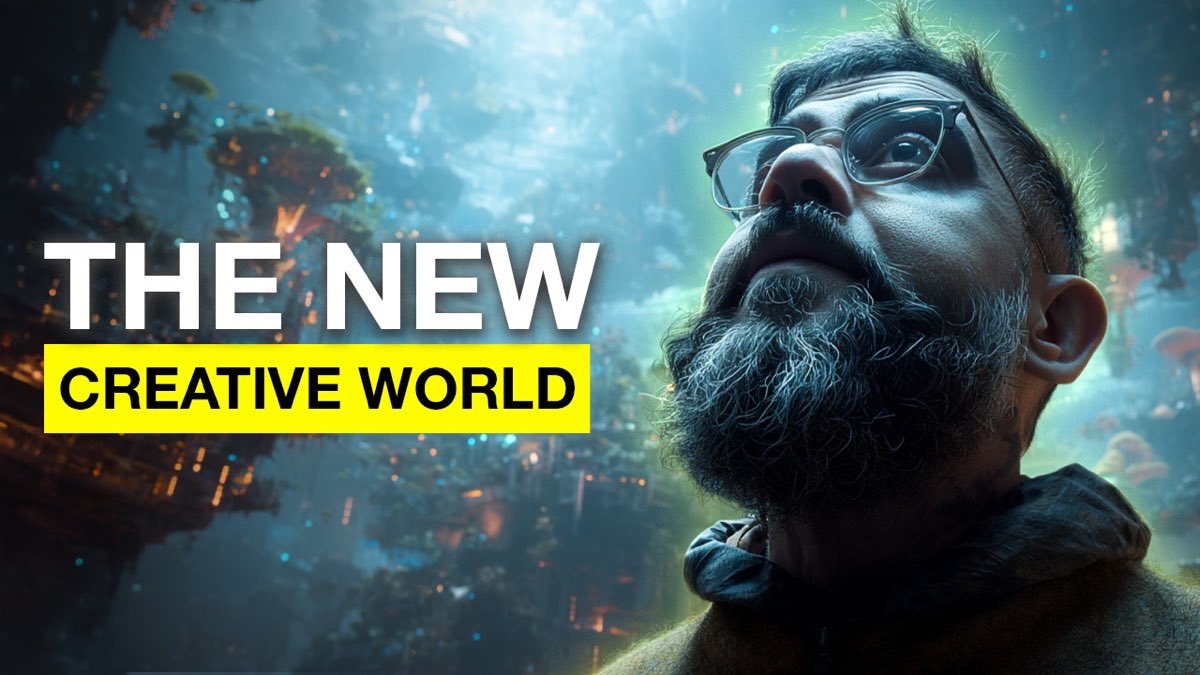
Just posted my Harvard GSD talk on the future of creative AI – where we’re going and how to harness it: https://t.co/oB9nDKMaZL
Topics covered:
- Spatial Intelligence: Photogrammetry, neural radiance fields (NeRFs), and 3D Gaussian splatting for digitizing reality.
- Visual Intelligence: AI-powered pose estimation, segmentation, depth inference, and relighting.
- Hybrid Workflows: Vibe coding, Model Context Protocol (MCP), and how LLMs interface with Blender, Unreal, and Runway.
- Content to Content Paradigm: Moving beyond text-to-video into fully personalized, dynamic, and just-in-time media.
- The Future of Media: Personalized podcasts, AR tours, generative AI games, and the blurring of software with content.
AI world models & why they matter... in 20 minutes.
The holodeck is closer than you think, and the implications for robotics, AR/VR and content creation are staggering.
In this video, I'll breakdown everything from Google Genie 3 and NVIDIA Cosmos to startups powering synthetic training data (Parallel Domain, Bifrost etc).
Chapters / Time Stamps:
00:00 Introduction
00:39 Dream Worlds at 24 FPS
01:46 Painting the Third Dimension
03:03 The World Model Wars
05:27 Robot Jungle Gyms (Hybrid Approach)
08:23 Synthetic Data Revolution
11:06 Cities That Think
14:07 The Holodeck Approaches
17:49 The Rendering Stack of Reality
We haven’t had the GPT moment for spatial intelligence yet — one model so general purpose it’s equally game changing for Palantir and Disney.
Something that can understand and reason about 3D worlds — then generate them, faithfully or fantastically.
That’s the convergence point everyone’s racing toward, whether they know it or not.
Check out this insanely detailed 3D scan of the Great Pyramids of Giza by Geomatex.
You can literally zoom in and read the tablet in front of the Great Sphinx.
Drone photogrammetry w/ high res textures is perfect for immortalizing these landmarks.


![bilawalsidhu's tweet photo. Since nano banana has gemini's world knowledge, you can just upload screenshots of the real world and ask it to annotate stuff for you.
"you are a location-based AR experience generator. highlight [point of interest] in this image and annotate relevant information about it." https://t.co/iLbCzPeyzr](https://pbs.twimg.com/media/GzUy4xQXgAAbwlf.jpg)
![bilawalsidhu's tweet photo. Since nano banana has gemini's world knowledge, you can just upload screenshots of the real world and ask it to annotate stuff for you.
"you are a location-based AR experience generator. highlight [point of interest] in this image and annotate relevant information about it." https://t.co/iLbCzPeyzr](https://pbs.twimg.com/media/GzUy4xMXkAAhY4s.jpg)
![bilawalsidhu's tweet photo. Since nano banana has gemini's world knowledge, you can just upload screenshots of the real world and ask it to annotate stuff for you.
"you are a location-based AR experience generator. highlight [point of interest] in this image and annotate relevant information about it." https://t.co/iLbCzPeyzr](https://pbs.twimg.com/media/GzUy4xLXcAASIjf.jpg)





![bilawalsidhu's tweet photo. Since nano banana has gemini's world knowledge, you can just upload screenshots of the real world and ask it to annotate stuff for you.
"you are a location-based AR experience generator. highlight [point of interest] in this image and annotate relevant information about it." https://t.co/iLbCzPeyzr](https://pbs.twimg.com/media/GzUy4xSXMAARweG.jpg)