We’re celebrating Anthropic’s historic IPO and leadership in responsible AI. At Bessemer, we backed Anthropic before it was the consensus bet in Silicon Valley. Its trajectory has been astonishing to watch.
The mission is not a side story to that success. It is the reason for it.
Anthropic’s mission has stayed constant: the responsible development and maintenance of advanced AI for the long-term benefit of humanity. Even as the industry races to deploy AI everywhere, its commitment to safety has only deepened, and enterprises have noticed.
Dario, Daniela, and the management team have provided stable, consistent leadership as Anthropic helps set the pace of the frontier.
That’s a wrap on celebrating the first-ever AI 100!
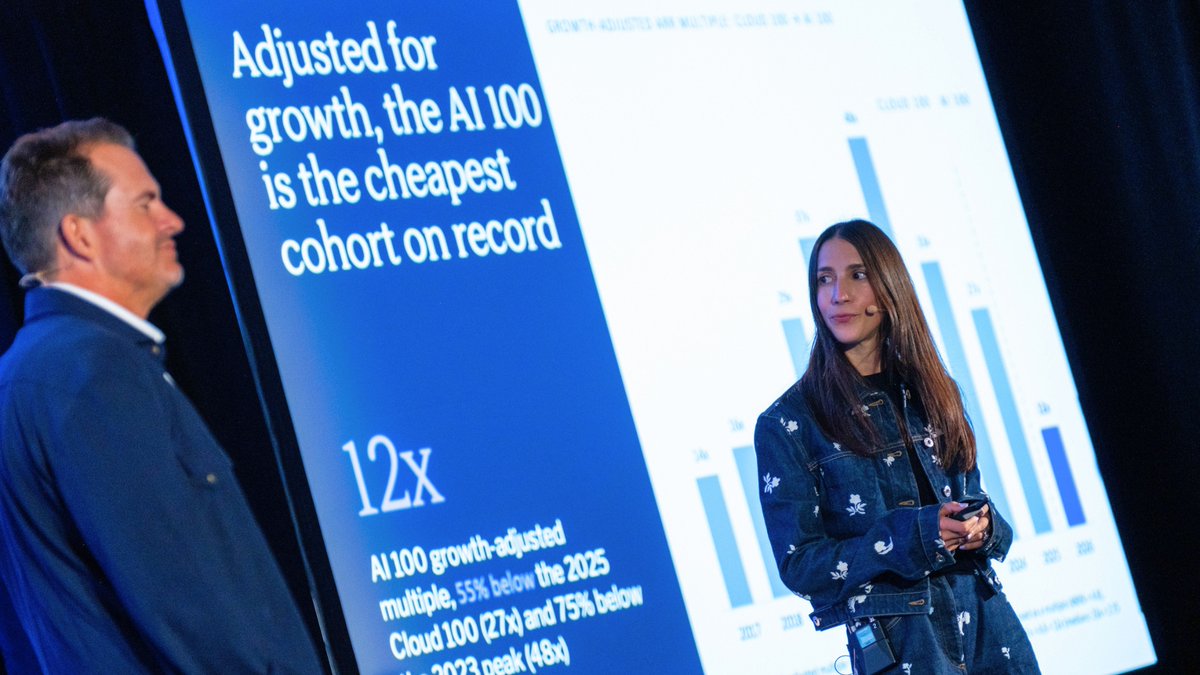
It was a thrill to join the builders behind the inaugural list at the Cerebral Valley AI Summit and meet so many of the companies in person.
Putting this list together meant looking closely at the companies defining the AI era, and meeting so many of the people behind them made it feel even more real. When I used to attend the Cloud 100 events as CEO at SendGrid, I did so in part because I loved being amongst my peers and the builders of the Cloud era.
Congrats to all 100 and thanks to @EricNewcomer and team for a terrific event.
Explore the full list: https://t.co/1U1rsV73WQ
I’ve worked in software for over three decades. Yet there have only been a couple of times where I’ve watched a demo and thought: “That’s magic.”
Once was a virtualization demo around 2005, when I saw one server run multiple operating systems at once. Another was in 2022, when I watched AI write a blog post in seconds. It’s fascinating to notice the parallels between the two:
𝗕𝗼𝘁𝗵 𝘄𝗲𝗿𝗲 𝗱𝗲𝗰𝗮𝗱𝗲𝘀 𝗶𝗻 𝘁𝗵𝗲 𝗺𝗮𝗸𝗶𝗻𝗴.
The foundation for virtualization actually spans all the way back to IBM mainframes in the 1960s. But it took 40 years to get to the version of the demo that I saw. We’re seeing that same pattern with AI now. It seems like the technology came out of nowhere, but it’s the result of 70 years of research. Change happens slowly, then very quickly.
𝗧𝗵𝗲 𝗺𝗮𝗴𝗶𝗰 𝘄𝗮𝘀 𝘁𝗵𝗲 𝘀𝘁𝗮𝗿𝘁 𝗼𝗳 𝘀𝗼𝗺𝗲𝘁𝗵𝗶𝗻𝗴 𝗺𝘂𝗰𝗵 𝗯𝗶𝗴𝗴𝗲𝗿.
Virtualization eventually became the foundation of cloud computing. Every time I’ve seen technology that feels like magic, a trillion-dollar supercycle has followed. That’s why we invested in AI back in 2022, when we saw the demo for Jasper and were completely blown away.
𝗧𝗵𝗲 𝗽𝗹𝗮𝘁𝗳𝗼𝗿𝗺 𝗺𝗼𝘃𝗲𝗱 𝗶𝗻𝘁𝗼 𝗮𝗽𝗽𝗹𝗶𝗰𝗮𝘁𝗶𝗼𝗻𝘀.
My first CEO job was at an application-layer startup called VMLogix, which was built on top of VMware. Right before I started, VMware bought one of our competitors and the chessboard changed overnight. The path forward was unclear. We’re seeing the same pattern now with the model companies, and a lot of founders are asking themselves the same questions I had back then.
I took that job anyway because of what I thought would happen next. I knew virtualization wasn’t going to stay a market of one, and every company that followed VMware would need what we’d built. My prediction fortunately panned out (the 2008 financial crisis, the following year, I did not see coming).
That’s the job, whether you’re a founder or investor. You look at the whole board, and use what you’ve seen before to decide what your next move will be.
History won’t hand you the perfect answer, but it sure beats starting from zero every time.
If you want to know where AI in law is going, look at software engineering. It’s about six months ahead.
Our engineers at @WeAreLegora are shipping 3x as much as they were this summer. Nothing about the team changed except how they work.
Here are a few examples of what that has produced over the past 6 months:
The Legora Agent: An AI agent that plans, executes, reviews, and delivers complex legal work end to end, with the lawyer in control where judgment is required.
Skills: Instructions teaching the Agent your standards, processes, and preferences, with 250+ ready-made Skills to start from.
Intake: The agentic legal front door for in-house teams, which turns ad-hoc requests into tracked work executed by the Agent.
Lists: A structured place to manage legal work, populated by the Agent, cited to source, and shared by the whole team.
Monitors: Regulatory horizon scanning across the jurisdictions and topics you choose, with continuous scanning and a single feed of what changes.
Ontological Legal Research: Legal research built on comprehensive legal data and a proprietary ontology that maps how sources connect, so the Agent sees the full picture of current law (live in the US).
Integration ecosystem: Permission-aware connectors linking the Agent to the systems legal teams already use, such as iManage, NetDocuments, SharePoint, and Box.
What we learned along the way is that the bottleneck moved. Writing code used to be the slow part. Now it’s fast, and the slow part is reviewing what the agents wrote. Our best engineers are spending less time typing and more time deciding whether the output is right.
I expect the same thing to happen in law. The first phase is manual: every task needs a person to start it, do it and check it. We’re now in the second phase, where work is faster and better but the operating model stays the same. In the third phase, AI takes a first pass at all work, or does it end to end where it’s permitted. Roles change at that point.
Review becomes a more important part of the job, and the legal teams that start building that muscle now will have a head start.
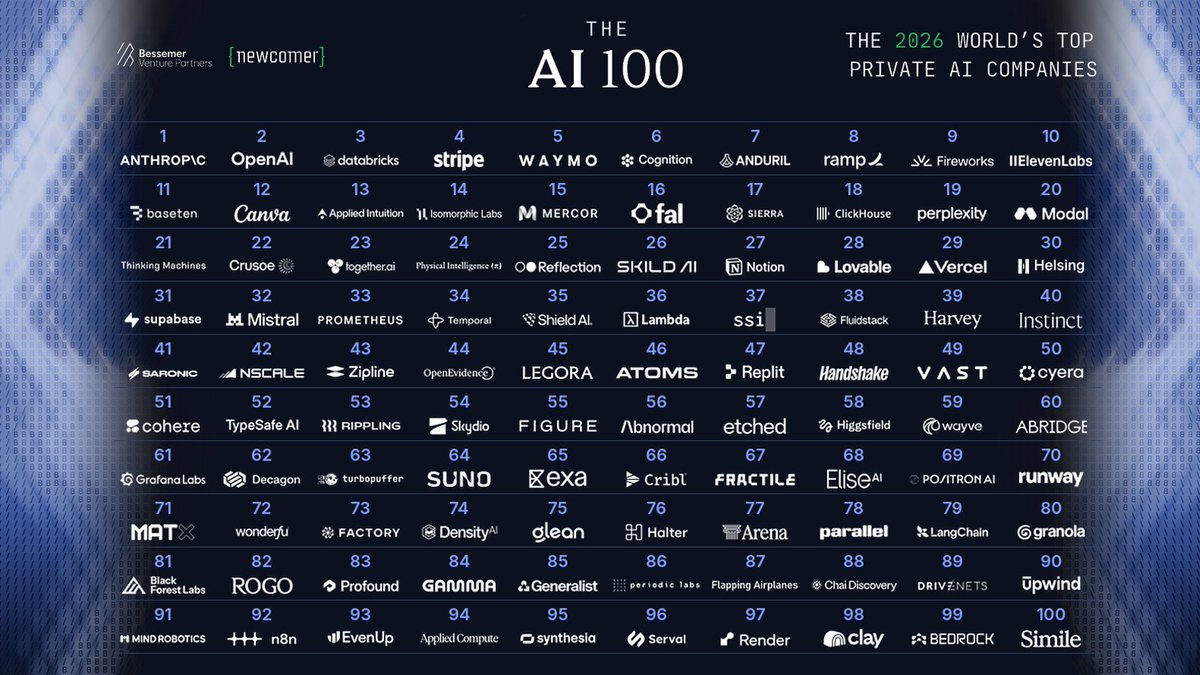
The AI 100 is live 🏆
Our inaugural list of the top 100 private AI companies just dropped on @NewcomerMedia. Honorees were evaluated on market leadership, estimated valuation, operating metrics, and people & culture, ranging from foundation models and AI infra to robotics and beyond.
Congratulations to the companies making AI history! See it here: https://t.co/DRDRXCmEqC
Intelligence is going to be a bigger market than oil.
Knowledge work alone is ~$40T in annual global spend. The entire digital economy is $15T. For 50 years, software sold tools to the people doing the work. AI is the first technology that can do part of the work itself.
That’s the thread through our AI 100 benchmarks. The AI 100 is worth $3.6T. Global labor is $65T.
We are still early. Read the full analysis on Atlas: https://t.co/1U1rsV73WQ
Today, @BessemerVP launched the AI 100 with @NewcomerMedia, and I couldn’t be more proud of the team and the founders who made this all possible.
These are the top 100 private AI companies changing the trajectory of not only the AI economy, but the global economy. This multi-trillion-dollar supercycle is unlike anything we’ve seen before, built upon the technology waves of the internet and cloud computing preceding this moment in AI.
It’s a privilege to reveal this list alongside my colleagues and the Newcomer team, as this list tells us more than who’s winning. It tells us that we’re still so early.
Check out the full list: https://t.co/4FB8afL3KK
LFG - @EvenUp just crossed $150M in recurring revenue, doubled since we led their Series E last year! Our conviction in this team’s ability to execute has only grown.
Welcome @killcreek to the team. Can’t think of a better fit.
Rami Karabibar and team aren’t close to done.
https://t.co/oo3K3sPDPJ
Introducing Claude Fable 5.2 and Claude Mythos 5.2, designed to tackle the most daunting technical challenges.
They’re capable collaborators on ambitious projects in many fields, and show improvements in areas like coding, reasoning, and vision.
We evaluated Nexus on 7 benchmarks and 1,222 tasks. It defines the Pareto frontier.
Mix open and closed models. Get better intelligence for 4x lower cost than a single frontier model.
The smartest way to extend your Claude, ChatGPT, or Codex plan, starting at $8/mo.
https://t.co/pwCYfD3OhS
Excited to welcome Dave Wehner to Fireworks as our CFO!
Dave brings extraordinary experience helping build and scale Meta through some of its most defining stages of growth. What excites me most is that he is eager to roll up his sleeves and build again. He sees AI as the defining technology shift of his lifetime and believes in our mission.
Our conviction is simple: every company should own its specialized intelligence. The next generation of AI leaders will build specialized intelligence from their unique data, knowledge, and expertise.
Making this happen requires more than powerful models. It takes co-designed training and inference, personalized model ensembles, and radically better economics.
We have an enormous opportunity ahead. I'm thrilled to have Dave join the journey!
Welcome to Fireworks, Dave. We're just getting started!
Everyone is wondering whether the model companies will eat the application layer. When people ask me, my answer is always the same.
It’s “and,” not “or.”
I believe share will concentrate to a handful of model companies at the platform layer. And dozens of AI application companies will emerge as winners too.
I’ve seen this pattern before in the cloud. The era ended up with only a handful of hyperscalers: AWS, Microsoft Azure, and Google Cloud. Building cloud infrastructure was massively capital intensive, so only a few players had the capital and scale to afford it. AI models are the same. They require enormous amounts of compute (for training, for inference, and for research), which means the market will also likely consolidate to a handful of players.
But the cloud also gave us many dozens of great software companies built on top of those platforms because every industry and use case needed its own purpose-built product. I believe AI will play out the same way. No - the models won't eat all the software application opportunities. Why?
It's not because their models couldn't produce the code for the product. It's because driving diffusion of AI into the Enterprise, in particular, requires a great deal of functional or vertical expertise. And FDEs or the equivalent are needed - to help companies re-engineer first, and then the users to subsequently adopt. It turns out that the "last-mile delivery" of that AI diffusion won't come easily. Humans tend not to like change, so having someone there to make the change feel seamless / manageable is a key part of the solution.
So, like the Cloud, it will be an "and," not an "or." If anything, the opportunity is even bigger this time (at both layers of the stack).
Got fable to hand-write weights of a 100k param model to recognize real versus fake legal citations.
Basically one-shotted a full NN that’s better than training it
Even with billions in your bank account, you can’t buy enough compute to beat the majors head-on. What you can do is extract far more value from every MW you have.
That’s why key theme of 2026 and 2027 for us is post-training. Improving the quality of diffusion models while making them an order of magnitude more efficient.