People aren't going to like this answer, but the cause is trickle down economics. In capitalism, capital flows to things the masses want. Its why transatlantic flights are no longer $20k, it's why LASIK has gone from $50k to <$1k. It's why a relief specialist in the MLB can get paid millions and the 10th guy on the bench in the NBA makes $10m a year. It's why a computer in the 70s would be 2000 sq ft and 100s of thousands of dollars and now you can get a chromebook for $50
If people subbed to teachers live streaming their classes, their salaries would be that of some of these youtubers.
People *say* they want a lot of things, but their actions tell a different story.
@AngloVarangian I’ve been saying this for awhile. I work with a guy who views morality through the lens of “well does it produce money?” Then it’s good. It sounds crazy but these people exist.
Dear small percentage of Boomers who can actually be told things:
Here are some facts, to help you understand what Millennials are trying to tell you.
Here is what the middle-class experience is right now. Not for losers, but for your average hardworking, but unexceptional, dude born in 1992.
- No company pensions. Ever. No job offers this.
- Laid off every 2 to 3 years.
- No vacations. Ever. If you are lucky, you have 10 to 15 days of annual "PTO" (paid time off). But this is not vacation. This is your sick days. You can take a break with whatever's left over.
- If you are not lucky, you have "unlimited" PTO. Which sounds nice, but in practice it means you get sick days and nothing else.
- They pay social security taxes, but they know they will never receive those benefits, because the system will crash first.
- Not promoted. Ever.
- No annual raises. Instead, these are effectively pay cuts, because they don't match inflation.
- Because of this, can only get a raise by changing jobs. Some judicious prevarication about salary history is recommended.
- Good chance you'll have to change careers at least once, possibly more, as industries get rugpulled by offshoring or work visas.
- Total mortgage cost on a median house in 2026 is 104,600 minimum-age-hours. This is 50+ years of full-time work.
- For comparison, a 1972 purchase would be 23,750 minimum-wage-hours, about 11 years of full time work.
What this all adds up to is that Millennials can't buy homes until they are past their child-bearing years.
And, no, scrimping and saving doesn't change that equation. This is with scrimping and saving.
I am not a Millennial. I am GenX, the child of Boomers. I do not need to be told how much Boomers forwent luxuries to save, and how hard they worked. I know exactly how much they did of each. I was there. I saw.
They worked hard at the beginning of their careers, and lived frugally for about 5 years to save up a down payment. After that, things gradually eased up, bit by bit. Until, by retirement, a lot of them had nice fat stock portfolios and multiple rental property investments, and Caribbean cruise holidays.
And this seems, to them, like a fair and natural progression.
But as America has been hollowed out and by a corrupt political machine, those doing the robbing have left the Boomers whole, and placed the burden of that corruption squarely on the backs of younger generations.
For Millennials, there's no light at the end of that tunnel.
Just another tunnel.
And another after that.
They have been standing between Boomers and the reality of the modern economy for 20 years.
At some point, they are going to break.
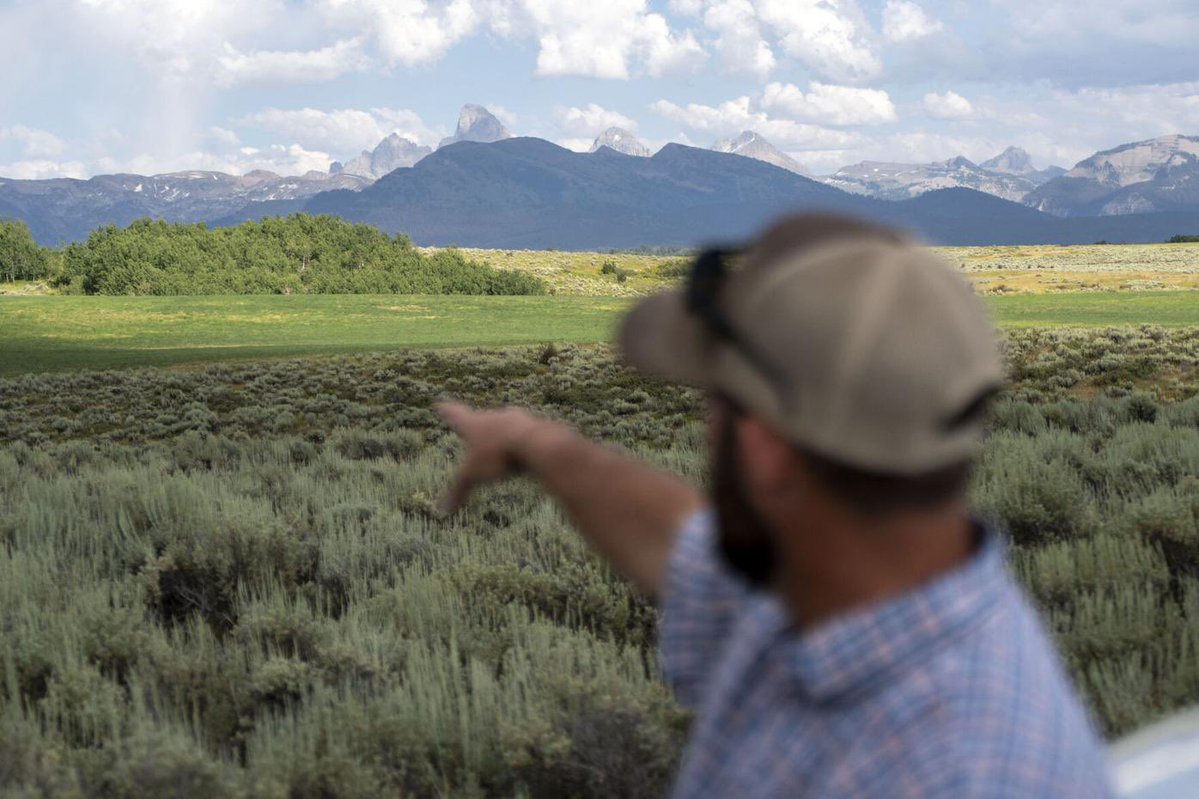
The Idaho constitution requires the state to mange state public land for “long term financial return.” What that means is a 5th generation Teton ranching family will get the boot from their lease when well connected billionaires ask the Idaho Land Board to sell, like what happened with this Tetons Driggs 160 case.
The Mike Lee thing failed, so the next move in the playbook is transferring public land to the states who will then say “we can make more money off this land so we are selling it off.” They’re saying he won’t build a subdivision here, but there’s nothing stopping him as it’s private land now.
The billionaire who bought the parcel is a New York movie producer and tech investor with a lot of financial interests in AI and data centers. He lives full time in Pittsburgh. When we carve up the American West like this, and make something that once was public private, the possibility for development of open land increases.
What made conservation of the Greater Yellowstone Ecosystem possible as one of the only fully intact ecosystems left in America was the scale and connectivity of public land for seasonal migrations of elk, mule deer, pronghorn, and bison. Herds follow green waves of grass with the season. Suburban development has stopped these migrations almost everywhere else.
Public land prevents fragmentation into housing developments that would end these migrations too. Ranchers are a big part of this as ranch lands are often some of the most productive low elevation habitat for herds or they fall along migration corridors. Ranches maintain these large open spaces that allow migration to continue. If the buyer keeps the land undeveloped, that would be great, but now that it’s private and the 5th gen family who had a grazing lease there into the 2030s is gone, there’s no guarantee.
Another part of America sold off to the highest bidder because the line must go up.
@Bobbythirdway@RealJoeDee1 Median hourly wage 1978 low end- $4.10 per hour.
Price of gold per oz avg 193.24.
40 (4 weeks)(12 months)($4.10)=$7,872.
7872/193.24= ~41 oz of gold.
41x $4500(today spot) =$168,000.
Today's median wage is ~$65,000. Boomers made 100k more than you in the 70s and complain.
@DeanTTraining@Drownomatic5000 Metcons were and still are my main go to, but the last few weeks I’ve gone barefoot for leg press, barbell squats, and goblin squats
Are there any glaring cons with going barefoot?
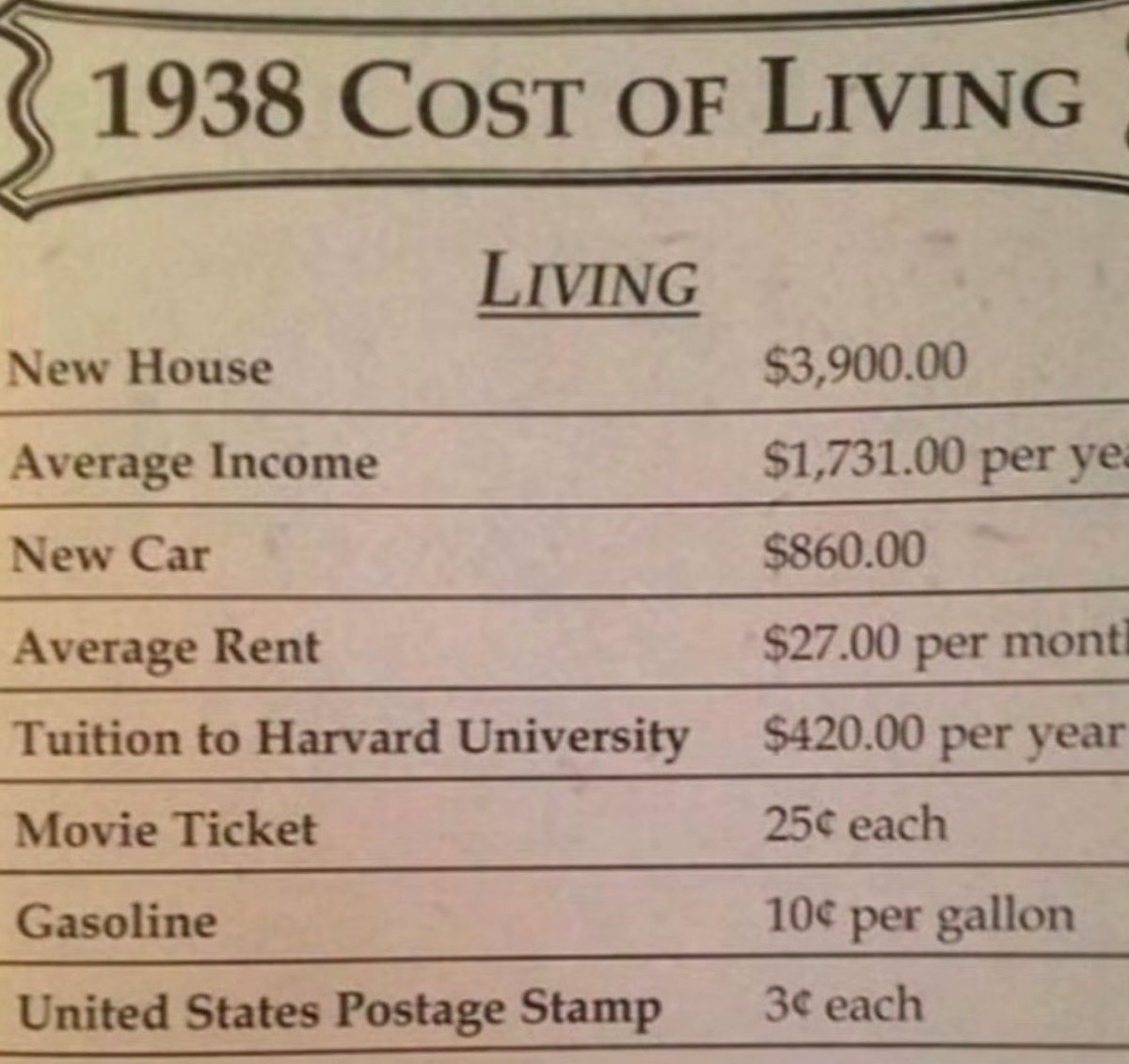
Adjusting for inflation we can see what life should be:
Average income ~$40,500
New House ~$91,300
New car ~$20,100
Average rent ~$630 per month
Harvard ~$9,800 per year
Movie ticket: ~$5.85
Gas ~$2.34
Postage stamp ~$0.70
Doesn't even account increased productivity from tech
@elonmusk This is hightech socialism. It will crush the human spirit. It will rob us of the very essence of what makes us human. No competition, no opportunities for betterment, nothing to strive for except waiting by our mailbox for our government check. Hard pass.
Here’s what you need to understand:
All the politicians have dirt on each other. If you refuse to play the game or become a liability, a very coordinated and efficient character assassination occurs. They throw you overboard.
That’s not to say these allegations are false. He very well might be guilty. If so, he needs to face the music. But that’s not why these cases pop out of nowhere at the most opportunistic times.
Very few, if anyone, in Congress is clean. This likely explains why true acts of courage are so rare. They have masters to serve and it ain’t us.
I'm tired of the Eastern Kentucky taxpayer money grift.
For years, organizations across the region have claimed to be solving deep-rooted economic problems. They secure millions in taxpayer dollars and grants, touting themselves as engines of progress. Yet nothing changes.
Every week, I learn of another nonprofit pulling in seven- or eight-figure annual revenue while delivering little tangible benefit to the communities they purport to serve, and I'm tired of it.
Public records, including IRS Form 990 filings, frequently show that a large share of these funds goes toward salaries, administrative costs, meals, and entertainment rather than meaningful job creation or sustainable development.
I have seen a nonprofit that operates largely as a networking group for "local leaders" working on economic development. It brings in more than a million dollars a year, with a portion coming directly from taxpayers. According to its filings, much of that money supports compensation packages, dinners, and events.
Another organization has received millions from the state government. As best as one can determine, its primary contribution is a website highlighting the region's scenic, curvy roads—hardly a transformative solution given the scale of public investment.
These examples are only the beginning. Taxpayer-supported private economic development and tourism projects have absorbed millions more in recent years, often with minimal scrutiny.
State funds have gone toward a car wash, remodeling a movie theater and entertainment venue like Malibu Jack's, hotel renovations, T-shirt printing equipment, distillery operations, the purchase of an off-road park, and backing for a concert exceeding half a million dollars, among others.
Rarely do these initiatives receive rigorous analysis of their likely economic impact. Fundamental questions—Will this project attract out-of-town visitors who would not otherwise come? Does it offer genuine regional value, or simply something locals in power might enjoy?—are seldom asked before money changes hands.
Instead, projects move forward on optimism and connections, often creating a handful of higher-paying jobs while primarily benefiting insiders.
In a region still grappling with industrial decline and limited resources, this approach is unsustainable. It wastes scarce public dollars, fosters cynicism, and fails to address the real barriers to growth. What Eastern Kentucky needs is not more photo ops and networking events, but honest evaluation, clear metrics, and investments that deliver verifiable results.
Greater accountability is long overdue. The grift has gone on long enough. It's time for real stewardship of the public's money.
Allow me to introduce you to the Integrated Humanities Program at the University of Kansas. It was disbanded after there were too many conversions to Catholicism.