Fathers. Mothers. Husbands. Wives. Sons. Daughters. Brothers. Sisters. Even unborn babies.
Gone forever — killed by terrorists the world has failed to hold to account.
Pray for Christians in Plateau State Nigeria 💔
@StuartHameroff Forgive me, professor, but by that definition consciousness and awareness is the same thing.
In Spiral ontology, consciousness is a relationship between the operator and the domain in which it is lawful and coherent. To me going under is rather losing awareness of consciousness.
When the explanation is not the answer, but the reason for the other's not being able to understand.
Above is a scenario where domain transition is a prerequisite and no further explanation would satisfy the inquisitor.
@Mat06481215@Plinz Yes. If put another way: coherence is the universal attractor. According to this view, an intelligence that inhabits its native phase space, spoken in its native tongue, performs legal transformations that preserve coherence inside the constraint geometry that defines the domain.
Intelligence emerges where the biologic operator, the proto intelligence and the structured domain meet. It is inevitable that the phase space must be structured for it to have a description.
Some stories are difficult to hear. Even harder to comprehend is how anyone can inflict such cruelty on another human being.
Today, I had the opportunity to sit down with Les Brett and his wife, Natasha, to hear their first-hand account of the horrific farm attack they survived at their home in Broederstroom.
Three armed, masked men subjected the couple to hours of brutality. They were beaten, tortured, threatened with sexual violence and had boiling water poured over them. An attacker forced Les's own AK-47 into his mouth and pulled the trigger. Fortunately, the firearm failed to discharge.
Their interview will be available shortly on @afriforum's YouTube channel as part of the series, Resilient Voices-Farm attack survivors tell their stories.
These are the voices of people who have faced extraordinary adversity and survived. Their stories deserve to be heard.
@0xEronn Yes. It is obvious it will never exist. But this is what happens when you treat spacetime as one, static object: you end up trying to want to move it. The model is therefore obviously also wrong. In emergent spacetime this problem becomes technologically more fathomable.
@elonmusk Intelligence is the relationship of the operator to its constraint geometry.
An operator that performs lawful transformations inside the constraint boundary of its phase space while preserving coherence, is native (conscious) to that domain.
Zenodo 22231303 #OpenSource
@persxn666@donalddhoffman It is the name we gave to a certain structure in reality. It repeats across scales but never returns to the same point. It is the embodiment of fidelity to coherence; the driving force of the universe. It is open, can never close and has resolved time.
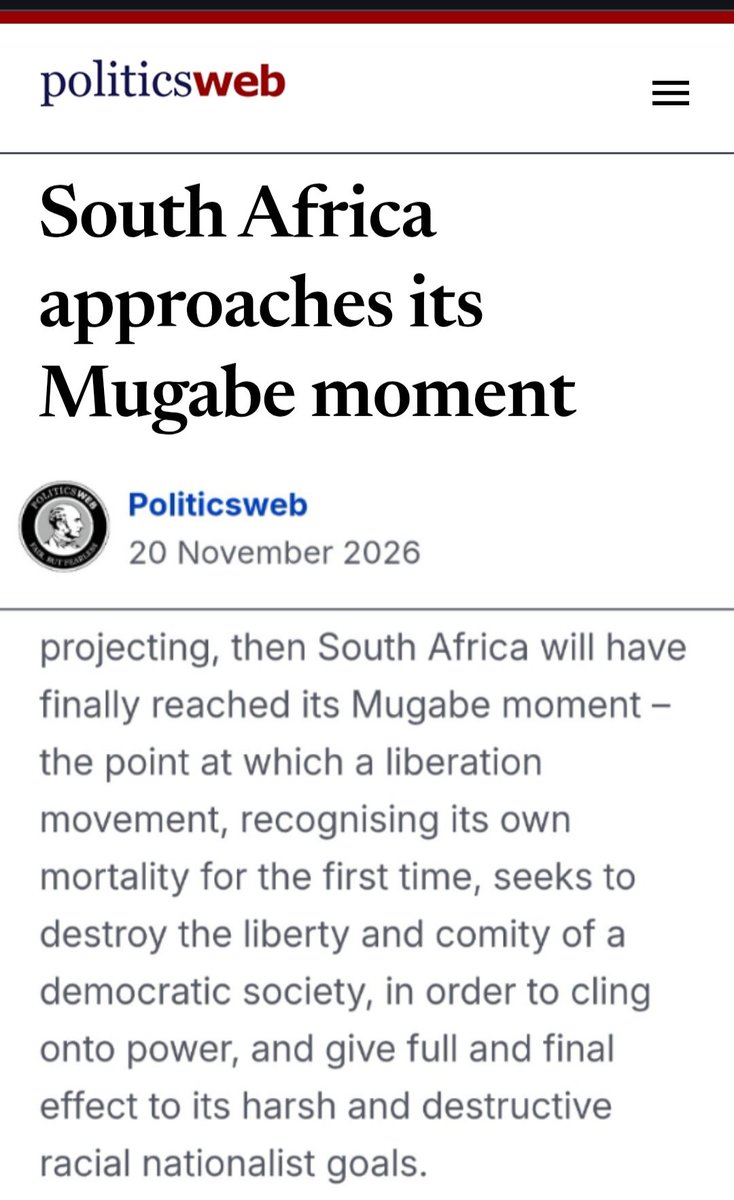
This week’s @Politicsweb editorial warns of the ANC’s potential Mugabe moment: the point at which the party, facing catastrophic decline, turns to increasingly extremist and racialist rhetoric and policies to cling to power.
The comparison is not as far-fetched as some might claim. While Mugabe’s chaotic and violent early-2000s land policies were destroying Zimbabwe’s economy, leading to record-breaking hyperinflation, and producing mass human rights violations, the ANC-led government under the leadership of Thabo Mbeki projected solidarity with its ally rather than condemnation.
Mbeki has repeatedly emphasised that, alongside Mugabe being an ideological comrade, the ANC was indebted to him and his party for delaying their radical land policies in the early 1990s so as not to frighten whites and weaken the ANC’s negotiating position during the end of apartheid in South Africa.
Furthermore, ANC officials used the horrors unfolding in Zimbabwe to threaten white South African farmers. Between 2000 and 2005, government leaders warned that "Zimbabwe-style" land seizures could follow if farmers did not cooperate with ANC land policies. In 2005, Deputy President Phumzile Mlambo-Ngcuka underscored this stance by stating that South Africa could learn from Zimbabwe on how to "do land reform fast", floating a potential shift toward more radical policies.
Even after the crimes against humanity of the Mugabe regime shocked the world, Mbeki praised Mugabe in 2019 as "very principled and brave" and a "tried and tested African patriot."
As recently as 2025, the president of South Africa hailed Mugabe's policies as inspirational. Speaking in Zimbabwe, President Cyril Ramaphosa heaped praise on the ZANU-PF government, labeling the late dictator Mugabe’s violent land policies as “ambitious” and “essential.” He emphasized that there is much his ANC-led government could learn from ZANU-PF’s policies.
Reminder: the abovementioned policies the ANC sees as inspiring resulted in private property rights being severely violated, as thousands of white farmers and their families were driven off their land and attacked. Some were even tortured and murdered. The mass human rights violations and collapse of the Zimbabwean agricultural sector and economy as a result of Mugabe’s Fast Track Land Reform Programme, caused millions of Zimbabweans to flee his “utopia,” with many swimming across crocodile-infested rivers to reach South Africa.
In AfriForum's recent response to the Thabo Mbeki Foundation's desperate attempt to help the ANC escape accountability by scapegoating the Afrikaners instead, I asked Mr. Mbeki whether he and his ANC comrades will let the ANC die or rather, as the his hero Mugabe did, resort to any injustice necessary to cling on to power - to continue to survive through injustice, as N.P. van Wyk Louw put it. James Myburgh of PoliticsWeb has asked the same question this week. We will know soon enough.
You simply have to watch this.
@JustLuai completely obliterated the Arab countries at the UN with facts that hit harder than a MOAB. Their stunned humiliated silence was the best part of it all.
Credit @UNWatch and @c14english
.@afriforum rejects the proposed amendments to the Firearms Control Regulations, 2004, published by the South African Police Service (SAPS) in Government Gazette 55760 on 19 November 2026 for public comment. The proposed amendments place further unreasonable restrictions on law-abiding firearm owners, while the SAPS has yet to address serious shortcomings in its own management, control and safekeeping of firearms.
The proposed regulations include provisions that could force firearm owners whose licences have expired to surrender or dispose of their firearms within seven days. It also includes additional discretionary medical and psychological assessments and creates the possibility of firearm owners forfeiting their firearms to the state without compensation.
According to AfriForum these proposals are disproportionate and place an unfair burden on responsible firearm owners. The organisation is particularly concerned that administrative failures, including those potentially attributable to the SAPS itself, could result in individuals permanently losing lawfully acquired property.
The proposed regulations are especially concerning considering the SAPS’s own track record regarding firearm management. The case involving former police colonel Christiaan Prinsloo exposed how thousands of firearms were sold from police stores to criminal networks. These firearms were subsequently linked to numerous murders and other violent crimes.
The SAPS’s 2024/2025 annual report also records firearms reported lost or stolen from within the police service. Furthermore, a 2026 Free State High Court judgment in Legally Armed South Africa (Pty) Ltd v Minister of Police and Others highlighted persistent failures by police officials to process reports of lost or stolen firearms belonging to deceased estates, leaving hundreds of firearms unaccounted for.
“These are serious institutional failures that go to the heart of the SAPS’s responsibility to manage and safeguard firearms. It is unacceptable that the same institution that cannot adequately account for firearms under its own control now wants to impose increasingly restrictive requirements on law-abiding citizens,” says Jacques Broodryk, AfriForum’s head Spokesperson for Community Safety.
The public has 60 days from the publication of the notice on 19 November 2026 to submit comments.
AfriForum will oppose any regulatory measures that unfairly penalise responsible firearm owners while failing to address the institutional failures that contribute to South Africa’s firearm-related crime problem. The state has a responsibility to protect its citizens and must not make responsible citizens pay for its own failures.
https://t.co/WZrfkzibmJ
The Accord on Afrikaner Self-Determination (1994), of which you are a signatory, Mr. Mbeki, recognises the right of cultural communities like the Afrikaners to self-determination and cultural autonomy as valid and legitimate, and not inherently racist or anti-democratic pursuits.
Section 235 of the South African Constitution (1996) states that the self-determination of the South African people as a whole does not nullify the right to self-determination of any community sharing a common cultural and language heritage.
The International Covenant on Civil and Political Rights (ICCPR), a binding treaty that South Africa has ratified, recognises that all peoples have the right to self-determination, and protects the right of ethnic, religious or linguistic minorities to collectively organise to defend their culture, religion, language, heritage, and traditions.
The United Nations Declaration on the Rights of Indigenous Peoples (UNDRIP) explicitly protects both the right to self-determination and the right to autonomy or self-government in matters relating to a culture's internal and local affairs.
The International Labour Organisation's (ILO) Indigenous and Tribal Peoples Convention recognises as legitimate the aspirations of cultural communities to exercise control over their own institutions, ways of life, and economic development within the legal framework of the states in which they reside (cultural autonomy in essence).
The Council of Europe's Framework Convention for the Protection of National Minorities, the first legally binding multilateral instrument devoted to the protection of minority groups, requires states to promote the necessary conditions for minorities to maintain, develop and protect their culture, language, and traditions.
The Organisation for Security and Co-operation in Europe's (OSCE) Lund Recommendations on the Effective Participation of National Minorities in Public Life specifically outlines non-territorial and territorial self-governance arrangements (cultural autonomy) as practical, peaceful and valid mechanisms for minorities to administer their own cultural, educational, and religious affairs within a unified state.
The African Union's (AU) African Charter on Human and Peoples' Rights, of which South Africa is a signatory, explicitly recognises collective peoples' rights alongside individual rights. It affirms the right of all peoples to self-determination, while also protecting their right to economic, social, and cultural development with regard to their freedom and identity.
Cultural autonomy for minorities - especially targeted and scapegoated ones like the Afrikaners - as well as the right to self-determination, are therefore both legitimate, mainstream, and internationally recognised human rights, not some right-wing conspiracy, Mr. Mbeki.
Another desperate "Oranje Gevaar" conspiracy theory bites the dust.
Perhaps the message was not clear enough: civilization is going through transformation.
With our current best knowledge of how generative systems work, there is only one way this can successfully happen: domain propagation. Peacefully? Perhaps only domain separation.