@DxrkZon3 "You become interchangeable." That's the line people need to sit with longer. The algorithm doesn't reward originality it rewards recognizability. A familiar emotional arc. A familiar structure. You train yourself to be legible to the feed, and in doing so, you become part of it
There is a version of you that existed before you knew what performed well.
That version had rough edges. Posted things without knowing if they would land. Said what they actually thought, not what they calculated would resonate.
Then the feedback loop kicked in.
Not overnight, that is rarely how it happens. It starts small. You notice one framing gets more traction than another. You file that away. You notice a certain emotional register makes people share faster. You file that away too. Slowly, almost without realizing it, you start writing for the version of your audience that already exists rather than the conversation you actually wanted to have.
The posts start performing better. The numbers climb. And from the outside, it looks like growth.
But something quieter is happening underneath that. You are slowly editing yourself out of your own work.
The irony is brutal. The more you optimize for reach, the less of a reason there is to reach you specifically. You become interchangeable. Another voice saying the same things in the same register that the algorithm currently favors. The thing that made you worth following in the first place gets sanded down in pursuit of the metrics that measure it.
Most people never notice when this happens to someone they follow. They just gradually stop finding that person interesting and move on without knowing why.
The few creators who avoid this trap are not the ones who found a better optimization strategy. They are the ones who decided, at some point, that the post they needed to write mattered more than the post most likely to perform. They accepted the tradeoff. Sometimes the numbers suffered. The work did not.
What you lose when you optimize forever is not your audience.
It is your reason for having one.
@RallyOnChain
One of my mutuals casually posted a wallet screenshot today.
A few USDC here.
A few USDC there.
Nothing crazy until I realized every payment came from the same place: @RallyOnChain.
I thought it was another points program.
It wasn't.
Turns out they've been getting paid actual stablecoins just for posting and participating
Maybe I'm late.
But judging by how many people seem to be quietly farming this without talking about it, I don't think I'm the only one just finding out.
The funniest part?
Most people won't see this until the campaign is over.
I was broke with no source of income. Then, one day I tapped into Notcoin, earned smol stimmy, and realized the internet could reward curiosity. That tiny payout sent me down the crypto rabbit hole, and I haven’t looked back since. @RallyOnChain
@DxrkZon3 Linking Cari Network’s $600B deposit base to ZKsync’s settlement layer is the most practical application of the 'SWIFT dynamic' I've seen in the space yet.
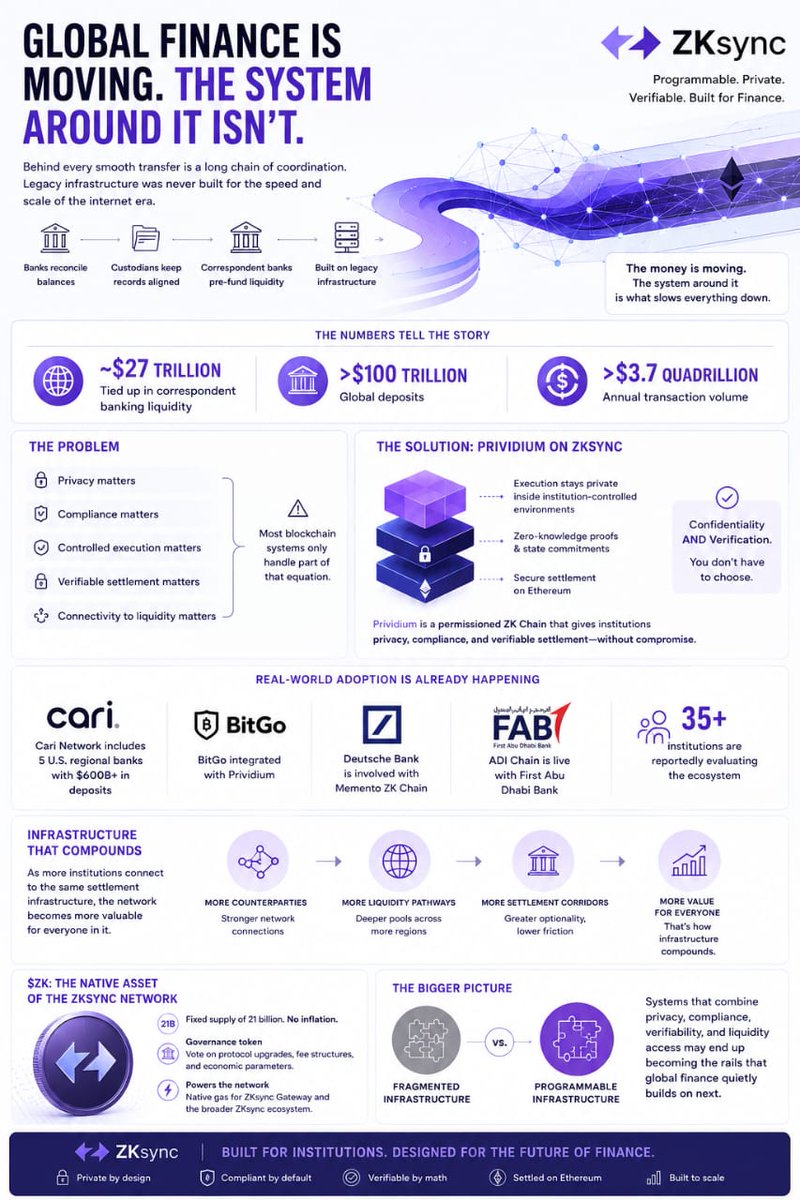
The easiest way to understand global finance is to look at what happens behind the scenes.
Because what looks like a smooth transfer on the surface is usually a long chain of coordination underneath it.
Banks reconcile balances. Custodians keep records aligned. Correspondent banks pre-fund liquidity across regions. And all of it sits on infrastructure that was never designed for the speed and scale of the internet era.
That is why the numbers are so striking.
Around $27 trillion is tied up in correspondent banking liquidity. Global deposits exceed $100 trillion. Annual transaction volume crosses $3.7 quadrillion.
The money is moving. The system around it is what slows everything down.
That is the real reason institutions are paying attention to programmable financial infrastructure.
Not because it sounds futuristic. Because the current model is expensive to maintain.
Privacy matters. Compliance matters. Controlled execution matters. Verifiable settlement matters. Connectivity to liquidity matters.
And most blockchain systems only handle part of that equation.
That is the problem @zksync is addressing with Prividium.
Prividium is built as a permissioned ZK Chain where institutions can keep execution private inside their own environments while zero-knowledge proofs and state commitments settle to Ethereum.
So instead of forcing banks to choose between confidentiality and verification, the system gives them both.
That shift is bigger than it first appears.
Because once verification becomes mathematical instead of dependency-heavy, and settlement becomes programmable instead of fragmented, the whole coordination layer starts to change.
This is not just about faster payments.
It is about reducing the friction built into the financial system itself.
And that shift is already starting to show up in the real world:
• Cari Network includes 5 U.S. regional banks with $600B+ in deposits
• Deutsche Bank is involved with Memento ZK Chain
• ADI Chain is live with First Abu Dhabi Bank
• 35+ institutions are reportedly evaluating the ecosystem
As more institutions connect to the same settlement infrastructure, the network becomes more valuable for everyone in it.
More counterparties. More liquidity pathways. More settlement corridors.
That is how infrastructure compounds.
At the center of the ZKsync network is $ZK, its native asset.
It has a fixed supply of 21 billion with no inflation, and it plays a role in governing protocol upgrades, fee structures, and economic parameters.
So the bigger picture is not really crypto versus traditional finance.
It is fragmented infrastructure versus programmable infrastructure.
And the systems that can combine privacy, compliance, verifiability, and liquidity access may end up becoming the rails that global finance quietly builds on next.
The Quiet Crisis Inside Global Finance
Think about what it actually takes to move money internationally right now. A business in Lagos wants to pay a supplier in Tokyo. That payment has to pass through multiple correspondent banks, each one holding pre-funded capital just to make the transfer possible. It takes days. It costs a percentage of the transaction. And somewhere in that chain, capital is just sitting there. Locked. Doing nothing.
This isn't a small inconvenience. Correspondent banking alone locks up $27 trillion in pre-funded capital globally. Global deposits exceed $100 trillion. Annual financial transaction volume crosses $3.7 quadrillion. And almost all of it runs on infrastructure designed before the internet existed.
The shift to onchain finance was never an ideological crypto dream. It's a practical response to a very real, very expensive problem. When transactions are verified mathematically, when settlement is near-instant, and when coordination becomes programmable, the economics of global finance change completely.
But here's where most blockchain conversations go off track. People assume the solution is simply putting banks on a public chain. Except banks need genuine privacy so sensitive transactions stay confidential, regulatory control over their execution environments, cryptographic verifiability without trusting third parties, and connectivity to existing liquidity. Most blockchain architectures fail at least one of these. Usually more.
This is precisely what @ZKsync built Prividium to solve. Transaction data stays completely offchain inside an institution-controlled environment, while zero-knowledge proofs published to Ethereum guarantee validity without exposing anything. You get the privacy of a closed system with the verification of a public blockchain.
And this is already happening. Deutsche Bank, First Abu Dhabi Bank, and Cari Network representing five U.S. regional banks with over $600 billion in combined deposits are all already in. Over 35 institutions are in active evaluation.
$ZK sits at the center as the network's only native asset. Fixed supply of 21 billion, no inflation. It powers ZKsync Gateway, governs protocol decisions, and captures fees as institutional adoption compounds. Every new institution joining expands the number of settlement corridors across the entire network.
The infrastructure isn't a whitepaper anymore. The institutions are already here.
@DxrkZon3 "privacy of a closed system with the verification of a public blockchain" if that actually holds up technically that's genuinely the unlock nobody's been able to crack. reading the ZK proofs documentation tonight because i need to understand if this is real
.@tomoland_app is building a Trustless Open Market Ownership (TOMO), an open ecosystem where creators, players, and builders help shape the platform and share in the value they create. Instead of being just a game, tomoland combines a game layer with a creator economy where users can build, explore, and monetize user generated content, AI creations, and gameplay activities.
The first participation layer in this ecosystem is the blueprint. Only 2,222 blueprints exist, and they are free to claim, serving as proof of early entry before the TOMO ecosystem opens more widely. Early participants gain structural advantages by joining while the platform is still forming. Holding the blueprint unlocks several benefits, including xTOMO point multipliers, airdrop allocation, multiplier earnings, exclusive platform discounts, holder only events and raffles, early VIP access, and limited edition partner avatars.
Blueprint whitelist opportunities can be obtained through Tomoland Discord events, the X community group, community marketplace engagement points, ecosystem partner raffles, and Tomodachi KOL ambassador raffle posts.
You can get the app using:
Apple App:
https://t.co/2atiLaBQ4R
Google App:
https://t.co/7Rfd0eWaWR
Follow and join the community:
Discord: https://t.co/YWlIcIqfPd
X Group: https://t.co/g2Kr9AVSCd
@TheCreatorFi, #TOMOBlueprint
David runs a mid sized cocoa farm and has always had the same constraint: capital is slow, banks are cautious, and expansion means paperwork that drags on for months. He owns productive land, contracts with buyers, and proven output. What he lacks is liquidity.
Then he discovers @metasoilverse.
Instead of selling equity or taking on expensive short term loans, David tokenizes a portion of his farm’s future output through a structured RealFi model. The yield logic is tied to actual production data. Performance metrics are verified on chain. Investors are not buying hype, they are buying exposure to measurable agricultural output.
With funding unlocked, David upgrades irrigation, secures better logistics, and increases seasonal yield. Distributions to token holders are automated based on real performance, not speculation. Compliance frameworks are already integrated, so cross border participation does not become a legal maze. The backend keeps running while he focuses on farming.
Meanwhile, an analyst in another country gains fractional exposure to agricultural revenue without owning land or managing operations. The system tracks metrics transparently. Returns are linked to productivity, not price momentum alone.
Now imagine this model applied to mining equipment, logistics fleets, or commercial property. The business becomes programmable. Liquidity meets production. Capital formation becomes data driven.
@BingXOfficial #RWA #Realfi #BingXBlast