Decent spot for an allocation to Bitcoin at 63k-64k right now
Lower likely in the next four months, maybe 20%
But this is a decent allocation spot for long term hold
10h ago @litecoin experienced a coordinated attack on the chain that resulted in 13 blocks reorg that took more than 3h to generate.
During this time attackers were performing double spend attacks on multiple cross-chain swapping protocols.
We are investigating the situation.
1/ I’ve spent most of the last few weeks since the Google, Caltech papers to think about tradable implications around quantum computing and crypto
specifically what happens to the market around q-day
Iran says it has presented an 8-point framework (described as part of a wider 10-point plan) to the American side through Pakistan as the basis for negotiations in Islamabad:
1. Organized passage through the Strait of Hormuz in coordination with Iranian armed forces
2. An end to the war against all components of the Resistance Axis
3. Withdrawal of all US combat forces from bases and deployment sites across the region
4. A safe-passage protocol for Hormuz that formally recognizes Iran’s control under the agreement
5. Full compensation payments to Iran based on official damage estimates
6. Lifting of all primary and secondary sanctions
7. Release of all Iranian assets frozen abroad
8. Final ratification through a binding UN Security Council decision
The statement says these principles will be the sole basis for two weeks of negotiations in Islamabad, while stressing that this does not yet mark the end of the war.
Life as a Trader: limit your execution to those few moments that are worth the resultant anxiety. Every trade is a draw on your mental health, choose wisely.
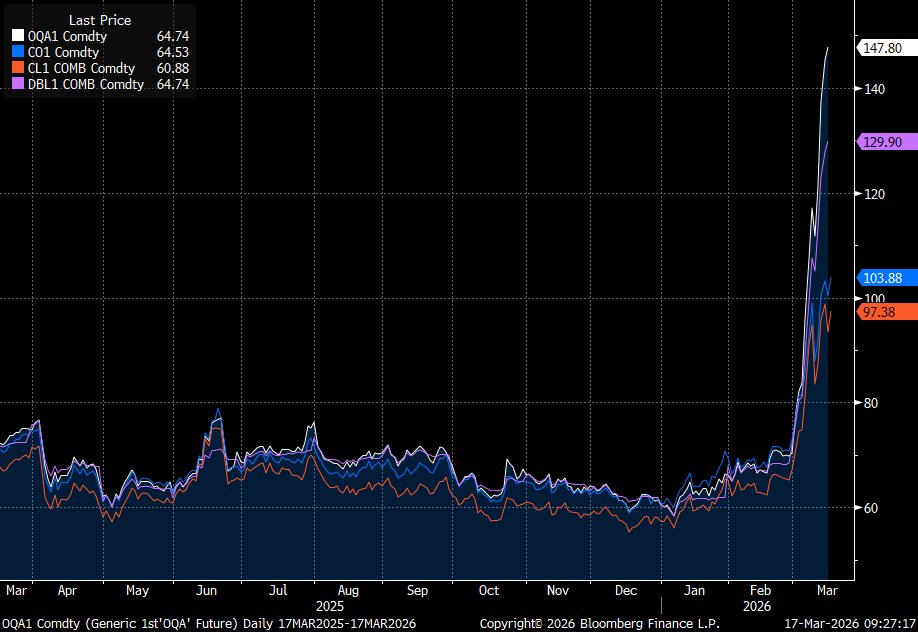
Crude futures across New York, London, Dubai and Oman currently show a pronounced divergence, with WTI trading at a notable discount to benchmarks more closely linked to Asian demand. While part of this spread reflects differences in contract expiry and delivery timing, it does not fully explain the scale of the dislocation.
The primary driver remains the acute tightness in Asian physical markets. With supplies from the Middle East—the region’s primary source—significantly disrupted, refiners are bidding aggressively for prompt cargoes to secure supply. This has lifted prices for benchmarks tied to the region, particularly those with shorter delivery horizons.
In addition, the forward curve is exhibiting near-record backwardation, with front-month contracts trading at a significant premium to deferred deliveries. In such an environment, proximity matters: the closer a benchmark futures contract is to both the spot market and the epicentre of demand—in this case Asia—the higher the price tends to trade.
By contrast, WTI, which is more insulated from immediate global flows and still reflects inland U.S. dynamics, remains under relative pressure despite the broader tightening in global supply.
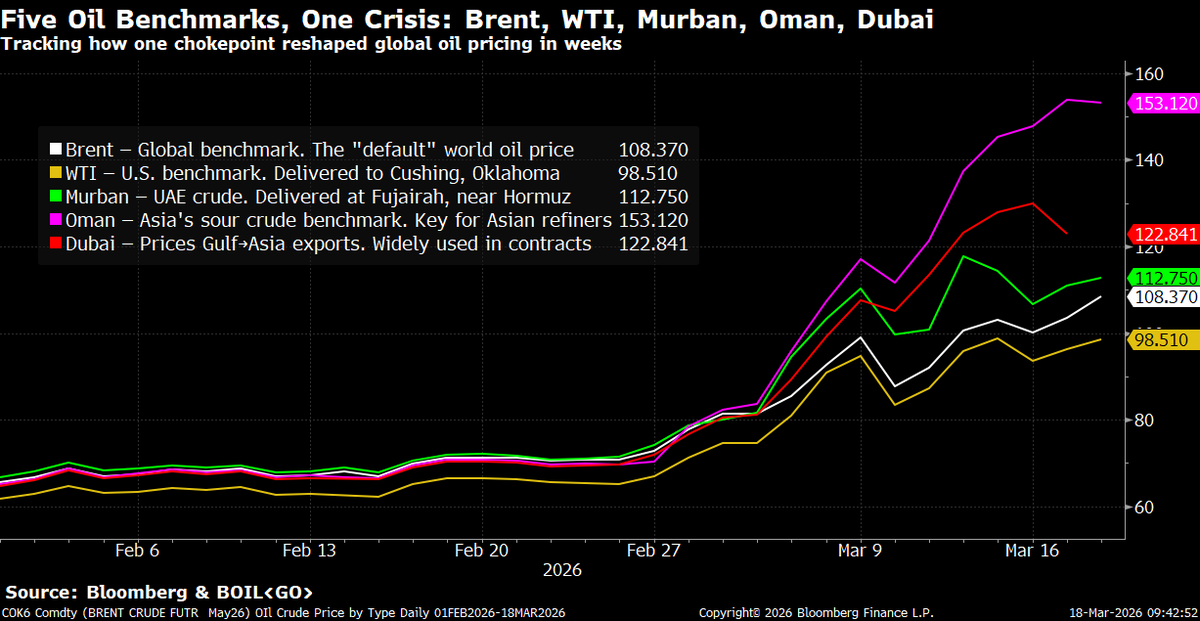
🛢️There's a lot being said about oil prices right now, so I put this chart together to help explain the major crude benchmarks and why they're all behaving differently.
⚪Brent (white) — The world's "default" oil price. Most global trade is priced off this. When the news says "oil is at $108," they mean Brent.
🟡WTI (yellow) — The U.S. benchmark, based on crude delivered to Oklahoma. It's the lowest line on the chart because American oil doesn't need to transit the Strait of Hormuz.
🟢Murban (green) — Crude from Abu Dhabi, delivered at Fujairah port, which sits just outside the Strait. Even though it technically doesn't have to pass through the chokepoint, drone strikes have hit Fujairah and nearby ports, pushing insurance and shipping costs up.
🟣Oman (purple) — The key benchmark for heavier crude sold into Asia. Many refineries in China, Japan, and South Korea are built specifically to process this grade. It's the highest line on the chart because Asian buyers are competing fiercely for a shrinking pool of cargoes.
🔴Dubai (red) — Used to price most long-term Gulf→Asia export contracts. It tracks alongside Oman as a measure of how hard Asian markets are being squeezed.
The story isn't any single price — it's the gap between them. In late February these five lines were within $6 of each other. Now the spread between WTI and Oman is over $50.
Since the U.S.-Israeli strikes on Iran began Feb 28, the Strait of Hormuz has effectively been closed. Daily transits have fallen from a historical average of ~138 ships to fewer than 5. The IEA has called it the largest disruption to global energy supply in history. Iran's IRGC has warned that not "a litre of oil" will pass for U.S. allies, while selectively allowing some Iranian, Indian, and Pakistani tankers through.
Saudi Arabia is rerouting oil to its Red Sea port at Yanbu, and the UAE is using a pipeline to Fujairah — but combined pipeline capacity is only 3.5–5.5 million barrels/day vs the 20 million that normally flows through the Strait. Meanwhile, the 400 million barrel emergency reserve release by IEA members covers roughly 4 days of global consumption.
Japan's refiners get ~95% of their crude from the Gulf. China receives 45% of its oil via Hormuz. South Korea, India, Thailand, Pakistan, and Bangladesh are all severely exposed. The wider the spread between the Asian benchmarks and Western ones on this chart, the more you're seeing that pain in real time.
We're refocusing Magic Eden on @solana, Packs & @DiceyHQ.📅 What's changing:
Mar 9 — EVM & BTC marketplaces sunset
Mar 27 — Bitcoin API shutdown
Apr 1 — ME Wallet deprecated
$ME remains central. Wallet users: export your keys before 4/1.
For more details, review the below help center articles:
- https://t.co/TNXWCYNWMt
- https://t.co/ii93T4zp4q
- https://t.co/UlHl9ZElzG
- https://t.co/Uylqzse4Ee
There have recently been some discussions on the ongoing role of L2s in the Ethereum ecosystem, especially in the face of two facts:
* L2s' progress to stage 2 (and, secondarily, on interop) has been far slower and more difficult than originally expected
* L1 itself is scaling, fees are very low, and gaslimits are projected to increase greatly in 2026
Both of these facts, for their own separate reasons, mean that the original vision of L2s and their role in Ethereum no longer makes sense, and we need a new path.
First, let us recap the original vision. Ethereum needs to scale. The definition of "Ethereum scaling" is the existence of large quantities of block space that is backed by the full faith and credit of Ethereum - that is, block space where, if you do things (including with ETH) inside that block space, your activities are guaranteed to be valid, uncensored, unreverted, untouched, as long as Ethereum itself functions. If you create a 10000 TPS EVM where its connection to L1 is mediated by a multisig bridge, then you are not scaling Ethereum.
This vision no longer makes sense. L1 does not need L2s to be "branded shards", because L1 is itself scaling. And L2s are not able or willing to satisfy the properties that a true "branded shard" would require. I've even seen at least one explicitly saying that they may never want to go beyond stage 1, not just for technical reasons around ZK-EVM safety, but also because their customers' regulatory needs require them to have ultimate control. This may be doing the right thing for your customers. But it should be obvious that if you are doing this, then you are not "scaling Ethereum" in the sense meant by the rollup-centric roadmap. But that's fine! it's fine because Ethereum itself is now scaling directly on L1, with large planned increases to its gas limit this year and the years ahead.
We should stop thinking about L2s as literally being "branded shards" of Ethereum, with the social status and responsibilities that this entails. Instead, we can think of L2s as being a full spectrum, which includes both chains backed by the full faith and credit of Ethereum with various unique properties (eg. not just EVM), as well as a whole array of options at different levels of connection to Ethereum, that each person (or bot) is free to care about or not care about depending on their needs.
What would I do today if I were an L2?
* Identify a value add other than "scaling". Examples: (i) non-EVM specialized features/VMs around privacy, (ii) efficiency specialized around a particular application, (iii) truly extreme levels of scaling that even a greatly expanded L1 will not do, (iv) a totally different design for non-financial applications, eg. social, identity, AI, (v) ultra-low-latency and other sequencing properties, (vi) maybe built-in oracles or decentralized dispute resolution or other "non-computationally-verifiable" features
* Be stage 1 at the minimum (otherwise you really are just a separate L1 with a bridge, and you should just call yourself that) if you're doing things with ETH or other ethereum-issued assets
* Support maximum interoperability with Ethereum, though this will differ for each one (eg. what if you're not EVM, or even not financial?)
From Ethereum's side, over the past few months I've become more convinced of the value of the native rollup precompile, particuarly once we have enshrined ZK-EVM proofs that we need anyway to scale L1. This is a precompile that verifies a ZK-EVM proof, and it's "part of Ethereum", so (i) it auto-upgrades along with Ethereum, and (ii) if the precompile has a bug, Ethereum will hard-fork to fix the bug.
The native rollup precompile would make full, security-council-free, EVM verification accessible. We should spend much more time working out how to design it in such a way that if your L2 is "EVM plus other stuff", then the native rollup precompile would verify the EVM, and you only have to bring your own prover for the "other stuff" (eg. Stylus). This might involve a canonical way of exposing a lookup table between contract call inputs and outputs, and letting you provide your own values to the lookup table (that you would prove separately).
This would make it easy to have safe, strong, trustless interoperability with Ethereum. It also enables synchronous composability (see: https://t.co/9jy6v1X6Fw and https://t.co/gZmu3YjebM ). And from there, it's each L2's choice exactly what they want to build. Don't just "extend L1", figure out something new to add.
This of course means that some will add things that are trust-dependent, or backdoored, or otherwise insecure; this is unavoidable in a permissionless ecosystem where developers have freedom. Our job should make to make it clear to users what guarantees they have, and to build up the strongest Ethereum that we can.
In every bitcoin cycle, the new participants always buy the top. They become hodlers and new evangelists in the next cycle. Next cycle will be pension funds and insurance companies. Following cycle will be developed nation states.. Then ETs.. Angels & demons.. God
Then u sell
1/6
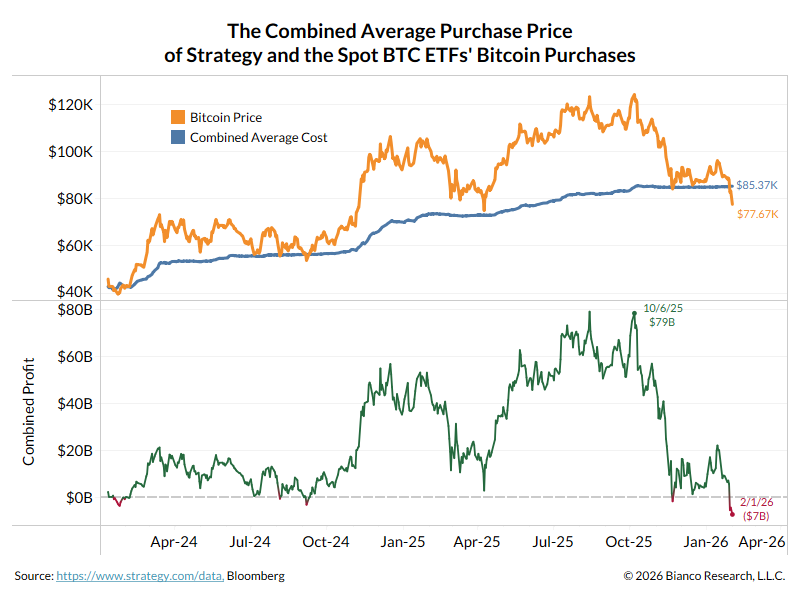
10% of the outstanding $BTC is held by $MSTR and the 11 Spot BTC ETFs.
These are the ways normies hold $BTC in regulated brokerage accounts.
Collectively, the avg purchase price is $85.36K, meaning the average is now ~$8k underwater, with an unrealized loss of ~$7B.
🧵
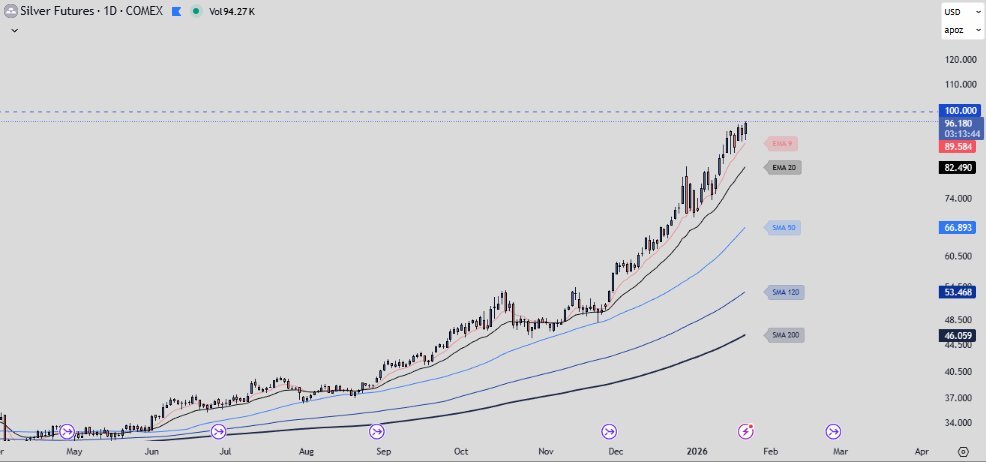
Silver is really close to the Hundy roll setup.
The Hundy Roll is a momentum trading concept, it centers on the psychological significance of a $100 price level or "century mark".
The Setup is that an asset (a stock originally) consolidates or hovers just below the $100 mark, typically in the $97–$98 range.
As the price finally pushes through the psychological resistance of $100, it often triggers an influx of volume and algorithmic buying.
The idea is that because humans are attracted to round numbers, breaking this barrier is seen as a major breakout signal.
The theory suggests that once $100 is cleared, the momentum will cause the price to "roll" quickly higher, often targeting the $103+ level ( so roughly a quick 3% run) as short-term euphoria takes over. It is essentially a play on round-number bias and the cascading buy orders that tend to sit just above triple digits.