Introducing Events by trade[XYZ].
With Events, we’re advancing our vision of Hyperliquid as the universal exchange—a single, composable system for trading financial assets and real-world outcomes.
A user can deposit spot BTC, borrow USDC through portfolio margin, open a pre-ipo SpaceX perp position, hedge an upcoming SK Hynix earnings event with an events market, and pick the US Open winner—all from a single unified account on trade[XYZ].
Events will span sports, politics, economics, and financial markets, with an expanding range of categories and contract formats.
Our initial Up/Down markets cover equities, commodities, and pre-IPOs, powered by the depth and liquidity of trade[XYZ] perpetuals on HIP-3. These perpetuals provide continuous price discovery and serve as the resolution source, so each contract is grounded in XYZ's liquid market prices rather than an external oracle.
We are releasing the first liquid way to trade Anthropic.
For far too long, frontier assets have only been accessible to a select few. We are here to bring them to the masses.
Introducing EntropyIO. We’ve raised $14M led by Ribbit Capital and a $40M HYPE stake to build both improved and entirely new markets, the first of which are live on Hyperliquid today.
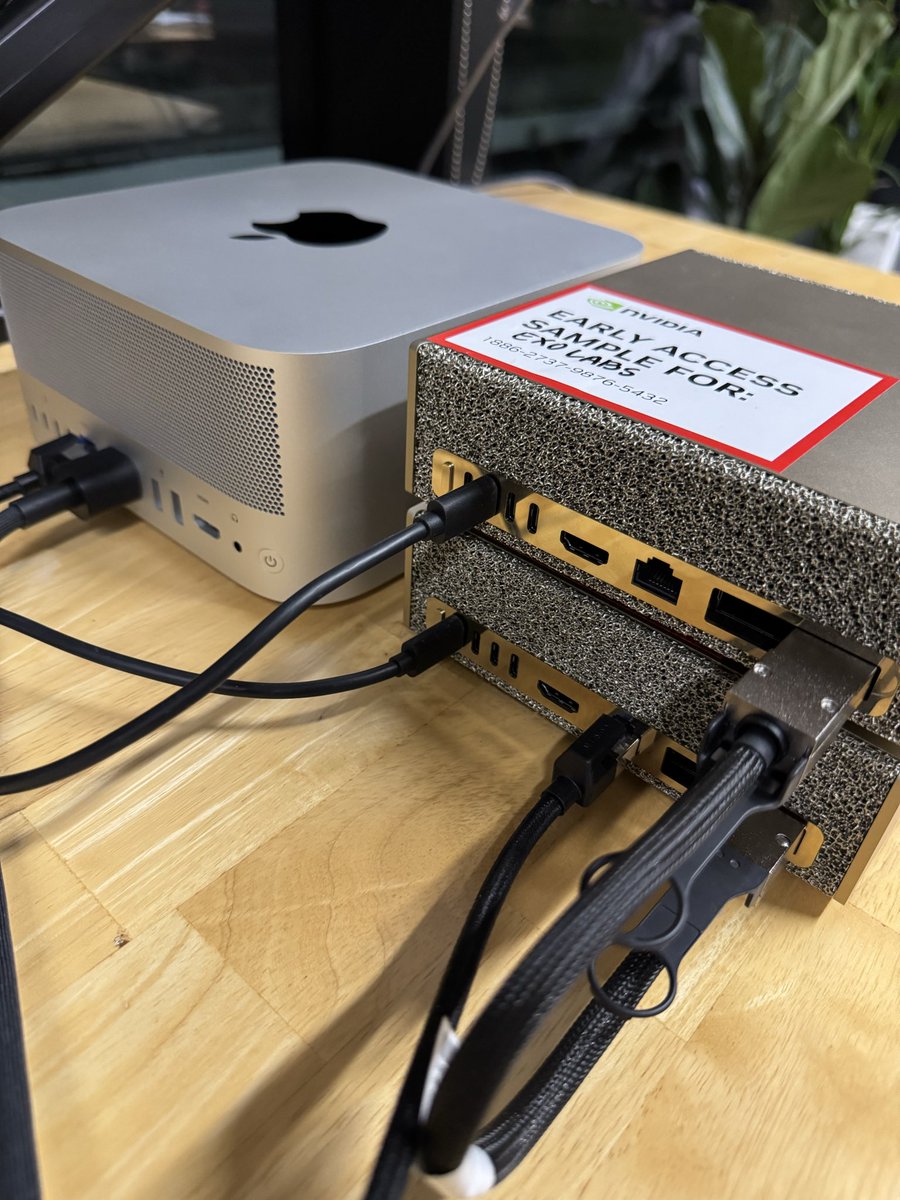
Clustering NVIDIA DGX Spark + M3 Ultra Mac Studio for 4x faster LLM inference.
DGX Spark: 128GB @ 273GB/s, 100 TFLOPS (fp16), $3,999
M3 Ultra: 256GB @ 819GB/s, 26 TFLOPS (fp16), $5,599
The DGX Spark has 3x less memory bandwidth than the M3 Ultra but 4x more FLOPS.
By running compute-bound prefill on the DGX Spark, memory-bound decode on the M3 Ultra, and streaming the KV cache over 10GbE, we are able to get the best of both hardware with massive speedups.
Short explanation in this thread & link to full blog post below.
Introducing Aviya - Institutional Credit on Hyperliquid.
Aviya is a private, compliance gated credit venue built on Hyperliquid, designed to extend structured credit access to institutional participants.
The platform facilitates bilateral, fixed-rate financing, initially against HYPE collateral, with a roadmap to expand into additional asset classes over time.
As capital allocators increasingly engage with on-chain markets, access to predictable, structured credit becomes a requirement. Aviya is designed to meet this demand by offering a more controlled alternative to fully permissionless lending systems, while still leveraging the efficiency and settlement advantages of Hyperliquid’s infrastructure.
We view Aviya as a core component in the development of HyperLend as the credit layer of the Hyperliquid ecosystem, enabling capital formation, leverage, and structured financing across both native and future tokenized assets such as equities, commodities, fixed-income instruments and even the likes tokenised pre-IPO companies.
Over time, Aviya will serve as a gateway for institutional credit into emerging on-chain markets, including real-world and tokenized financial assets.
We are also pleased to deepen our collaboration with @HyperionDeFi, working together on institutional business development and capital formation.
Aviya represents a continued step toward integrating credit natively into the broader Hyperliquid financial system.
gLend.
Major structural win for Hyperliquid.
A tier 1 CEX and the largest US-regulated stablecoin issuer are both staking HYPE and sharing revenue with the protocol. It's an admission that Hyperliquid is too dominant in perps to displace, so better to align and capture distribution.
We should see an increase of ~$140M+ in annualised revenue which will be used to buyback HYPE. This is the floor and will scale with USDC supply growth. Roughly a 20% increase in annualised revenue looking at recent data.
The USDC USDH fragmentation is now fixed.
Coinbase and Circle staking HYPE also reduces circulating supply.
Hyperliquid continues to get more attractive for institutions with Coinbase and Circle putting their weight behind the protocol.
Without knowing what's coming, Bryan Johnson will soon have a child, with some kind of dysfuction or malformation. And it will be the end of this "we can avoid disease" trend.
We will be back to allocating resources to "how do we solve these impossible to prevent diseases"
🚨 I HAVE NO MICROPLASTICS IN MY BALLS 🚨
This should not be possible.
Studies show that 100% of men have microplastics in their semen. I am the first human ever to show a complete reduction to zero.
This may be a world-first breakthrough in fertility research.
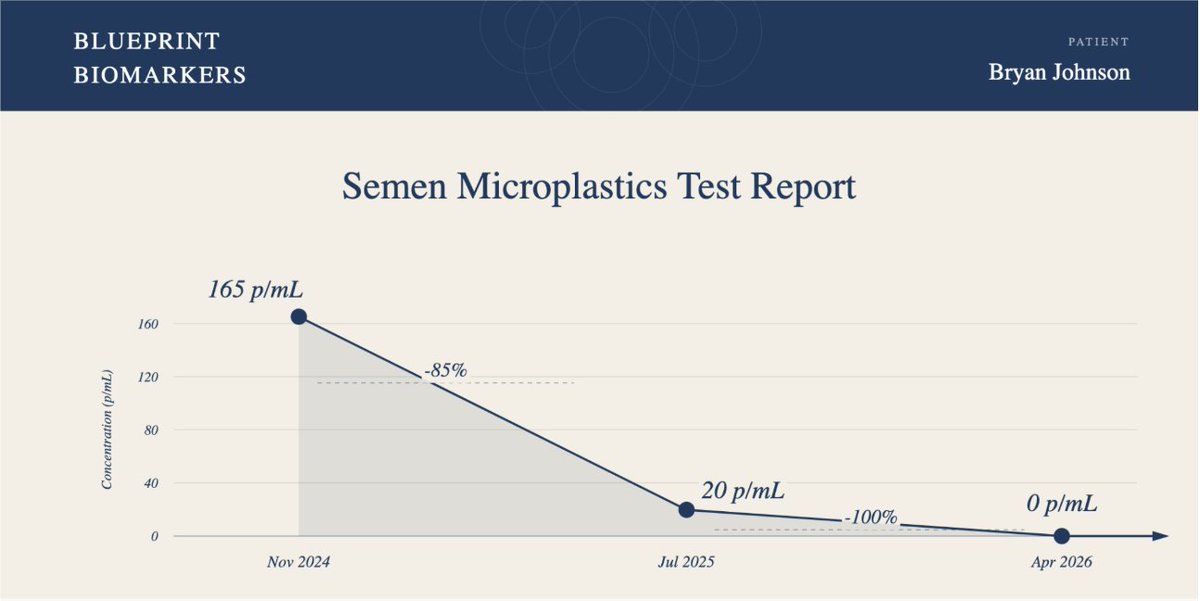
I had 165 microplastic particles in my semen just 18 months ago. Now, I have zero.
Five published studies have measured microplastics in human semen. Two found them in 100% of men. The other three found then in 44 to 76% of men tested, but those used methods that miss the smallest particles and the clear ones. Corrected for that, the real rate is likely 100%. Almost every man alive has plastic in his semen right now. The same applies to testicular tissue, testing 100% positive for microplastics.
Microplastics hurt sperm.
Human studies show the impact of various types of plastic, associated chemicals, and other toxins on male fertility:
+ 60% fewer normal shaped sperm (from PFAS)
+ 5x higher odds of low sperm count (from PTFE)
+ 10% lower sperm concentration (from PTFE)
+ 15% lower swimming ability (from PTFE)
+ 41% lower swimming ability (from PET)
+ 12% lower sperm swimming ability (from BPA)
+ 3x higher odds of low sperm count (from Phthalates)
+ 2x higher odds of poor swimming (from Phthalates)
The effects compound: each extra type of plastic drops sperm swimming ability by about 21%.
This matters even if you’re NOT trying to get pregnant.
Sperm count is one of the cleanest biomarkers of overall health we have. And microplastics don't stop at the testes.
The same particles are showing up everywhere we look. Studies show 4.5x higher rate of heart attack, stroke, and death in people with microplastics in their arterial plaque vs. those without. Microplastics were also found in 100% of human placentas tested.
100% of post-mortem human brains tested positive for microplastics. Brain concentrations rose ~50% between 2016 and 2024, and now sit at roughly 11x the levels found in the liver or kidney.
Where do these come from?
+ PTFE, commonly in non-stick pans
+ PET, water bottles
+ Phthalates, makes plastic soft and bendy
+ BPA, can linings
+ PFAS, stain-resistant fabrics & food packaging
Inside the body, plastic causes a kind of cellular rust. It triggers inflammation in the testicles, kills the cells that make sperm and drops testosterone. It's been confirmed across 39 animal and cell studies, then in human data.
MY PROTOCOL:
Note, what I did is n=1, not a controlled trial, I cannot prove cause.
1. Sauna (dry). My toxin blood panel confirms sauna clears plastic related chemicals: BPA, phthalates, PFAS, flame retardants, pesticides. The plastic particles themselves are too big to sweat out directly. Heat may activate other clearance routes: bile flow through the liver, the cell's internal cleanup system, and the gut barrier. Humans have almost no enzymes that can break plastic apart, so the body has to physically push it out.
2. Reverse osmosis water filter. Drinking water is likely a major source of microplastic getting into your body. A reverse osmosis filter pushes water through a very tight membrane and strains the particles out. I filter everything I drink.
3. Trying to rid my environment of the big plastic items: cutting boards, cups, plates, food storage containers, non-stick pans, cling wrap, tea bags, water bottles, kitchen utensils, kettles, and synthetic clothing. Note, as hard as I try, I'm always finding new plastic things in my life. This can be all-consuming thing so try to just knock out the big ones.
I did all three interventions at the same time. I cannot say which one did the most work. What I can say is this: going from 165 to zero in 18 months is possible.
Results:
Nov 2024: 165 particles/mL
Jul 2025: 20 particles/mL
Apr 2026: 0 particles/mL
The 18 month window also captures roughly 7 full spermatogenesis cycles.